In an article in The Boston Globe, the author tells the story of a former abortion clinic nurse.
12 week unborn baby
She is now employed as a school nurse. She is mother of three.A woman of memory, conscience and deep regret that, combined with an eyewitness’s logic, cause her to wonder what wounds a culture suffers when it allows abortion to be obtained as easily as a flu shot. “I worked in the autoclave room. That is where they sterilize the trays and the instruments after the procedure,” she recalled the other day.
“When the doctors finished, they would bring in a small metal tray. There would be a plastic container as well as the instruments used to perform the abortion on the tray. “The instruments are called dilators. They are long metal sticks that are wider toward the end. Obviously, they are used to dilate the women.
“My job was to sterilize the instruments.
hands at 20 weeks
Then I would take the plastic container, which was filled with formaldehyde along with what they refer to as ‘the product of conception,’ and label it before sending it out to some lab. “After each abortion, the doctor would bring the tray to me, wrapped in sterilization paper, to be washed and labeled. I would clean the trays and utensils for the next procedure.
“We were not supposed to perform abortions past 12 weeks. But it would, and did, happen that some women were aborted at 16 to 20 weeks. “When that would happen, I would find that the tray contained blood, tissue and bone. That happened quite a lot and anyone who says it doesn’t is lying.
16 weeks
“What would you do?” she was asked. “With the tissue, bone and blood?” she wanted to know. “Right,” she was told.
She responded with a sigh
“I’d dump it in the sink, Just like it was a disposal.”
“The first time I saw it, I said, ‘Oh my God!’ And then I washed it away down the sink.
“Tissue, bone and blood,” she repeated. “That’s not life?”
Norma McCorvey, the “Roe” in the court case Roe Vs Wade, was instrumental in making abortion legal. She spent time working in abortion clinics in subsequent years. She later wrote a book about her experience.
Norma McCorvey Won By Love (Thomas Nelson, Inc: Nashville, TN) 1997 p 13
“I worked in several abortion facilities over the years. In fact, I even worked at two clinics at the same time, and they were all the same with respect to the condition of the facilities and that “counseling” the women receive. One clinic where I worked in 1995 was typical: light fixtures and plaster falling from the ceiling; rat droppings over the sinks; backed up sinks; and blood splattered on the walls. But the most distressing room in the facility was the “parts room.” Aborted babies were stored here. There were dead babies and baby parts stacked like cord wood. Some of the babies made it into buckets and others did not,….. The stench was horrible. Plastic bags full of baby parts, little tiny hands and feet visible through the jars, frozen in blood. The abortion clinic’s personnel always referred to these dismembered babies as “tissue.”
On page 58
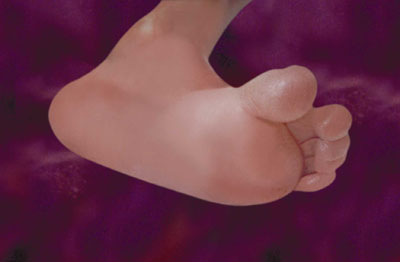
unborn baby’s foot at 14 weeks
“When a later abortion was performed, workers had to piece the baby back together, and every major part–head, torso, two legs, and two arms –had to be accounted for. One of our little jokes at the clinic was, “If you ever want to humble a doctor, hide a leg so he thinks he has to go back in.” Please understand, these were not abnormal, uncaring women working with me at the clinic. We were just involved in a bloody, dehumanizing business, all of us for our own reasons. Whether we were justifying our past advocacy (as I was), justifying a previous abortion (as many were) or whatever, we were just trying to cope–and if we couldn’t laugh at what was going on, I think our minds would have snapped. It’s not an easy thing trying to confuse a conscience that will not stay dead.”
Also, in her sworn deposition (Norma McCorvey A.k.a. Jane Roe of Roe v. Wade) Sworn to on 15 day of March, 2000:
While all the facilities [I worked in] were much the same, the abortion doctors in the various clinics where I worked were very representative of abortionists in general. The abortionists I knew were usually of foreign descent with the perception that the lax abortion laws in the United States present a fertile money-making opportunity. One abortionist, in particular, would sometimes operate bare-chested, and sometimes shoe less with his shirt off, and earned a six-figure income. He did not have to worry about his bedside manner, learning to speak English, or building a clientele.
While the manners of the abortionists and the uncleanliness of the facilities greatly shocked me, the lack of counseling provided the women was perhaps the greatest tragedy. Early in my abortion career, it became evident that the “counselors” and the abortionists were there for only one reason – to sell abortions. The extent of the abortionists’ counseling was, “Do you want an abortion? Ok, you sign here and we give you abortion.” [sic]. Then he would direct me, “You go get me another one.” There was nothing more. There was never an explanation of the procedure. No one even explained to the mother that the child already existed and the life of a human was being terminated. No one ever explained that there were options to abortion, that financial help was available, or that the child was a unique and irreplaceable. No one ever explained that there were psychological and physical risks of harm to the mother. There was never time for the mother to reflect or to consult with anyone who could offer her help or an alternative. There was no informed consent. In my opinion, the only thing the abortion doctors and clinics cared about was making money. No abortion clinic cared about the women involved. As far as I could tell, every woman had the name of Jane Roe.
Typically, most of the women would cry as soon as the suction machine was shut off, or, at some point. Sometimes I thought that they realized what had been done to their babies. Once, I heard a woman call her mother and say, “I just killed my baby. I’m so glad you never killed me!”
The doctors always hid the truth from the mothers. I would say about eighty-percent of the women would try to look down during the abortion and try to see what was happening. This is the reason the doctors would start with the scalpel: to make sure there was just blood and torn up “tissue” for the women to see. Specifically, I remember one woman who came in for an abortion, a pretty, sweet young woman about eighteen years old, with a teddy bear. During the procedure she looked down and saw the baby’s hand fall into the doctor’s hand. She gasped and passed out. When she awoke and asked about what she saw, I lied to her and told her it didn’t happen. But she insisted that she had seen part of her baby. A few weeks later, when she returned for her follow-up exam, she was a changed person: her sweetness had died and had been replaced with an indescribable hardness. I . could not look her in the eye. It took quite a few beers that night to make that particular day go away.
feet of unborn baby at 8 weeks
In all of the clinics I worked in the employees were forbidden to say anything that could talk the mother out of an abortion. The experience of abortion began to take its toll on me. While the abortionists’ counseling was non- existent, my counseling technique gradually became different depending on my mood and the stage of my career. In later years, I would sometimes take all the instruments that were used in an abortion procedure and purposely leave a little of the blood on some the instruments. Laying the instruments out on the little table in front of the woman, I would tell her that, “This is the first instrument that is going to be inserted into your vaginal area.” It would have just had a little smudge of blood, and I thought it was very dramatic. In retrospect, I don’t even know why I was doing these things. It was as if I was trying to talk these women out of the abortion– something we were forbidden to do. In other counseling sessions, I would demonstrate the position and warn her that the instruments were sharp, and that if she moved the doctor might slip, and puncture her uterus, and she would bleed to death. In other situations, when a woman asked me how much it cost, I asked her in response how much she wanted to pay to kill her baby. She replied, “They told me it wasn’t a baby.” I responded, “What do you think it is inside you, a fish?” Other times I would comfort them after the abortion by saying, “It wasn’t a baby. It was only a missed period.” Sometimes when I managed to make the women unsure, I would offer to refund their money except for the ultrasound.
……
After I saw all the deception going on in the abortion facilities, and after all the things that my supervisors told me to tell the women, I became very angry. I saw women being lied to, openly, and I was part of it. There’s no telling how many children I helped kill while their mothers dug their nails into me and listened to my warning, “Whatever you do, don’t move!” I can assure the court that the interest of these mothers is not a concern of abortion providers.
Because I was drunk or stoned much of the time, I was able to continue this work for a long time, probably much longer than most clinic workers. It is a high turnover job, because of the true nature of the business. The abortion business is an inherently dehumanizing one. A person has to let her heart and soul die or go numb to stay in practice. The clinic workers suffer, the women suffer, and the babies die.
From a book by former Feminists for Life president Rachel MacNair:
“Joy Davis (read her story here) told the story of one of the few times the abortion clinics within Birmingham got together. “They sat down and agreed, we’re going to take a half page ad [in the Yellow Pages]. That way, nobody went with a full-page ad… We took out a half page ad, and all the rest of them came out with full-page ads.”
This was on page 53 of Rachel M MacNair, PhD. Achieving Peace in the Abortion War (New York: iUniverse, 2009)
on page 54, Davis mentioned that they always considered supply and demand when figuring out how to make the most money in the abortion clinic.
“We always did that in Birmingham, with Summit and New Women’s Healthcare. We would call in applications to find out what they were charging for that day, and then that’s what our price would be.”
Dr. Susan Poppema, an abortionist, discounts post abortion trauma as an “antichoice” myth. However, in her book, she says:
“Sorrow, quite apart from the sense of shame, is exhibited in some way by virtually every woman for whom I performed an abortion, and that’s 20,000 as of 1995. The sorrow is revealed by the fact that most women cry at some point during the experience… The grieving process may last from several days to several years… Grief is sometimes delayed… The grief may lie sublimated and dormant for years.”
Suzanne Poppema with Mike Henderson, Why I Am an Abortion Doctor (New York: Prometheus Books, 1996) 125 – 126
Quoted in Rachel M MacNair, PhD. Achieving Peace in the Abortion War (New York: iUniverse, 2009)
But sometimes the reality of the procedure shines through. Here is an example of the clinic worker relating in abortion:
“First Roger [the abortionist]locates the approximate location of the fetal heart, makes an X with the sonogram jelly, turns off the machine, and injects the anesthesia. Then he takes a bigger sort of tube needle and puts that into the same spot where he injected the local, turns the sonogram back on and finds the heart, and then put in the digoxin. The women are lying down and can’t see the sonogram. The heart looks like a flashing light. The woman who was really frightened held my hand: Hallie had the job of holding the ultrasound device still on the women’s belly for Roger. Afterwards, when Roger had left, the woman said she felt the fetus moving around. She said, “This is what kills the baby, right?” And started to cry before either of us could answer.”
20 week-old unborn baby – legal to abort in every US state
This was an abortion in the second trimester. This particular clinic does abortions up to 26 weeks. Digoxin is sometimes used as a poison to stop the fetal heart. it can be injected directly into the fetal heart, stopping it instantly, or can be injected into the amniotic fluid causing the baby to be poisoned and die slowly over the course of several hours. Most clinics inject it into the amniotic fluid.
Wendy Simonds. Abortion at Work: Ideology and Practice in a Feminist Clinic (New Brunswick, New Jersey: Rutgers University Press, 1996) page 74
“Following first trimester abortions, sterile room workers strain the contents of the aspirator jar and cannulae to isolate the fetal tissue,… After eight weeks gestation, weight should increase according to the doctor’s estimate of gestational length, and sterile room workers look for fetal parts. If they did not find evidence of the spine, skull, and upper and lower extremities, the client was called back into the examination room for a reaspiration.”
Wendy Simonds. Abortion at Work: Ideology and Practice in a Feminist Clinic (New Brunswick, New Jersey: Rutgers University Press, 1996) page 70
“When does the life of a human being begin? To answer this question is to decide whether or not human embryos are, in fact, human beings and, as such, possessors of inherent human dignity. Where do we go to find the answer? Not to the Catechism of the Catholic Church.… Not to the Bible, which says nothing about human embryos. Not to the Talmud, which (like the Bible) was composed centuries before the discovery of the ovum – a time when almost nothing was known about embryogenesis. Not to the Koran. Not to our “moral intuitions.”
Rather, we go to the standard texts of modern human embryology and developmental biology – for example, the texts by Keith Moore and TVN Persaud; Bruce M Carlson; Ronan O’Rahilly and Fabiola Mueller; and William J Larsen. When we consult these works, we find little or nothing in the way of scientific mystery or dispute. The texts tell the same story and answer the key question in the same way. Anyone who wishes to know when he or she as a distinct living member of the species Homo sapiens came into existence need only open any of these books and look up the answer.
So I have a proposal for people of good will who wish to affirm the inherent and equal dignity of all human beings but disagree with those of us who are opposed on moral grounds to embryo destructive research. Let’s leave religion out of this. Let’s agree to resolve our differences of opinion strictly on the basis of the best available scientific evidence as to when the life of a new human being begins. Any takers?”
Robert P George is an advisor on the President’s Council on Bioethics, a professor at Princeton University posted this on the National Review Website
Scott Klusendorf. The Case for Life: Equipping Christians to Engage the Culture. (Wheaton, Illinois: Crossway Books, 2009) 108 to 109
When I was 38 weeks pregnant with my first son, Zac, my doctor couldn’t feel if he was breach or not. Right after my appointment, my husband and I went down the hall to have an ultrasound, just to make sure he was head down. My husband’s aunt works at the radiology department in the hospital and asked to come in, when she saw we were there. It took about 30 seconds to find out that everything was fine, and the ultrasound technician asked if we wanted to see Zac’s face, just for fun. So as we were looking at his face, the technician and my husband’s aunt were ‘awwwwing’, at Zac sucking his thumb. The women were standing by the door and my husband was sitting on the other side of me. My husband didn’t say much, but every time he did (3 or 4 times), we could see Zac’s eyes look in Daddy’s direction and stop sucking! We were all blown away! He could hear muffled, unfamiliar, voices and carried on.
But so as he heard Daddy, he knew who that was, and actually looked for him.
I knew babies recognize their Mommy’s voice, they hear it all the time. But they know Daddy’s voice too! And probably anyone else, close in the family, like Brother or Sister.
These unborn people aren’t just fetuses, or even ‘just a baby’, they are Geniuses! Very Awesome!
seven months old – not a person, according to US law
The law requires doctors performing abortions at clinics to have hospital privileges. This is important because women injured in abortions need to be hospitalized with a minimum of trouble. A number of women have died because they were not transported to the hospital in time after a botched abortion.
One clinic owner, whose clinic had to close because of the law, said the following:
“I’ve been able to keep the doors open and the phone staff working up until this week,” she said in the letter. “We’ve been working on legal remedies, injunction, etc., but I was unable to bridge the financial gap of paying the monthly lease and operating expenses without knowing when we could resume seeing patients. … I’m so angry about this, also sad, and I’m grateful for whatever wisdom I possess that keeps me from feeling like a victim.”
Kristi L. Nelso “Abortion clinic director blames new state law for closure” Knoxnews.com Saturday, August 18, 2012
Is this clinic worker a “victim?” Or does that designation pertain more properly to the babies aborted in her clinic?
unborn baby at nine weeks – the majority of abortions take place around this time
A clinic worker said the following about counseling at her clinic:
“At the clinic where I worked, abortion counselors were discouraged by the management from engaging in long sessions with clients or staying with them during their abortions. If we took our time or we left our offices, the clinic slowed down, and the average waiting time could creep up to two hours or more.”
Wendy Simonds. Abortion at Work: Ideology and Practice in a Feminist Clinic (New Brunswick, New Jersey: Rutgers University Press, 1996) 7