Abortion Clinic Owner Badmouths Her Patients

Sometimes abortion providers seem to show contempt for the very women are supposed to be serving. A clinic owner and administrator of two clinics, said the following about her abortion patients:

“Most of them don’t think [they] can take care of a child or another child or not mentally able at this time to take care of a child. Some are not the brightest light bulb. They’re really kind of “blank.”

James D Slack Abortion, Execution, and the Consequences of Taking Life (New Brunswick: Transaction Publishers, 2009) 73

Share on Facebook

Abortion Damages Relationships between Parents and the Surviving Children

A study came to the following conclusion:

“Abortion can produce a deep, subtle (and often permanent) fracture of the trusting relationship that once existed between a child and a parent.”

Garton, J. “The Cultural Impact of Abortion and Its Implications for a Future Society” In: Mannion M, editor. Post-abortion Aftermath (Kansas City: Sheed and Ward, 1994: 88 – 99; P91

Siblings of aborted babies often suffer. Read the testimony of one sibling here.

Share on Facebook

Parents of Disabled Children Often Rushed Into Abortions

One study that revealed parents of babies aborted due to disability of “fetal anomaly” suffer depression and loss said this:

“Despite the shock and grief they may experience upon hearing the news of a fetal anomaly, the pregnant woman and her partner are usually urged to make the decision to terminate quickly. Behind the urgency is the physician’s desire to avoid complications of “late” terminations of pregnancy. Because of the delays involved in amniocentesis, abortions may occur in the second and even third trimesters of pregnancy. In health care settings, the issue of such late abortions has raised ethical and legal questions. In one early study, most of the terminations occurred within 72 hours of the woman receiving the news of the abnormality. This hardly allows time for the couple to become informed about parenting children born with that anomaly and thus consider carrying through with the pregnancy.”

Donnai P, Charles N, Harris R. Attitudes of Patients after “Genetic” Termination of Pregnancy British Medical Journal 1981; 282: 621 – 622, P622 in Elizabeth Ring-Cassidy and Ian Gentles. Women’s Health after Abortion: The Medical and Psychological Evidence Second Edition (Toronto, Canada: The deVeber Institute for Bioethics and Social Research, 2003) 159

Read more about the abortion of disabled babies here. 

Share on Facebook

Incest Victim Tells of her Trip to Planned Parenthood

Here is a story from a victim of incest who opposes abortion in cases of rape and incest:

She was abused by her brother and also by an older friend of the family. Here is her story in her own words:

“About three or four months after the abuse began, I was late for a period. I told my brother this, and he informed me that I “should’ve made guy wear a rubber, you idiot.” [Referring to the family friend’s abuse] I did not know what a “rubber” was, or where it was worn, or why. All I knew was that if you did not have periods, you were pregnant. And if you are pregnant, you’re in trouble.

….

[She describes going to her Sunday school teacher for help, who directed her to Planned Parenthood]

So my older brother took me to Planned Parenthood.

I had never been to a doctor without my mother, and I had never had a gynecological exam. The whole visit was terrifying. No one explained anything. I was examined, gave urine and blood samples, and was shown a chart of an egg going around a big circle marked by days of the month. I was asked questions like “frequency of intercourse?” And “method of birth control preferred?” I did not know what intercourse meant, so I just said “a lot,” and I had no idea what birth control methods existed. No one asked who my “partner” was, nor expressed any dismay, concern, or even interest that a 12-year-old girl needed a pregnancy test.

I heard a lot about “being responsible” and “taking control of my body.” Someone gave me a handful of condoms on the way out, and made a joke about being an assortment – red, blue, and yellow. The yellow ones were called Tinglers. I stuffed them in my purse, and threw them away later.

My older brother maintained a strong silence throughout the entire time – no one asked him a single question.

Two days later I received a phone call telling me the test was positive, and to come in the following Saturday morning with a sanitary napkin and a friend who could drive. The caller never used the word “pregnant” or “abortion.” I did not keep that appointment; my period started that evening.

The sexual abuse ended a couple of months later, as the family friend moved away my older brother began to abuse two younger neighborhood children instead.

It was not until three years later that I discovered, in a high school biology class, that you cannot get pregnant from oral sexual contact. I also found out what intercourse was, and that I’d never had it.

I remember the feeling of horror that came over me as I realized that I’d been scheduled for abortion.…

Over the years, I found that my story is very common in two aspects… The first is the fact that my experience with Planned Parenthood was not an aberration. The sexual attitude often championed by Planned Parenthood is a serious factor in preventing the discovery of sexual abuse of young people. Had anyone shown even the least bit of disapproval or concern, I would have divulged the truth and begged for help. Everyone around me seemed to accept as normal that a 12-year-old girl could and should be sexually active (so long as she is responsible – remember the “rainbow”!)” And remember to who took me to Planned Parenthood – an older brother with an urgent interest in my being aborted! Abortion on demand, no questions asked, makes it easier for incest and child abuse to continue. Abortion for incest victims sounds compassionate, but in practice it is simply another violent, deceptive tool in the hand of the abuser.

The other unhappy aspect of this situation is that incest, rape, and child abuse are far more common than most pro-lifers want to admit….

Abortion defenders need to realize that while abortion may keep one of the results of incest and sexual abuse from seeing the light of day it does absolutely nothing to protect a young girl from continued abuse, and, in fact aids the abuser and his crime. Furthermore, birth control counseling and abortion often indirectly contribute to the victim’s sense of shame, guilt, and blame for what is happening, since she is told to “take control” and “be responsible” for her “sexual activity,” implying that this situation is, indeed, within her power to control.”

Rachel McNair, Mary Krane Derr, and Linda Naranjo-Hubbl. Pro-Life Feminism: Yesterday and Today (New York: Sulzburger & Graham Publishing, Ltd.) 262-263

Share on Facebook
Doctor Would Have Been “Bored Silly” Without Abortion

Abortionist Jane Hodgson:

“I think in many ways I’ve been lucky to have been a part of this. I mean life is dull if you can’t get involved in something worthwhile. If I hadn’t gotten involved, I would have gone through life probably being perfectly satisfied to go to the medical society parties and it would’ve been very, very dull. I would have been bored silly.”

Carole E. Joffe Doctors of Conscience: The Struggle to Provide Abortion Before and After Roe v Wade (Beacon Press 1996) 26

Thank you to Live Action for this quote.

Share on Facebook

Joyce Ann McCauley-Benner and her Testimony

When Joyce Ann McCauley-Benner became pregnant, she didn’t know if the father was her boyfriend or the man who raped her. This is her story:


Share on Facebook

Abortionist: I Make an Awful Lot of Money

From the chief of gynecological and obstetrical services at an abortion clinic:

“I practice medicine not to make a living and yet I like to make money at it. We made a lot of money in abortions. I don’t really know why I did it. I sort of fell into it. I was the director of the service here, so when the abortion program came in I looked at it is sort of a challenge. We did set up a very good program. But then I could see from the point of view of management that they were less interested in the best program than in the best paying program. For the first two or three months I didn’t do any of the abortions… Then I suddenly realized I had all the headaches because whenever they ran into trouble I got involved. I took over gradually and work two days a week and I found that I work very hard, but it made an awful lot of money.”

Magda Denes, PhD. In Necessity and Sorrow: Life and Death in an Abortion Hospital (New York: Basic Books inc) 1976

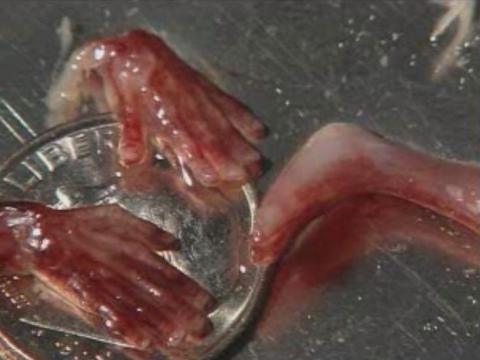
aborted baby’s foot at 16 weeks
Share on Facebook

Naomi Wolf On Pictures of Aborted Babies

While most pro-choice activists deny that pictures of aborted babies are real, one pro-choice feminist admits that they are and speaks out against the hypocrisy of pro-choicers  who want to hide them:

she is referring to pictures like this one

“So what will it be: Wanted fetuses are charming, complex, REM-dreaming little beings whose profile on the sonogram looks just like Daddy, but unwanted ones are mere ‘uterine material’? How can we charge that it is vile and repulsive for pro-lifers to brandish vile and repulsive images if the images are real? To insist that the truth is in poor taste is the very height of hypocrisy. Besides, if these images are often the facts of the matter, and if we then claim that it is offensive for pro-choice women to be confronted by them, then we are making the judgment that women are too inherently weak to face a truth about which they have to make a grave decision. This view of women is unworthy of feminism.”

Naomi Wolf,  feminist author and advocate of legal abortion, in “Our Bodies, Our Souls”, The New Republic, 10/15/1995

Share on Facebook

Abortionist Susan Poppema Reassures her Patients

14 weeks

Dr. Suzanne T. Poppema, abortionist, start selling women on the next abortion as soon as she finishes performing  one. She says to the women:

“Women will say: ‘Oh, I’ll never do this again. I’ll never get pregnant again.’ And I say: ‘I’m sure you’re going to try, and it’s a good approach. But if anything untoward occurs we’ll be here to help you.’

Suzanne T. Poppema, and Mike Henderson, Why I Am an Abortion Doctor (Amherst, NY: Prometheus Books, 1996) p 35

Some abortion providers have a less tolerant attitude towards repeat abortions. Go here to read about them.


Share on Facebook

Ambivalent Woman’s Counseling in an Abortion Clinic

Two abortion clinic workers recount the following story:

They describe how they counseled a woman who comes in for an abortion and is ambivalent.

The woman in described how her boyfriend was mean to her oldest child, who was not his biological child. She discussed the difficulty of wanting to break up with him but not being sure. Of abortion, she said:

“I am against this sort of thing: abortion and adoption. Last time, my mother said, “You will have it. We don’t do things like abortion.” This time, her mother said the same thing but apparently without as much conviction. Her sister supports her, but is worried about how she will do afterwards. “You’re different from me,” she said. “You’re more sensitive and it would be hard on you.” She too was worried about how she would cope. “Do women have a hard time after?” She asked.”

So – obviously, this woman is very ambivalent, and things with her are not going to be easy if she has abortion. In fact, she’s likely to suffer grief and regret. Now, if she was at a crisis pregnancy center, at this point, the counselor would be talking about ways to have the baby. The counselor would be giving her support, describing all the resources that could be utilized, as well as giving her the facts about postabortion syndrome. She would be genuinely helping this woman. Instead, the counselor says

“We talked about how her first responsibility is to her children, especially to her oldest, who was suffering. Could her boyfriend change his heart or his behavior? She thought not, she had tried to talk to him, begged him to change. How would she feel about adoption? It turns out her sister could not conceive; could she give the pregnancy to her sister? Not without his legal permission, I pointed out. Could you sacrifice this pregnancy – this beginning of life, for her other two children and for herself and feels she was doing “the least bad” thing? She would think about it.”

The counselor does not reveal whether or not the woman eventually decided to abort her eight-week-old baby. But it is clear that whatever the woman decides to do, she will be cut loose after her abortion with no counseling, no follow-up, and no help. Whereas the crisis pregnancy center would be offering continuous support for up to a year after the baby was born or even longer.

Krista Jacob. Abortion under Attack: Women on the Challenges Facing Choice (Emeryville, CA: Seal Press, 2006) 146- 147

Read more about biased abortion counseling (and sometimes outright deception in abortion counseling) here.

Share on Facebook