An abortion in the first trimester is usually done one of two ways. One way is the medical way, done by medications that make the pregnancy miscarry. Usually this is done by the “abortion pill” RU-486. This is generally effective until around 7-9 weeks of pregnancy. Go here for more information about the abortion pill.
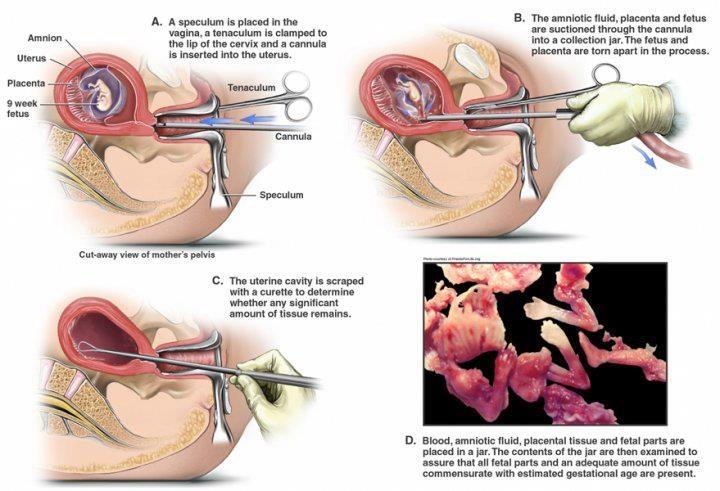
Abortions up to 13 weeks can be done surgically. These are usually done by suction curettage. A suction curettage abortion is done by dilating the cervix, inserting a cannula which is attached t0 a tube and a suction machine, and suctioning out the placenta and the developing baby. See the diagram below of a suction abortion done at 9 weeks.
Diagram of first trimester suction curettage abortion
After the abortion is complete, the doctor needs to carefully examine what he/she has suctioned out so that no parts are left behind. If parts of the baby or placenta stay in the uterus, serious infection can result. The doctor must piece together the baby and verify that he has two arms, two legs, etc.
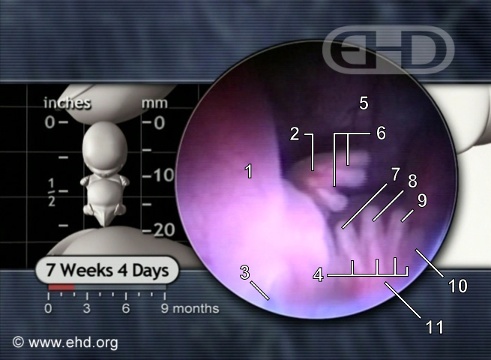
Here is a picture of a seven week old unborn baby, both before and after an abortion
7 week old fetus after a suction abortion
Although this information is graphic and controversial, women have a right to know what is happening in their own bodies and what will happen in an abortion.
If you or anyone you know is struggling with an unplanned pregnancy and wants to know what options are available to you, call this number. 1 800 395 HELP.
The cost of abortions vary slightly from clinic to clinic and also depend on how far along the pregnancy is. A late term abortion is more expensive than an earlier one. The abortion pill is usually a little more expensive than the surgical type.
Most clinics require upfront payment. They will not perform the abortion (or even give counseling) until they are given the money. Actual policy varies from clinic to clinic.
A first trimester abortion can cost 4-500 dollars, slightly more for the RU-486 pill. But beyond the actual monetary cost, abortion has other costs.
First of all, it costs a human life. This is an unborn baby at 8 weeks
8 weeks
Here is what he looks like after he has been aborted.
8 weeks
He was torn from his mother’s womb by a powerful suction device. This baby paid the price for his mother’s abortion. He is part of the cost.
Abortion also often leads to emotional scars. An increased risk of suicide has been documented in many women after abortion. In fact, a teenage girl who has an abortion is 10 times more likely to commit suicide than a girl who has not had an abortion. See studies here.
Emotional trauma is another cost of abortion. And the trauma is often not limited to the woman. Many men, forgotten fathers, grow to regret the child that never was born. Here are some of their stories.
Surviving siblings too, can suffer from the loss of their unborn brother or sister. They too are part of the cost, the price of abortion. Read the story of one sibling here.
If you came here considering an abortion, please take your time and make a decision you can live with. A baby’s heart starts beating as early as 18 days after conception. An abortion will stop this heart. The developing brain gives off waves at five weeks.
Here is a picture an unborn baby at 6 weeks- this baby was from an unruptured ectopic (tubal) pregnancy
There are places you can go to for help, places that will provide emotional support, counseling, free ultrasounds (which you would otherwise have to pay for at the abortion clinic or at Planned Parenthood) and quite often supplies for the baby, a place to live, and even, in some instances, medical care, as well as job training. These places are crisis pregnancy centers. Going to a crisis pregnancy center does not mean you will be bullied or forced into having your baby – no one can force you to have your baby, nor can anyone legally force you to have an abortion. But the people at these centers, many of whom have had abortions and/or unplanned pregnancies themselves, know what you are going through. They can help.
Go here to find a pregnancy center in your area. Or dial 1 800 395 HELP to talk to a pregnancy counselor right now. The call is free and completely confidential. Consider calling and finding out what resources are available in the community if you choose to have your baby.
If you want to learn more about abortion, feel free to look around this website. You can read the stories of former abortionists and clinic workers here.
In an essay entitled “Abortion: the War on Women” author Elizabeth Fox – Genovese cited the following statistic:
only 5 out of 100 obstetricians/gynecologists are now willing to perform abortions
Lawrence B Finer and Stanley K Henshaw, “Abortion Incidence and Services in the United States in 2000,” Perspectives on Sexual and Reproductive Health 35:1 (2003): 6 – 15
Erika Bachiochi. The Cost of “Choice”: Women Evaluate the Impact of Abortion (San Francisco, CA: Encounter Books, 2004) 51
Pro-Choice author Melody Rose, in her book Safe, Legal and Unavailable? Abortion Politics in the United States, discusses Republican and Democrat views on abortion. by comparing voting records, she came to the following conclusion:
After examining the voting records of Republicans and Democrats on abortion related legislation between 1994 and 2005, she says that Mathematically, she calculates that the average party unity score (instances of Republicans voting pro-life and Democrats voting pro-choice) was 87% for Republicans and 71% for Democrats—meaning that Republicans more consistently voted pro-life than Democrats voted pro-choice. She makes the point that the Republican Party is more committed to its antiabortion stand in the Democratic Party is committed to the pro-choice platform.
Melody Rose “Safe, Legal and Unavailable? Abortion Politics in the United States” (Washington DC: CQ Press) 2007 Table on page 172
An article in the national Catholic Register mentions counselor Heidi Heystek of Kalamazoo, Michigan, of Freedom Ministries, who is active in a post-abortion healing that was started in a prison.
The article says:
“Although statistics are hard to come by, Heystek estimates that up to 70% of women in prison have had a prior abortion.”
“Women Victimized by Abortion Strengthen Pro-Life Viewpoint” Nancy Valko “The National Catholic Register” Sept 13-19 1998
The disposal of the remains of aborted babies is one final indignity inflicted on these little people. While it is recommended medical practice for the remains to be sent to a pathology lab to be examined, after which they are incinerated or buried, many clinics cut corners by simply throwing them out. See this section for examples of what happens to the baby’s bodies after abortion.
Dr. Curtis Stover, and abortionist himself, wrote about the disgust he felt witnessing the way aborted babies were disposed of in one clinic, the Mayfair Women’s Clinic in Aurora, Colorado.
“Dr. Parks reached up to a shelf and brought down several pieces of metal that were parts of a meatgrinder and place them on the counter. Next, he assembled the grinder and clamped it to the countertop. As I looked at the grinder I realized that it was very old and resembled the same meatgrinder that my mother used years ago to grind up meat into hamburger meat. Dr. Parks then began to empty each bucket into the hopper on top of the grinder, and his left hand pressed the fetal tissue down into the hopper as he turned the handle with his right hand, grinding the tissue. As he did this the tissue oozed out of the end of the grinder like multiple tubes of pink toothpaste. After all the fetuses were ground up into a large bucket, he [Dr. Parks] dumped the contents into the sink and washed it down the sink with water. Finally, he disassembled the grinder, rinsed it off, and placed it back on the shelf.”
Affidavit of Curtis E. Stover, M.D., dated June 15, 1992, corroborated in depositions of Dr. Parks and clinic staff. From Robert C Cetrulo. That Reminds Me of the Story: Reflections of a Pro-Life Warrior (Covington, Kentucky: Northern Kentucky Right to Life Educational Foundation, 2003) page 9
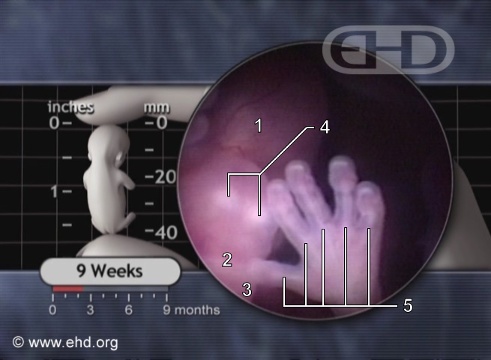
Here is an example of what an unborn baby at nine weeks looks like before he or she is aborted and then ground up.
When is the fetus viable? The term viable means able to live outside the womb on their own with medical treatment. According to an article in the Journal of American Medical Association, babies have been born and survived as early as 20 weeks. A study of teenagers who were born between 20 and 23 weeks found that they:
“view their health-related quality of life is quite satisfactory.”
“Self Perceived Health Status and Health Related Quality of Life of Extremely Low Birth Weight Infants at Adolescence” JAMA, August 14, 1996, P453
Quoted in JC Willke “Why Can’t We Love Them Both: Questions and Answers about Abortion” (Cincinnati, Ohio: Hayes Publishing, 1997)
this baby was born at 21 weeks. Her name is Kellythis baby was three weeks older – 24 weeks. He was aborted
See ads from abortion clinics that perform abortions after viability
“Recently at our Morristown center, I served a young, strong-willed woman, named Gina. She came with some supportive friends to receive options counseling before getting an abortion. While Gina waited with her friends, another client stopped by our office. The two were family acquaintances and immediately the current client began questioning Gina about why she was at First Choice. As soon as Gina mentioned she was pregnant and that she was terminating, the other client began telling her why she was making such a bad decision. At first, I thought this was great, because the other client was instructing Gina to keep the baby and not abort. However, as soon as I sat down with Gina she clearly stated, “No one can change my mind about getting an abortion! Not my friends in the waiting room and not that girl who just came in, and definitely not you.” I let Gina know that was not my intention to force her not to abort but rather to present her with her options so she could make the best, most well-informed decision.
I began mentally preparing to alleviate myself of this client’s decision to terminate her pregnancy because her decision was not my burden to carry. I knew this was her choice and she was clearly set on it. After all, if she remained steadfast in her decision despite the people in her life encouraging her not to abort, why would she respect the information I had to share with her?
Gina and I met for about an hour and it was such a pleasant time. I got to know her and her family dynamics, life objectives, and relationship with the father of her baby. I reviewed information on abortion with her and invited her to listen as I discussed the options of parenting and adoption so that she could truly make the best decision for herself. She welcomed the opportunity and afterwards thanked me for helping her to think about the pregnancy from other perspectives. But even after our time together, Gina was firm in decision to abort.
Then Gina had an ultrasound, and it was life changing! Immediately after looking at the monitor, Gina looked at our nurse and me and said, “Yo, that’s it! That’s my baby!” (This was the first time she identified “it” as a baby.) “I can do this!” It was such a turn of events…”