From a former abortionist, as told to Paul B Fowler:
“Instead of a loop shaped knife [as is used in a D&C], a grasping forceps (similar to pliers with teeth) is inserted into the womb, to grasp part of the fetus. Because the developing baby already has calcified bones, the parts must be twisted and torn away. This process is repeated until the body is totally dismembered and removed. Sometimes the head is too large and must be crushed in order to remove it. Bleeding is profuse.”
Paul B Fowler Abortion: Toward an Evangelical Consensus (Portland, Oregon: Multnomah Press, 1987) 192
He is describing abortions done by D & E in the 2nd trimester.
“And typically when the abortion procedure is started we typically know that the fetus is still alive because either we can feel it move as we’re making our initial grasps or if we’re using some ultrasound visualization when we actually see a heartbeat as we’re starting the procedure.”
This account of D&E abortion procedure is part of sworn testimony given in US District Court for the Western District of Wisconsin (Madison, WI, May 27, 1999, Case No. 98-C-0305-S), by Dr. Martin Haskell, an abortionist
16 weeks. A baby of this age would be killed, mostl likely, by a D&E abortion.Share on Facebook
Abortionist Lisa Harris speaks about performing an abortion while she was pregnant, and feeling her own baby Just as she was pulling the leg off of the baby she was aborting.Sadly, this did not make her stop doing abortions.
18 week old unborn baby
When I was a little over 18 weeks pregnant with my now pre-school child, I did a second trimester abortion for a patient who was also a little over 18 weeks pregnant. As I reviewed her chart I realized that I was more interested than usual in seeing the fetal parts when I was done, since they would so closely resemble those of my own fetus. I went about doing the procedure as usual, removed the laminaria I had placed earlier and confirmed I had adequate dilation. I used electrical suction to remove the amniotic fluid, picked up my forceps and began to remove the fetus in parts, as I always did. I felt lucky that this one was already in the breech position – it would make grasping small parts (legs and arms) a little easier. With my first pass of the forceps, I grasped an extremity and began to pull it down. I could see a small foot hanging from the teeth of my forceps. With a quick tug, I separated the leg. Precisely at that moment, I felt a kick – a fluttery “thump, thump” in my own uterus. It was one of the first times I felt fetal movement. There was a leg and foot in my forceps, and a “thump, thump” in my abdomen. Instantly, tears were streaming from my eyes – without me – meaning my conscious brain – even being aware of what was going on. I felt as if my response had come entirely from my body, bypassing my usual cognitive processing completely. A message seemed to travel from my hand and my uterus to my tear ducts. It was an overwhelming feeling – a brutally visceral response – heartfelt and unmediated by my training or my feminist pro-choice politics. It was one of the more raw moments in my life. Doing second trimester abortions did not get easier after my pregnancy; in fact, dealing with little infant parts of my born baby only made dealing with dismembered fetal parts sadder.
This doctor writes, after observing her first second trimester procedure at 21 weeks:
“Seeing an arm being pulled through the vaginal canal was shocking. One of the nurses in the room escorted me out when the colour left my face… Not only was it a visceral shock; this was something I had to think deeply about… Confronting a 21-week fetus is very different. It… cannot feel pain or think or have any sense of being, but the reality is, this cannot be called ‘tissue’. It was not something I could be comfortable with.”
“What about us? Staff reactions to D&E”. In: Hern WM, Corrigan B editor. Advances in Planned Parenthood. 15:1980;p. 3–8
She decided to do only earlier abortions.
The article was about the D&E procedure, which is what this abortionist witnessed. In this type of abortion, the baby is dismembered with forceps. See diagram below.
Diagram of partial birth abortion, the abortion Dr. Weiss is describing
Dr. Gerson Weiss, abortionist, on what he tells women before he does an abortion:
THE COURT: Do you tell them that you are going to use a suction device and suck the brain out of the baby?
THE WITNESS: Yes.
THE COURT: You use simple words and tell them that?
THE WITNESS: Yes.
Dr. Gerson Weiss, abortionist, in sworn testimony in National Abortion Federation, et. al. v. Ashcroft, U.S. District Court, Southern District of New York, April 7, 2004
Partial birth abortions are now illegal, but current methods of abortion, like the D&E method, are even more brutal.
“The fetus passes through the catheter and either dies in transit as it’s passing through the catheter or dies in the suction bottle after it’s actually all the way out.”
Sworn testimony given in US District Court for the Western District of Wisconsin (Madison, WI, May 27, 1999, Case No. 98-C-0305-S), by Dr. Martin Haskell, an abortionist.
He is describing the way an aborted baby passes through the tube attached to the suction machine. The baby can come out intact, or, more often, mangled like the one below
Abortionist Amos Grunebaum Said the following under oath at the partial-birth abortion ban trial in New York:
“We have been told by grieving counselors to take pictures of all dead fetuses and babies – specifically babies, but also fetuses – so there is a memory of the baby by the mother.”
Testimony of abortionist Dr Amos Grunebaum, National Abortion Federation, et. al. v. Ashcroft, U.S. District Court, Southern District of New York, March 30, 2004.
He is referring to the practice of late-term abortionists’ giving “keepsakes” to women who have abortions. These women are offered the chance to hold their babies and “say goodbye” as if it were a natural death or miscarriage. Some of them take photographs with their dead child. Other abortionists have also spoken of this and Dr. George Tiller offered such services in his late term abortion clinic.
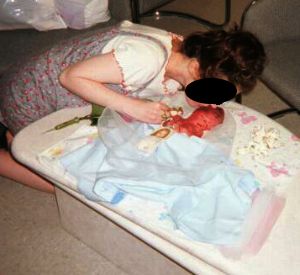
The women or couples that do this are usually ones that aborted their babies because the babies would’ve been disabled – in some cases, these children had such severe problems if they would have been stillborn or may have died soon after birth, but in many more cases, the disability was one that the child could’ve lived with.Below is one such picture. It was taken of a woman who now regrets her abortion. Her identity has been obscured, but you can see the body of the baby and her features (the child was a girl). The baby had been diagnosed with cystic fibrosis, a serious illness, But one that can be managed. The average life expectancy for someone with cystic fibrosis is in the early 40s. Perhaps 40 years of life were taken from this baby.
From Nightline. Reporter Martin Bashir of ABC news interviews Dr. William Harrison, an abortionist.
DOCTOR WILLIAM HARRISON (PHYSICIAN) My conscience calls me to do abortions because I consider the mother’s life much, much more important than that tiny little blob of tissue.
MARTIN BASHIR (ABC NEWS) (Off-camera) It’s interesting you say it’s a blob of tissue, but as you know after just 21 days, the heart is pumping blood. At 42 days, the child has recordable brain waves. And you are, every day, relentlessly terminating that life, and you’re happy with that?
feet of unborn baby at just seven weeks
DOCTOR WILLIAM HARRISON (PHYSICIAN) Am I happy with it? No, but I’m not distressed about it. I would be a lot more distressed if I could not terminate that life for the patient that that life is going to be a disaster for.
DOCTOR WILLIAM HARRISON I’ve had lots of patients who come in for second, third, fourth, fifth, even one who had nine abortions.
MARTIN BASHIR (ABC NEWS) (Off-camera) Is that really appropriate?
DOCTOR WILLIAM HARRISON (PHYSICIAN) If she needs nine abortions, yeah.
18 year old patient
MARTIN BASHIR (ABC NEWS) (Off-camera) Did you see a photograph of the fetus yesterday?
PATIENT (FEMALE) Yes, I did.
12 weeks
MARTIN BASHIR (ABC NEWS) (Off-camera) What effect did that have?
PATIENT (FEMALE) It made it a little more difficult. I think it made me a little more nervous about it.
MARTIN BASHIR (ABC NEWS) (Off-camera) Did you consider the possibility of perhaps adoption?
PATIENT (FEMALE) I thought about it. But I really thought that that might be even harder going through the whole pregnancy stage and seeing the child and then having to give it away, I just think would really, really tear me up inside.
DOCTOR WILLIAM HARRISON (PHYSICIAN) The most important decision that a woman ever makes is to have a baby. Whether you have an abortion or not is relatively minor. Basically, abortion is a method of birth control. You know, it’s not the best method of birth control. But all it does is stop the birth of a baby that a woman doesn’t want at a time she doesn’t want it.
….
DOCTOR WILLIAM HARRISON (PHYSICIAN) I’ve had one of the most emotionally satisfying careers that I can imagine anyone having. I can’t tell you how satisfying it is, when two weeks after a young woman has come in distraught and thinking that her life is ruined, and she comes back two – two weeks after the abortion and she is a new woman. She’s been given her life back.
MARTIN BASHIR (ABC NEWS) (Off-camera) And for her to be born again, you’ve had to kill the fetus.
DOCTOR WILLIAM HARRISON (PHYSICIAN) Uh-huh. That’s right.
MARTIN BASHIR (ABC NEWS) (Off-camera) And that’s a fair exchange?
DOCTOR WILLIAM HARRISON (PHYSICIAN) That’s a fair exchange.
MARTIN BASHIR “THE ABORTIONIST” Nightline (ABC), 1/11/2006
THE WITNESS: I think that’s a concern. My approach has been to say that the cord usually comes down and severing of the cord means that the fetus sanguinates.
THE COURT: Do you think that a normal woman patient understands those words?
THE WITNESS: Well, bleed to death is the analogy on more lay terms.
Dr. Carolyn Westhoff, abortionist, in sworn testimony in National Abortion Federation, et. al. v. Ashcroft, U.S. District Court, Southern District of New York, April 5, 2004.
24 weeks. Dr. Westoff is describing aborting a baby around this ageShare on Facebook
Recently, I wrote an article for Live Action according a former abortion doctor who admits that he was “terminating babies”:
“Nobody wants to perform abortions after 10 weeks because by then you see the features of the baby, hands, feet. It’s really barbaric.
Baby’s feet at ten weeks
Abortions are very draining, exhausting, and heartrending. There are a lot of tears. Some patients turn on you. They say, “Let’s get out of here,” after the abortion, as if you’re some dirty person. It’s vicious. Then you get these teenyboppers in the office who laugh their way through it. It doesn’t mean a thing to them. That bothers me. Then you’ve got the right to lifers calling you on the phone, coming in the office, preaching, threatening to picket your office.
15 weeks sonogram
I do them because I take the attitude that women are going to terminate babies and deserve the same kind of treatment as women who carry babies. So I started doing abortions on an altruistic basis. I’ve done a couple thousand, and it turned into a significant financial boon, but I also feel I’ve provided an important service.
The only way I can do an abortion is to consider only the woman as my patient and block out the baby. I’ve delivered enough babies, seen enough divorces, and seen enough abused kids to do abortions with a clear conscience. This may be some kind of mental gymnastics on my part, but I really feel that parenthood is so tough that people shouldn’t back into it.
I don’t feel I’m violating my trust as a doctor by doing abortions, but I don’t want to do them anymore because you can do them to a certain point, and then you get overloaded. I’m at that point.
John Pekkanen M.D.: Doctors Talk about Themselves (New York, New York: Bantam Doubleday Dell Publishing Group, Inc., 1988) 93 – 94