Testimony of a Medical Student

This is from a student who preferred to remain anonymous:

“To begin, I must say that until yesterday, Friday, July 2, 2004, I was strongly pro-choice. I am a pre-medical student, and being very scientific, I understood that the mass of cells that forms the fetal body is not often capable of survival before 24 weeks in the womb.

I am also somewhat liberal, and I believed that every woman should have the right to choose what she did with her body and one that could potentially be growing inside of her.

This summer, I was accepted into a pre-medical program in NYC in which we are allowed to shadow doctors and see all sorts of medical procedures. When given the opportunity to see an abortion, I did not hesitate to accept the offer. It was something new, edgy, and exciting that I had never seen.

When I entered the operating room, it felt like any other I had ever been in. On the table in front of me, I saw a woman, legs up as if delivering a child although she was asleep. Next to her was a tray of instruments for the abortion and a vacuum machine for suctioning the fetal tissues from the uterus.

The doctors put on their gowns and masks and the procedure began. The cervix was held open with a crude metal instrument and a large transparent tube was stuck inside of the woman.

Within a matter of seconds, the machine’s motor was engaged and blood, tissue, and tiny organs were pulled out of their environment into a filter. A minute later, the vacuum choked to a halt.

The tube was removed, and stuck to the end was a small body and a head attached haphazardly to it, what was formed of the neck snapped. The ribs had formed with a thin skin covering them, the eyes had formed, and the inner organs had begun to function.

The tiny heart of the fetus,obviously a little boy, had just stopped — forever. The vacuum filter was opened, and the tiny arms and legs that had been torn off of the fetus were accounted for. The fingers and toes had the beginnings of their nails on them.

The doctors, proud of their work, reassembled the body to show me. Tears welled up in my eyes as they removed the baby boy from the table and shoved his body into a container for disposal.

I have not been able to think of anything since yesterday at 10:30 besides what that baby boy might have been. I don’t think that people realize what an abortion actually is until they see it happen.

I have been tortured by these images – so real and so vivid – for two days now…and I was just a spectator. Never again will I be pro-choice, and never again will I support the murder of any human being, no matter their stage in life.”

Sat, Jul 3 22:29:15 2004

Share on Facebook

Nurse at an Abortion Clinic: “I Saw a Little Foot”

“I saw a little foot – caught in the end of the suction tube.”

Nurse who assisted in a number of suction abortions, after viewing the aftermath of one for the first time.

Thomas Gulick “Even Abortionists are Having Second Thoughts” Human Events April 12, 1980

10-week-old aborted baby
Share on Facebook

Abortionist on Women’s Feelings Postabortion

Dr. Suzanne T. Poppema is a nationally-known abortionist who wrote a book entitled Why I am an Abortion Doctor.
From her book:

“We hear from many women that the grieving process actually ends by the time they leave the office. This is because the vast majority of women feel relieved at the end of the procedure. They can go on with their lives, which is precisely why they come to us. No matter how women choose to work through accompanying their decision to abort, the fact remains that they seek us of their own volition. Those who don’t come in to abortion clinics obviously have made the choice my husband and I made when we decided to have our children. Whatever their reason for either decision, their choice requires no explanation, much less an apology.”

Poppema acknowledges that some women cry in the clinic. She ascribes these women’s tears to relief and being moved at the kindness they are shown in her clinic.

Suzanne T. Poppema and Mike Henderson, Why I am an Abortion Doctor (Amherst, NY: Prometheus Books) 1996 p 127

Is this true? Do women  seldom regret their abortions? .Read some testimonies of actual women here

Read about mental health studies of women who had abortions here


Share on Facebook

Partial Birth Abortion

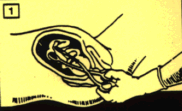
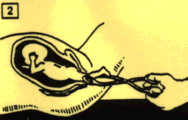
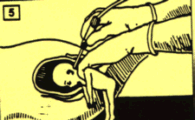
Partial-Birth abortions became illegal when the Supreme Court allowed a ban against them to stand. The court had previously ruled against the ban, and the law was sent back with minor changes after a new justice was confirmed.  It was a very long battle to ban this type of abortion, which usually took place between 20 and 26 weeks. Here are some pictures of how these abortions were performed.

Prominent abortionist Dr. Martin Haskell, who performed the abortion Brenda watched, was asked about the diagram in an interview, and answered that it was “accurate from a technical point of view.”

(AMA- American Medical News July 5, 1993)

He describes partial-birth abortion this way:

“At this point, the right-handed surgeon slides the fingers of the left had [sic] along the back of the fetus and “hooks” the shoulders of the fetus with the index and ring fingers (palm down). Next he slides the tip of the middle finger along the spine towards the skull while applying traction to the shoulders and lower extremities. The middle finger lifts and pushes the anterior cervical lip out of the way.

While maintaining this tension, lifting the cervix and applying traction to the shoulders with the fingers of the left hand, the surgeon takes a pair of blunt curved Metzenbaum scissors in the right hand. He carefully advances the tip, curved down, along the spine and under his middle finger until he feels it contact the base of the skull under the tip of his middle finger.

Reassessing proper placement of the closed scissors tip and safe elevation of the cervix, the surgeon then forces the scissors into the base of the skull or into the foramen magnum. Having safely entered the skull, he spreads the scissors to enlarge the opening.

The surgeon removes the scissors and introduces the suction catheter into the hole and evacuates the skull contents. With the catheter still in place, he applies traction to the fetus, removing it completely from the patient.”

He then goes on to say that the procedure can be used essentially all the way to birth.

“The author is aware of one other surgeon [J McMahon, now deceased] who uses a conceptually similar technique…Coupled with other refinements and a slower operating time, he performs these procedures up to 32 weeks or more.”

Martin Haskell, M.D. “Dilation and Extraction for Late Second Trimester Abortion” Contained in National Abortion Federation “Second Trimester Abortion: From Every Angle.” Fall Risk Management Seminar, September 13-14, Dallas, Texas. Presentations, Bibliography and Related Materials. 1992

Share on Facebook

Dr. Leroy Carhart, on Sucking the Brains out of Children

Dr. Carhart performed partial-birth abortions and fought against laws forbidding partial-birth abortions. in his speech to the religious coalition for reproductive choice, he puts things in perspective:

“We’re not asking for the right to suck the brains out of every child that walks down the street, we need to continue to offer safe abortions to women who need them to be done.”

Dr. LeRoy Carhart, addressing the Religious Coalition for Reproductive Choice, Omaha World-Herald, 1/2001

24 week-old unborn baby, a typical candidate for a partial birth abortion
Share on Facebook

Doctor: It “Isn’t Pleasant” To Look at Aborted Baby Parts

“What would you describe what you see on your machine when you do a second trimester D&E abortion?

“Yes. While I’m doing the abortion my assistant has the abdomen and it gives a picture of the uterus and the placenta and fetal tissue at actual show my cannula coming to the cervix into the cavity of the uterus and as the tissue is sucked out and removed the uterus slowly clamps down by contraction until it’s finally empty and then we know that were complete. I think it might be a problem for anybody to look at that for the first few times very much like when we amputate a leg in surgery that’s a terrible thing to look at also, an amputated leg. It certainly isn’t pleasant to look at fetal parts but we’re taking care of the patient.”

“Death on Demand: An Abortionists Day  American Portrait Films: “Generation Kill” part 2: Death on Demand

Share on Facebook

D&E Is a “Horrible Procedure”

Here is another quote on the D & E procedure:

“I do D & E’s because I think it is safer. It is a horrible procedure. Staff burnout is a major problem. But are you functioning in the interests of taking care of your staff or taking care of your patients?”

Dr. William Rashbaum, a gynecologist affiliated with Beth Israel

“When Abortion Becomes Birth: A Dilemma of Medical Ethics Shaken by Advances” New York Times Feb. 15, 1984

Read a doctor’s firsthand account of the D&E abortion here.

Share on Facebook

The Sensations of Dismemberment

A D&E abortion is so gruesome that when it was first developed in the 1970s, a leading abortionist said:

“We have produced an unusual dilemma. A procedure is rapidly becoming recognized as the procedure of choice in late abortion, but those capable of performing or assisting with the procedure are having strong personal reservations about participating in an operation which they view as destructive and violent…Some part of our cultural and perhaps even biological heritage recoils at a destructive operation on a form that is similar to our own…No one who has not performed this procedure can know what it is like or what it means…We have reached a point in this particular technology where there is no possibility of denial of an act of destruction by the operator. It is before one’s eyes. The sensations of dismemberment flow through the forceps like electric current…”

Warren Hern, M.D, 1978: (Rachel M. MacNair Perpetration-Induced Traumatic Stress: The Psychological Consequences of Killing (Westport, CT:Praeger, 2002) 73

Diagram of a D&E:

Share on Facebook