Testimony from a trial in New York concerning partial birth abortion:
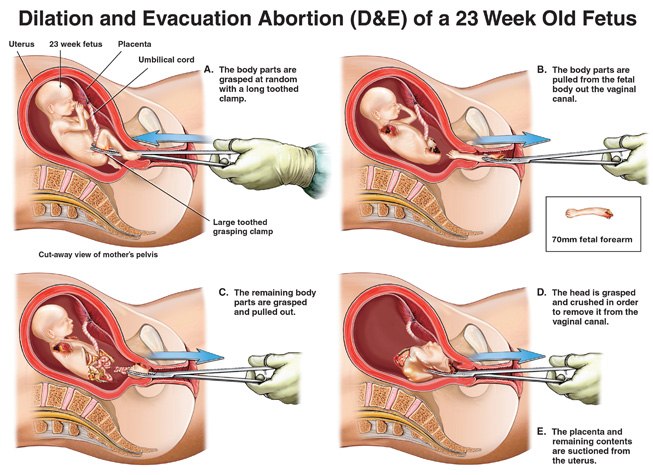
THE COURT: Excuse me. Grasping forceps, does that mean you crush the skull?
THE WITNESS: You compress the skull, yes.
THE COURT: You crush it, right?
THE WITNESS: Yes.
Dr. Marilynn Frederiksen, abortionist, in sworn testimony in National Abortion Federation, et. al. v. Ashcroft, U.S. District Court, Southern District of New York, April 6, 2004
The skull of the baby is crushed in both the now banned partial birth abortion procedure (D&X) and the commonly used D&E procedure, which is still legal.
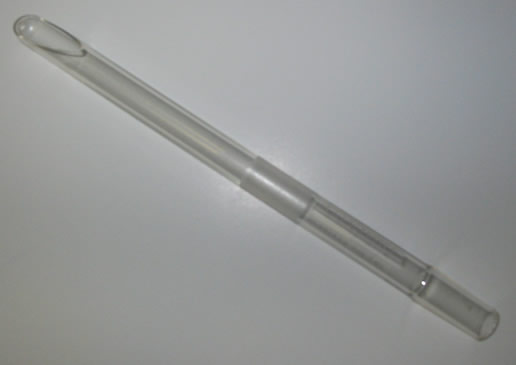
“Question: Can the heart of a fetus or embryo still be beating during a suction curettage abortion as the fetus or embryo comes down the cannula? Answer: For a few seconds to a minute, yes.”
Sworn testimony given in US District Court for the Western District of Wisconsin (Madison, WI, May 27, 1999, Case No. 98-C-0305-S), by Dr. Harlan Raymond Giles, an abortionist.
“Each of the ‘contents of the uterus’ was placed in a clear glass bowl and then examined under a light. One bowl clearly contained 3 perfect, tiny arms. I asked why there would be a third arm. ‘Twins’ was the response and because it might upset the mother, this information was never shared with any mother.”
“Sometimes during the D & E procedure, a part of the fetus protrudes from, or is pulled through the cervical os before the fetus is fully removed. Although in the vast majority of cases, there is fetal demise before this occurs, from the disruption occasioned by the suction and/or forceps, there could be rare instances where the fetus is “living” within the meaning of the [partial birth] act- whatever that meaning is- when part of the fetus is within the uterus and part is outside….”
10 weeks
Phil Greenberg “To Life: A Collection of Editorials & Columns on Abortion, Life, and Choice” (Little Rock, Arkansas: The Arkansas Democrat Gazette, 1999)51-54
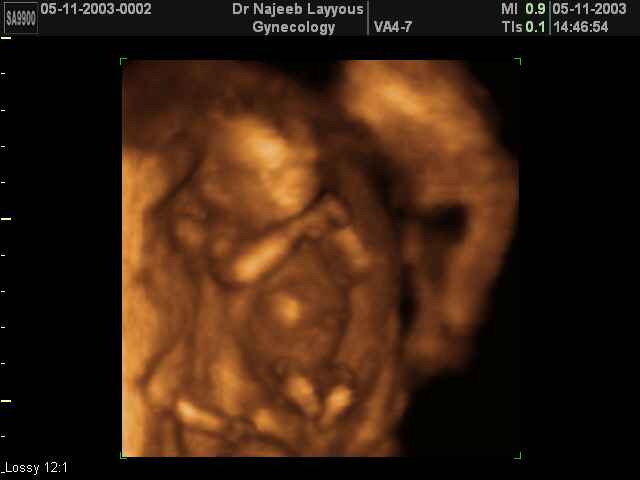
Stuart Campell, a former abortionist who developed 3-D ultrasound, describe the impact that seeing the unborn baby on the ultrasound screen had for him:
“I think you’re programmed into just doing it as a job. The doctor is not around to see the baby being expelled. My job was to inject the foetus’s heart. You’ve got a hundred other things to do that day so you just go ahead and do it. But with the traditional 2-D scanning I think you are less connected with the reality of what you’re doing than you would be with these new techniques.”
Many people are not aware that abortions in the late second and third trimester are legal, much less that they occur often. Read more about late term abortion in this section. Most late term abortions are done for elective, not medical, reasons.
Pro-choice feminist Wendy Simonds interviewed clinic workers who talked about how they felt when their clinic started performing abortions up to 26 weeks.
From one clinic worker:
“… We were so excited that women who were 26 weeks could get an abortion at our clinic and not have to go to Pavilion for a saline induction… But we were also extremely sensitive to what the increasing gestation was going to do to us as human beings… We’re just not hardened to the fact that abortion is hard. The women… are going to be in more pain… The abortions are going to be longer. The assistant is going to have to watch a much, you know, further abortion. And there’s a marked difference between 26 weeks and 21 weeks in terms of fetal development… We had [meetings] where we talked about our feelings… We talked about the ambivalence about wanting to provide this service and being really excited about it and being really nervous about handling the tissue.”
26 weeks
From another:
“so I felt like the women were getting a good procedure. And then I also felt… Thank God that were doing this!… I’m glad we’re doing it.”
Picture of an abortion around 26 weeks
A third clinic worker:
“I like that we go up to 26 weeks. For a while it kind of gave me some things to learn… Plus it gives a whole new dimension to working with those women who come in for later abortions. It’s, like, great because they almost can’t have an abortion. They’re almost about to have a baby, and they don’t want to. And they’re really appreciative.”
Wendy Simonds. Abortion at Work: Ideology and Practice in a Feminist Clinic (New Brunswick, New Jersey: Rutgers University Press, 1996) 62, 63
24 week abortion- two weeks before the cut off of when this clinic performs them
Dr. Richard Hausknecht, a New York City gynecologist who used to perform late abortions but no longer does so describes the partial birth abortion method:
the type of abortion he describes
”You go in and fish out a foot and pull the fetus into a breech position. You turn it so that the backside is up, pull down on its hips and rotate. When you get to the shoulder blade, it’s easy to sweep the arms down. Then, most of the time you have to crush or fenestrate the skull so that it can come out.”
”This is not something I rely on, but I find it absolutely bizarre that Congress wants to ban it….In my view, it’s as if they were to forbid me to use a certain kind of suture.”
Deborah Sontag “Doctors Say It’s Just One Way”The New York Times, March 21, 1997
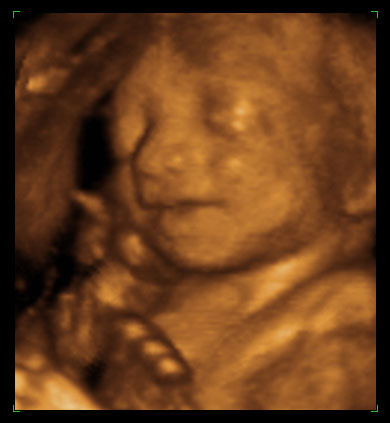
Here is a picture of a 22-24 week old baby, of the age when most abortions of this type were done.
“Expanding rods are inserted through the cervix, opening it according to the size of the baby. Then comes the sound. Suctioning out the pieces of the baby makes a noise like no other. If death has a sound, this is it.”
Susan Thayer, former abortion practitioner
What a 10 week-old baby looks like after the pieces are suctioned out
The Director of nursing at one abortion clinic said the following:
20 weeks
“I feel that up to 20 weeks you really push an abortion. Personally. And if they had modified that law I would be all for it. Because after that stage they’re getting pretty big. I mean, have you seen the 20 week ones? And I must say, it turns my stomach, and I agree with the staff in one way that they feel little repulsed when you get a big fetus. It’s very traumatic for the staff to pick this up and put it in a container and say, “Okay, that’s going to the incinerator.”
18 weeks
Magda Denes, PhD. In Necessity and Sorrow: Life and Death in an Abortion Hospital (New York: Basic Books inc 1976) 153 – 154
“… I think from a straight moral point of view I probably would object to abortion. Because I love kids. From that point of view every fetus is a potential child, and morally I just really don’t think that should be done. Socially there’s a great need for abortion, purely because there’s a large group of women who for various reasons will get pregnant and they don’t want a child.… Of course, there’s abortion that gets abused. Women who come back three, four, and five times. This is another one of the boundaries a place in my own personal feelings. I would just not do it, I would probably refuse to do the abortion after two.”
17 weeks
Magda Denes, PhD. In Necessity and Sorrow: Life and Death in an Abortion Hospital (New York: Basic Books inc 1976) 146
If abortion is simply the removal of some cells, the termination of a pregnancy, and is morally benign, why should having more than one disturb a doctor?