An abortion in the first trimester is usually done one of two ways. One way is the medical way, done by medications that make the pregnancy miscarry. Usually this is done by the “abortion pill” RU-486. This is generally effective until around 7-9 weeks of pregnancy. Go here for more information about the abortion pill.
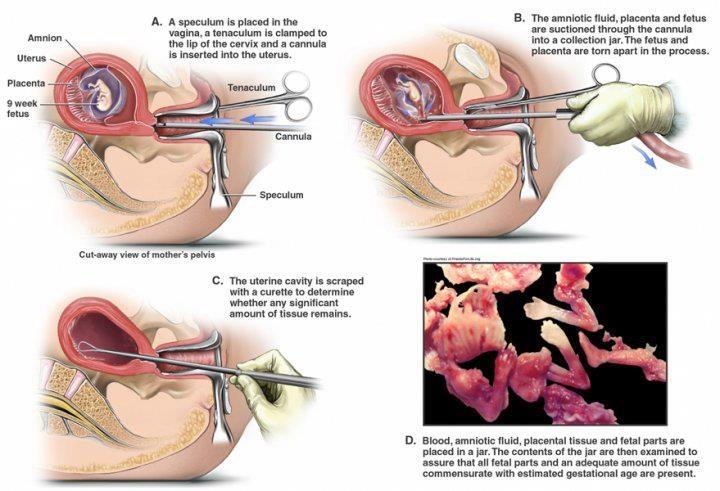
Abortions up to 13 weeks can be done surgically. These are usually done by suction curettage. A suction curettage abortion is done by dilating the cervix, inserting a cannula which is attached t0 a tube and a suction machine, and suctioning out the placenta and the developing baby. See the diagram below of a suction abortion done at 9 weeks.
Diagram of first trimester suction curettage abortion
After the abortion is complete, the doctor needs to carefully examine what he/she has suctioned out so that no parts are left behind. If parts of the baby or placenta stay in the uterus, serious infection can result. The doctor must piece together the baby and verify that he has two arms, two legs, etc.
Here is a picture of a seven week old unborn baby, both before and after an abortion
7 week old fetus after a suction abortion
Although this information is graphic and controversial, women have a right to know what is happening in their own bodies and what will happen in an abortion.
If you or anyone you know is struggling with an unplanned pregnancy and wants to know what options are available to you, call this number. 1 800 395 HELP.
Pro-Choice people like to say that abortions are never done because the baby is the wrong gender. Legislation that sought to protect unborn baby girls from being aborted just because they were girls failed in Congress. Pro-choicers adamantly opposed this law. Despite their professed concern about women, they are not worried about unborn women– to these champions of “women’s rights” is perfectly acceptable for an abortion to be done solely because the parents want a boy when their unborn baby is a girl.
Kelly Clinger is a sidewalk counselor (a person who intervenes in the clinic and tries to convince women to have their babies instead of aborting them) who witnessed a woman five months pregnant with twins who went to get an abortion at Orlando Women’s Center.
Orlando Women’s Center performs abortions up to 28 weeks – see this ad in the local paper
this is what an unborn baby looks like at 20 weeks (five months)
The woman, whose name has been withheld, was aborting her babies solely because they were girls and she wanted boys. The reason for her abortion came out as she talked to the sidewalk counselors.
Offers of financial help, free housing, and offers to adopt the babies poured in as soon as this picture when viral. Unfortunately, despite so many people’s prayers and offers of help, this woman aborted her baby girls. See a picture of what babies look like at 20 weeks after they are aborted
Unfortunately, there are no significant legal barriers preventing women from getting abortions all the way up to birth anywhere in the United States. Many states have no laws on the books at all. Other states have laws with health exceptions, but health has been defined so broadly by the Supreme Court (in Doe versus Bolton) that any emotional distress can qualify as a health risk. Often, all the woman has to do is convince the abortionist, who clearly has a vested interest in her choice, that her emotional health would be compromised by giving birth and she can have the abortion legally. Minor physical conditions like heart burn can also be used to justify late-term abortion. Sometimes a little bit of paperwork is needed – other times not.
Many pro-choicers are uncomfortable with late-term abortions and have no idea that they are even legal. Other pro-choice activists maintain that they are only done for the direst of medical reasons – but this is a myth. While some late-term abortions are done because the baby has a defect (often down syndrome or similar condition) the majority are done for elective reasons. According to a survey in the Journal of Perspectives of Sexual and Reproductive Health, these are the reasons why women have late-term abortions:
45% had trouble finding abortion provider
37% unsure of date of last menstrual period
68% had no pregnancy symptoms
58% Didn’t comfirm pregnancy until in second trimester
30% had difficulty deciding on abortion
31% had previous second trimester abortion
Did not cite a single case of fetal abnormality
“Second Trimester Abortion: Logistics and Lack of Symptoms are Factors” Perspectives of Sexual and Reproductive Health Volume 38 No 2, June 2006
The cost of abortions vary slightly from clinic to clinic and also depend on how far along the pregnancy is. A late term abortion is more expensive than an earlier one. The abortion pill is usually a little more expensive than the surgical type.
Most clinics require upfront payment. They will not perform the abortion (or even give counseling) until they are given the money. Actual policy varies from clinic to clinic.
A first trimester abortion can cost 4-500 dollars, slightly more for the RU-486 pill. But beyond the actual monetary cost, abortion has other costs.
First of all, it costs a human life. This is an unborn baby at 8 weeks
8 weeks
Here is what he looks like after he has been aborted.
8 weeks
He was torn from his mother’s womb by a powerful suction device. This baby paid the price for his mother’s abortion. He is part of the cost.
Abortion also often leads to emotional scars. An increased risk of suicide has been documented in many women after abortion. In fact, a teenage girl who has an abortion is 10 times more likely to commit suicide than a girl who has not had an abortion. See studies here.
Emotional trauma is another cost of abortion. And the trauma is often not limited to the woman. Many men, forgotten fathers, grow to regret the child that never was born. Here are some of their stories.
Surviving siblings too, can suffer from the loss of their unborn brother or sister. They too are part of the cost, the price of abortion. Read the story of one sibling here.
If you came here considering an abortion, please take your time and make a decision you can live with. A baby’s heart starts beating as early as 18 days after conception. An abortion will stop this heart. The developing brain gives off waves at five weeks.
Here is a picture an unborn baby at 6 weeks- this baby was from an unruptured ectopic (tubal) pregnancy
There are places you can go to for help, places that will provide emotional support, counseling, free ultrasounds (which you would otherwise have to pay for at the abortion clinic or at Planned Parenthood) and quite often supplies for the baby, a place to live, and even, in some instances, medical care, as well as job training. These places are crisis pregnancy centers. Going to a crisis pregnancy center does not mean you will be bullied or forced into having your baby – no one can force you to have your baby, nor can anyone legally force you to have an abortion. But the people at these centers, many of whom have had abortions and/or unplanned pregnancies themselves, know what you are going through. They can help.
Go here to find a pregnancy center in your area. Or dial 1 800 395 HELP to talk to a pregnancy counselor right now. The call is free and completely confidential. Consider calling and finding out what resources are available in the community if you choose to have your baby.
If you want to learn more about abortion, feel free to look around this website. You can read the stories of former abortionists and clinic workers here.
Former clinic worker Luhra Tivis discusses her role as an abortion counselor. Tivis was pro-choice when she started working at the clinic, but became uneasy with abortion based on the experiences she had working there.
“They decided they would train me to answer the phone. So I thought they were going to tell me how they wanted the information sheet filled out, and how to keep the phone record, and this and that. But what I was handed instead was a packet of information, materials to study, on how to be a high-pressure salesperson over the phone — you know, like telemarketing. How to convince somebody to buy your product. There was nothing in the material that had anything to do with the medical profession or helping women. I was very puzzled as to why they would be doing this. I hadn’t found out how lucrative it was yet. So I studied, and I tried to answer the phone the way they wanted me to, even up to the very end.”
Quoted by Rachel MacNair in Achieving Peace in the Abortion War” by Rachel M MacNair, Ph.D., published by the Feminism & Nonviolence Studies Association January 2009.http://www.fnsa.org/apaw/
In the film “Abortion: An Inside Look” Tivis said the following:
And one woman called and she said I’m calling for my daughter, I want to know how the procedure done and so forth and she said have you ever had a live birth? And it really shook me up to hear that question because I didn’t even think about that. So I asked my supervisor Elana, what should I tell her, which is she talking about?” And Elana told her “tell her we have never had a live birth at this clinic.” And I found out later that was a lie.
“From May to November 1988, I worked for an abortionist. He specializes in third trimester killings. I witnessed evidence of the brutal, cold blooded murder of over 600 viable, healthy babies at seven, eight and nine months gestation. A very, very few of these babies, less than 2%, were handicapped…
what an unborn baby looks like at 7 months
I thought I was pro-choice and I was glad to be working in an abortion clinic. I thought I was helping provide a noble service to women in crisis….I was instructed to falsify the age of the babies in medical records. I was required to lie to the mothers over the phone, as they scheduled their appointments, and to tell them that they were not ‘too far along’ Then I had to note, in the records that Dr. Tiller’s needle had successfully pierced the walls of the baby’s heart, injecting the poison what brought death…one day, Dr. Tiller came up the stairs from the basement, where the mothers were in labor. He was carrying a large cardboard box, and ducked into the employees only area of the office so that he wouldn’t have to walk through the waiting room. He passed behind my desk as I sat working on the computer, and he turned the corner to go around a short hall. He called out for me to come and help him. the box was so big and heavy in his arms that he couldn’t get the key into the lock. So I unlocked the door for him, and , pushing the door open, I saw very clearly the gleaming metal of the crematorium- a full sized crematorium, just like the one’s used in funeral homes. I went back to my computer. I could hear Dr. Tiller firing up the gas oven. A few minutes later I could smell burning human flesh. Mine was the agony of a participant, however reluctant, in the act of prenatal infanticide.”
Luhra Tivis “Where is the Real Violence?” Celebrate Life. Sept/Oct 1994
Note: this article was written before the murder of Dr. Tiller. Violence against abortion providers is morally wrong and hypocritical. The owners of clinic quotes vehemently oppose such actions.
I came into a company that was very well established. This particular company is one of the largest in the nation, it does operate abortion clinics to this day, 12 clinics across the United States. When I came into this industry, I was asked during my initial interview, “Are you pro-choice?” Well, of course I said yes, even though I really hadn’t thought much about it. The next question I was asked is “Can you handle the fact that this is a business?” and of course I fit right in, I have a business background, I have a medical background as well. There was no mistaking the fact that I was here to make them money. No one ever said to me, “I hope you’re pro-choice because we want you to help these women. I never felt that.
Well I had this noble cause because that because that I had worked in medicine I was used to sterile environment that I could bring that knowledge into the abortion industry and I could try to turn that clinic around so that we could give quality health care to women.
Well that sounds real nice, the only problem was that the industry, instead of me changing it, it changed me.
The first thing I did was clean up the clinic. At least on the outside. But soon I realized it was gonna cut into my bottom line. Because you see every time we bought a piece of equipment, we like you had absolutely no life support equipment, we had no crash cart we didn’t have any of those things in the clinic, and the state of Georgia where I’m from and where I operated this particular clinic, we were regulated by the state for the state didn’t require that we had any life support, didn’t require that we had any recovery room equipment though we did perform abortions under general anesthesia.
Because I was beginning to see things the way the abortionist sees things which is the more abortions we perform the more money I’m going to make. That was the bottom line.
I began, to see these women, I never saw them as women. If you want to know the truth, I never saw them as women. To me, if they were so stupid that they would come in and believe our lies, they deserved exactly what we were gonna give them. And that’s exactly the way I treated each and every woman.
14 weeks
But in our clinics, our doctors, those were not their patients. That’s common around the country. These doctors don’t care about their patients. We could see a separation, OB/GYN’s that worked in their own private practice and then they’d came to our clinic, if one of our patients had a problem afterward they called me. That’s common. I, like Joy, I’m not a medical doctor , I’m not trained to evaluate a woman’s problems, postoperative hemorrhaging, etc., I have no skills to enable me to make that diagnosis and to prescribe the method of treatment, but that was required of me and I did it for three years. When they called me after hours and said, “I’m hemorrhaging, what can I do?” It was my problem, not the doctors. I was the person on call, I was one who called in all the drugs, I was the person who prescribed the medication.
[discussing another clinic worker who is required to shred medical records of a patient who died] We had a personal shredder in my office for that purpose. There would not have been a medical record if the DA had shown up on the my doorstep the next morning.
The state of Georgia is one of those states that is very heavily regulated or technically very heavily regulated, meaning that they are subjected to an annual inspection by a governing body, they also, we have surprises inspections, they do come in without being announced, other than the first inspection. However, some of the material I brought with me and that I was holding up and showing you this morning are actual deficiencies, listed by this governing arm, such as patients who have a cardiac arrest, although their patient records indicate that they were ready, that they were healthy, that they were ready to be discharged from the clinic.
….
In the future, I believe, that we are going to have to deal with a generation of women who have Hepatitis B, who are HIV positive, because they’ve contracted if through an abortion procedure. If you reuse a vacuum aspiration cannula, you’re going to infect the next person. But when you get busy in a clinic, there is no time to sterilize instruments. I’m sorry. You wash them, you repack them, and you reuse them. And then, when the state comes in to look at your logbook, they have these nice little strips that you just stick on the autoclave and you put a date on there and you put a time, and we stick them in by the handful, and then we take them out and we show that we ran fifteen loads that day. When we didn’t.
There are a number of regulations, and the regulations are only as good as the enforcing arm behind it. I also have an original memorandum from the Georgia Department of Human Resources, which is our governing body that states that they realize that there were some criminal violations that were detected in these clinics as well during their routine inspections. However, because they are not given the authority to act upon criminal codes, it basically has to be dismissed. There is no action taken. So it does, the rules and the regulation varies very widely from state to state, most of them are in name only, and unless we begin to push our legislators and say that we want some accountability for the agencies that are responsible for inspecting abortion clinics, you’re really not going to see a change. You can write laws all day long that make people feel good and give you a warm, cozy feeling, but if there is no enforcement, there is no law.
8 week old unborn baby
Incomplete abortions, those happen very very frequently. I kept a file in my office, it was separate, it was under lock and key and absolutely no one had access to that but me. Those were our “problem patients.” Those were pulled out, they were purged from the normal filing system because we did not want an inspector to come in and routinely pull records and pull those records. Those were the women that we knew we sent home bleeding, the women that we knew we sent home with a problem. They were the ones that we knew we were going to hear from again.
You see when I came that we did have it, to the clinic, we did have a complication log book. Well, I asked the staff, I said how- would you explain to me how you gather the data for your statistics? They said well, we guess. I said, Ok. You guess at how many patients have complications after an abortion. So I tell you this because when you stop and look at CDC statistics, other statistics that you come across showing just how safe legal abortion is, you need to understand who reports those statistics.
I have a memorandum that came from our national director of this particular company, and in that memorandum she states, “You do not report it if it’s not a hospitalization. I don’t care how many times you perforate a uterus, you pack them, you massage the uterus, you give them some [medicine] and you send them home, but you don’t report it.
One incident in particular, when I was working in the clinic. We had a young girl, she was actually 14 years of age, and this particular Doctor came in to me and he said, “Hellen, I perforated her uterus and I pulled the bowel through. What do I do?” I knew what he meant. He wasn’t asking me what he should do as a doctor., he was asking me what do I do to make sure that this stays under wraps. So the decision was made. Poke it back in and sent her home. Because I’m going to tell you something, life or death means nothing in the clinic. If you do not respect the life of the unborn, how can you respect the life of the mother and why? It doesn’t happen.
Whether she lived or died I do not know. And I wish I could stand here and even tell you that I cared, but I didn’t. Because you see I wasn’t there to care about women. I knew that in the abortion clinic, there are women exploiting women. And I was one of them.
There are a lot of things that go on in a clinic that you would not tolerate if it happened in any other branch of medicine, and I say that speaking as one who is still in the medical industry. But it’s important that you understand to what lengths people in the industry will go to preserve their image. There is nothing that is too low. I say this because I want you to understand that when I worked in the industry there were no delusions of helping anyone. I helped myself to the money. I helped myself to a position of power. And I didn’t care how many dead bodies I had to crawl over to get there. I walked into the laboratory every day. I saw dead babies every day for three years. I played with many of them. I never saw human life. And I never cared. If I could see 50 I was so happy, because you know what that meant? It meant I’m really gonna have a good bonus in my next paycheck.
You see we did work from a tight script, but because we understood that if we could gain control of that conversation immediately, and then we could start telling her a little bit about us and what we were saying to her is, “I care about you. I am in control. I am the adult, I’ve done this before. I am the answer to your problem, no matter what it is.” It was a very, it was sales, it was a marketing tool.
I had one counselor though, who approached me and said, “I’d like to start a postabortion syndrome counseling session.” Well of course I said, “we can’t do that, because there’s no such thing as post abortion syndrome.” This was a counselor who was hearing from a lot of hurting women. But I quickly set her straight, “I don’t know where you got your statistics, but they are wrong. There is no such thing. If a woman calls you and says, “I feel terrible. I’m hurting. I’m empty. Something’s wrong,” we were trained to tell her, “if you have a problem, you had it before you had the abortion. The abortion has nothing to do with it. Now, if you need our services again, feel free to call us back, otherwise you need to speak to someone else.”
So you see, there’s a process that happened and it happens to other people who work in the industry, regardless of what your position is, that’s not, that irrelevant to the issue, the industry is motivated, it is driven by money. But there is this secret, which nobody talks about, which is we have to pretend, at least pretend, for the sake of image, that we care about someone. Because we, if people really saw us for the way we are, and could really see our heart, abortion would not have the level of respect that it seems to have in the community and this country at large….
Behind closed doors, we used to joke about the term pro-choice. In our clinic, the only choice you have is what clinic gets your business. There is no choice
This testimony is excerpted from the film “Abortion: The Inside Story” by the Pro-Life Action League
The following testimony comes from The Pro-Life Action League’s Abortion: The Inside Story conference:
“It is difficult work abortion for any length of time and continue to believe that it is a safe procedure. Even with the best doctors, abortion days are filled with minor and sometimes major complications. I watch Dr. William P perforate a woman’s uterus and then lie about the severity of the perforation. The most horrifying complication that I witnessed was a woman who stopped breathing during the abortion. Dr. Michael Sussman just walked out of the room when he was finished. Despite my telling him that our client was not breathing, he left me alone with her. When Dr. Sussman was forced to return we didn’t even follow emergency protocol for that situation. It was a miracle that this woman didn’t die.
Although workers can be protected from seeing the babies butchered bodies, there is no inoculation to make clinic workers immune to the smell of blood, and the smell of blood permeates the clinic on killing days. Generally there is one clinic worker in charge of the babies. No one at Planned Parenthood wanted this job. I did not particularly want this job. However, I did not want to see the babies treated disrespectfully. I did not want to hear Janice callously say she was taking the kids and putting them into daycare….
I began to wonder if we were really caring of these women, or if we were just working for another corporation whose only interest was the bottom line.
The average clinic worker does not know that there are medical malpractice suits against the clinic where she works. Planned Parenthood does not encourage talk of complications or mistakes. Planned Parenthood workers are not informed of the injuries and deaths that happen within clinics in the same affiliate.
When someone would show me a picture of an aborted baby and say, “to me this is abortion,” I would agree with them. When someone begged me not to kill my baby, I’d look at them and say, “oh, I’m not here to kill my baby. I’m here to kill other people’s babies.”
Dr. Arnold Hapern was the director of a Planned Parenthood abortion clinic. In the movie “Eclipse of Reason,” which was produced by former abortionist Dr. Bernard Nathanson, he tells of his conversion:
“…I never personally considered a fetus a real baby until 20 weeks of gestation when one could hear the fetal heart tones and a woman feel movement.
Now somewhere along the line I was apprised or thought I was apprised that the fetus was not a human being until it arrived to the point where women could feel that baby move. As we’ve gone from1982 to 1986 and into the late 1980s we realize that the fetus really is a child and that it really is moving, and that the heart beat is really beating by the use of ultrasound and modern techniques of detecting the fetus.…
In one day I walk to the abortion clinic with 10 or 12 or 13 women waiting and I realized I cannot do anymore abortions. I felt uncomfortable doing it, I felt disgusted at myself.
I realized now that I’d started doing second trimester abortions and not only did I I see a little tissue coming out , I saw fetal parts, I saw babies coming out, and I felt that I was so uncomfortable at this point that I could not continue and I walked out of the clinic and left that clinic without doing the abortions and never entered the abortion clinic again.”
An article in The Weekly Standard discussed the phenomena of abortionists and clinic workers who quit. After remarking on studies that showed that clinic workers are often emotionally drained by their work, it said:
“Such studies are few. In general, abortion providers have censored their own emotional trauma out of concern to protect abortion rights. In 2008, however, abortionist Lisa Harris endeavored to begin “breaking the silence” in the pages of the journal Reproductive Health Matters. When she herself was 18 weeks pregnant, Dr. Harris performed a D&E abortion on an 18-week-old fetus. Harris felt her own child kick precisely at the moment that she ripped a fetal leg off with her forceps:
“Instantly, tears were streaming from my eyes—without me—meaning my conscious brain—even being aware of what was going on. I felt as if my response had come entirely from my body, bypassing my usual cognitive processing completely. A message seemed to travel from my hand and my uterus to my tear ducts. It was an overwhelming feeling—a brutally visceral response—heartfelt and unmediated by my training or my feminist pro-choice politics. It was one of the more raw moments in my life.”
Harris concluded her piece by lamenting that the pro-choice movement has left providers to suffer in silence because it has “not owned up to the reality of the fetus, or the reality of fetal parts.” Indeed, it often insists that images used by the pro-life movement are faked.
(Pro-choice advocates also falsely insist that second-trimester abortions are confined almost exclusively to tragic “hard” cases such as fetal malformation. Yet a review of the literature in the April 2009 issue of the American Journal of Obstetrics and Gynecology found that most abortions performed after the first trimester are sought for the same reasons as first-trimester abortions, they’re just delayed. This reality only intensifies the guilt pangs of abortion providers.)”
18 week old fetus
Despite this disturbing experience, Dr. Harris did not stop performing abortions.
Columnist Phil Greenberg witnessed former abortion provider Kathi Aultman’s testimony at a trial on Partial Birth Abortion at a federal courthouse. From his column:
“One of the expert witnesses, Dr. Kathi Aultman of Orange park, Florida, explains that she no longer does abortions. She used to. She never thought overmuch about what it was she was destroying. Actually, she found it fascinating, how all the expelled parts fit together into a tiny, perfect being. Amazing. She would go down to Pathology and section them- the little hearts and livers and lungs.
But one day Dr. Aultman read an article comparing the abortion industry with the Holocaust.
“Personally,” she testifies, “I had a hard time understanding how the German doctors could do what they did during the war.” Now it became clear. “Any time you take a group of people and consider them non-human, you can do anything to them. It wasn’t until I had my own baby and then read that article that I understood how the German doctors could do what they did….All of a sudden, I saw what happened to me during training.”
Phil Greenberg “A Perfectly Normal Morning” October 12, 1997.
From “To Life: A Collection of Editorials & Columns on Abortion, Life, and Choice” (Little Rock, Arkansas: The Arkansas Democrat Gazette, 1999) P 91
On another day of testimony:
Testimony of Kathi A. Aultman, MD before the House Judiciary Committee’s Subcommittee on the Constitution at a Legislative hearing on HR 4965 the “Partial-Birth Abortion Ban Act of 2002” July 9, 2002
When I started my OB/GYN Residency, I was very pro-abortion. I felt no woman should have go through a pregnancy she didn’t want. I felt abortion was a necessary evil, and I was determined to provide women with the best abortion care possible. I perfected my D&C with suction technique and then convinced one of our local abortionists to teach me to do D&Es. I moonlighted at an abortion clinic in Gainesville as much as I could. The only time I felt uneasy was when I was on my neonatal rotation and I realized that the babies I was trying to save were the same size as the babies I had been aborting.
I continued to do abortions almost the entire time I was pregnant (with my eldest daughter) without it bothering me. It wasn’t until I delivered my daughter and made the connection between fetus and baby that I stopped doing abortions. I found out later that few doctors are able to do abortions for very long. OB/GYNs especially, often experience a conflict of interest because they normally are concerned about the welfare of both their patients but in an abortion they are killing one of them. It’s hard for most doctors to deliver babies and do abortions.
It also has to do with the fact that to almost everyone else the pregnancy is just a blob of tissue, but the abortionist knows exactly what he is doing because he has to count all the parts after each abortion. I never had any doubt that I was killing little people, but somehow I was able to justify and compartmentalize that.
Even though I later became a Christian, I continued to be a staunch supporter of abortion rights. I just couldn’t stomach doing them myself anymore. It wasn’t until I read an article that compared abortion to the Holocaust that I changed my opinion. I had always wondered how the German doctors could do what they did to people. I realized that I was no better than they were. I had dehumanized the fetus and therefore felt no moral responsibility towards it.”
24 weeks. partial birth abortions were often done around this timeShare on Facebook
In December 1999, the Nebraska University Regents board met to discuss partial-birth abortions, which were being performed by Dr. Leroy Carhart at the University of Nebraska medical center.. A reading of the testimony was taped and played a local radio program the following Monday, introducing it into the public arena. Dr. Carhart was under oath.
“Are there times when you don’t remove the fetus intact?
Carhart: yes, Sir.
Can you tell me about that – when that occurs?
Carhart: That occurs when the tissue fragments, or frequently when you rupture the membranes. An arm will spontaneously prolapse through the os… We talk about the forehead and the skull being first. We talked about the feet being first, but I think in probably the great majority of terminations, it’s what they would call a transverse lie; so really you’re looking at a side profile of a curved fetus when the patient’s uterus is already starting to contract, and they are starting to miscarry, when you rupture the waters, usually something prolapses through the uterine, through the cervical os, not always but very often an extremity will.
What do you do then?
Carhart: My normal course would be to dismember that extremity and then go back and try to take the fetus out either foot or skull first, whatever end I can get to first.
Unborn baby 22-24 weeks
How do you go about dismembering that extremity?
Carhart: Just traction and rotation, grasping the portion that you can get a hold of which would be usually somewhere up the shaft of the exposed portion of the fetus, pulling down on it through the os, using the internal os as your counter traction and rotating to dismember the shoulder or the hip or whatever it would be. Sometimes you will get one leg and you can’t get the other leg out.
In that situation… Are you… When you pull on the arm and remove it, is the fetus still alive?
Carhart: Yes.
Do you consider an arm, for example, to be substantial portion of the fetus?
Carhart: In the way I read it, I think if I lost my arm, that would be a substantial loss to me. I think I would have to interpret it that way.
And then what happens if you remove the arm? You then try to remove the rest of the fetus?
Carhart: Then I would go back and attempt to either bring the feet down or bring the skull down, or even sometimes you bring the other arm down and remove that also and then get the feet down.
At what point is the fetus… Does the fetus die during that process?
Carhart: I don’t really know. I know that the fetus is alive during the process most of the time because I can see the fetal heartbeat on the ultrasound.
The Court: counsel, for what it’s worth, it still is unclear to me with regard to the intact D&E when fetal demise occurs.
Okay, I will try to clarify that. In the procedure of an intact D&E where you would start foot first, with the situation where the fetus is presented feet first, tell me how you’re able to get the feet out first
Carhart: Under ultrasound, you can see the extremities. You know what is what. You know what the foot is, you know what the arm is, you know what the skull is. By grabbing the feet and pulling down on it, or by grabbing a knee and pulling down on it, usually you can get one leg out, get the other leg out, and bring the fetus out. I don’t know where this… All the controversy about rotating the fetus comes from. I don’t attempt to do that – just attempt to bring out whatever is the proximal portion of the fetus.
At the time you bring out the feet, in this example, is the fetus still alive?
Carhart: Yes.
Then what’s the next step you do?
Carhart: I didn’t mention it. I should. I usually attempt to grasp the cord first and divide the cord, if I can do that.
What is the cord?
Carhart: The cord is the structure that transports the blood, both arterial and venous, from the fetus to the back of the fetus, and it gives the fetus it’s only source of oxygen, so that if you can divide the cord, the fetus will eventually die, but whether this takes 5 min. or 15 min. and when that occurs, I don’t think anyone really knows.
Are there situations where you don’t divide the cord?
Carhart: There situations when I can’t.
What are those?
Carhart: I just can’t get to the cord. It’s either high above the fetus and structures where you can’t reach up that far. The instruments are only 11 inches long
Let’s take the situation where you haven’t divided the cord because you couldn’t, and you have begun to remove a living fetus feetfirst. What happens next after you have gotten the feet removed?
Carhart: We remove the feet and continue with traction on the feet until the abdomen and the thorax come through the cavity. At that point, I would try… You have to bring the shoulders down, but you can get enough of them outside, you can do this with your finger outside the uterus, and then at that point the fetal… The base of the fetal skull is usually in the cervical canal.
What do you do next?
Carhart: And you can reach that, and that’s where you would rupture the fetal skull to some extent and aspirate the contents out.
At what point in that process does fetal demise occur between initial remove… Removal of the feet or legs and the crushing of the skull or – I’m sorry – the decompressing of the skull?
Carhart: Well, you know, again, this is where I’m not sure what fetal demise is. I mean, I honestly have to share your concern, your honor. You can remove the cranial contents and the fetus will still have a heartbeat for several seconds or several minutes; so is the fetus alive? I would have to say probably, although I don’t think it has any brain function, so it’s brain-dead at that point.
So the brain death might occur when you begin suctioning out of the cranium?
Carhart: I think brain death would occur because the suctioning to remove contents is only two or 3 seconds, so somewhere in that period of time, obviously not when you penetrate the skull, because people get shot in the head and they don’t die immediately from that, if they’re going to die at all, so that probably is not sufficient to kill the fetus, but I think removing the brain contents eventually will.”
Testimony of Leroy Carhart, M.D. Quoted in Randy Alcorn “Pro-life Answers to Pro-Choice Arguments” (Sisters, Oregon: Multnomah Publishers, 2000) page 207-208