Half of Planned Parenthood’s Income Comes from Abortion

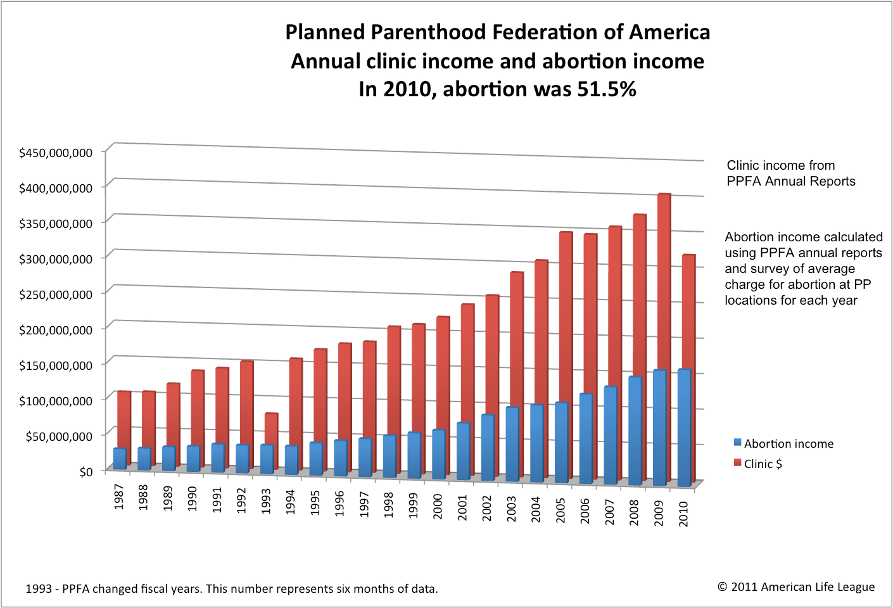
According to Planned Parenthood’s 2009-2010 Annual Report Abortion comprises 51.5% of PP’s clinic income. (click on chart to enlarge)

PP-clinic-income-and-abortion-income-1

Abortion is therefore very important to Planned Parenthood.

Jill Stanek Planned Parenthood Annual Report reveals organization in decline


Share on Facebook

Woman who regretted her abortion: “no options were presented to me”

Katerina, who had an abortion and suffered great emotional pain afterward:

“The lady who met me there [at the local Family Planning Service] treated me as rudely as anyone could treat someone; there was no caring or concern in her manner. No options were presented to me. She said I was stupid to get pregnant and as I was 18 and at university she “presumed I wanted an abortion.” I remember asking about the difference between local and general anesthetic and she said, “Have [a] local as then you will know what has happened and never make this mistake again.” Her negative and unsupportive attitude is something I will always remember. I asked her at the time about other options, and she said, “Do you want to finish Uni?” I… I don’t remember making the decision, just that this is what I was expected to do; from the little information I had been told it seemed there would be no support and no future for me if I was to have the child…”


 Melinda Tankard Reist Giving Sorrow Words: Women’s Stories of Grief after Abortion (Springfield, IL: Acorn Books, 2007) 32

Share on Facebook

Pro-choice author: abortion has to do with “life and death”

The pro-choice author of Abortion: A Positive Decision interviewed abortion providers and postabortion women talking about how great abortion is, and how helpful to women. However, in the beginning of the book, she says:

“No matter that legal abortion is as safe a procedure as having your tonsils out or a penicillin injection or wisdom tooth extracted. It is far more than a safe medical procedure because of the complicated decision-making that is involved, and the fact that it has to do with sex and life and death.”

Patricia Launneborg Abortion: a Positive Decision (New York: Bergin & Garvey, 1992) 3 – 4

Whose life and whose death? Throughout the book, Launneborg presents abortion in the most positive terms possible, but she admits that she knows that abortion is a life-and-death issue, that abortion, ultimately, destroys a life – kills a child.

Other pro-choice activists have said the same thing.

And is abortion really safer than a wisdom tooth extraction? Women who died from legal abortions or suffered complications would disagree

Share on Facebook

Margaret Sanger is a “hero” at abortion clinic despite racism

From a pro-choice author who interviewed clinic workers for a book she wrote:

“Many of the staff [at the abortion clinic] moreover, were aware of the family planning establishment’s historic ties to the eugenics movement. As Bernice, a black counselor put it: “Margaret Sanger is the big hero around here, but she said some outrageously racist things.”

Carole Joffe The Regulation of Sexuality: Experiences of Family-Planning Workers (Philadelphia: Temple University Press, 1986) 85

Share on Facebook

3rd trimester abortion to save a woman’s life?

Dr. Anthony Levantino, former abortionist, explains how abortion in the third trimester is never needed to save a woman’s life. He explains that abortion this late requires three days to perform- the cervix must be dilated over a period three days. He explains:

“In cases where a pregnancy places a woman in danger of death or grave physical injury, a doctor more often than not doesn’t have 36 hours, much less 72 hours, to resolve the problem.

Let me illustrate with a real-life case that I managed while at the Albany Medical Center. A patient arrived one night at 28 weeks gestation with severe pre-eclampsia or toxemia. Her blood pressure on admission was 220/160.

A normal blood pressure is approximately 120/80. This patient’s pregnancy was a threat to her life and the life of her unborn child. She could very well be minutes or hours away from a major stroke.

This case was managed successfully by rapidly stabilizing the patient’s blood pressure and “terminating” her pregnancy by Cesarean section. She and her baby did well. This is a typical case in the world of high-risk obstetrics.

In most such cases, any attempt to perform an abortion “to save the mother’s life” would entail undue and dangerous delay in providing appropriate, truly life-saving care. During my time at Albany Medical Center

I managed hundreds of such cases by “terminating” pregnancies to save mother’s lives. In all those cases, the number of unborn children that I had to deliberately kill was zero.”

Testimony of Anthony Levatino, MD, JD before the Subcommittee on the Constitution, Committee on the Judiciary, U.S. House of Representatives on The District of Columbia Pain-Capable Unborn Child Protection Act (H.R. 3803) May 17, 2012

Share on Facebook
Abortionist: it’s too hard to dismember a baby after 20 weeks


Diagram of partial birth (D&X) abortion

Abortionist Martin Haskell originated the D&X [partial birth] procedure because:

“… most surgeons find dismemberment [i.e., D&E] at twenty weeks and beyond to be difficult due to the toughness of fetal tissues at this stage of development.”

 Martin Haskell, M.D. “Dilatation and Extraction for Late Second Trimester Abortion.” National Abortion Federation conference proceedings Second Trimester Abortion: From Every Angle, September 13-14, 1992, Dallas, Texas

This is the procedure he said was difficult:

de

Share on Facebook

OB/GYN lies about doing abortions

Retired OB/GYN Marciana Wilkerson who performed abortions and had a private practice knew that if the public knew she was an abortion provider, she would lose patients, so she used deceit.

“What we did to protect me in private practice was, if someone called and asked for an abortion on the phone and she wasn’t one of our patients, the staff politely told her that I didn’t perform that service.… But if they knew who she was, they bring her in and I’d speak to her face-to-face. There was a big need for it; women would usually come and say “can you refer me to someone?” And they were thrilled when they found out I could offer the service and not send them out.”

Sarah Erdreich Generation Roe: inside the Future of the Pro-Choice Movement (New York: Seven Stories Press, 2013) 53

Share on Facebook

Prochoicer compares pregnancy to rape, justifies abortion

Prochoicer Eileen McDonagh:

“Some might suggest that the solution to coercive pregnancy is simply for the woman to wait until the fetus is born, at which point its coercive imposition of pregnancy will cease. This type of reasoning is akin to suggesting that a woman being raped should wait until the rape is over rather than stopping the rapist…. the fetus is not innocent but instead aggressively intrudes on a woman’s body so massively that deadly force is justified to stop it.”

She acknowledges:

“Few people are going to be comfortable with the idea.”

Eileen L. McDonagh, Breaking the Abortion Deadlock: From Choice to Consent (Oxford: Oxford University Press, 1996), pp. 7, 11–12, 192.

Is this a rapist?

9 – 10 weeks
9 – 10 weeks
Share on Facebook

Restricting Medicaid abortions result in 25% decrease in abortion rate among poor women

Stanley Kershaw, a senior fellow at the Guttmacher Institute and author of the 2009 study Restrictions on Medicaid Funding for Abortions: A Literature Review:

“The research literature clearly shows that restricting Medicaid funding for abortion forces many poor women – already at greatest risk of unintended pregnancy – to carry an unwanted pregnancy to term. Antiabortion advocates are using these restrictions in a misguided attempt to reduce the nation’s abortion rate.… In the end, approximately 25% of poor women seeking abortions are forced to give birth because funding for termination is unavailable.”

“How Can I Find All of the Money I Need?” National Network of Abortion Funds, Retrieved January 17, 2013 http://www.fundabortionnow.org/get–help/financial–counseling Quoted in Robin Marty, Jessica Mason Pieklo Crow After Roe (Brooklyn, New York: ig Publishing, 2013)

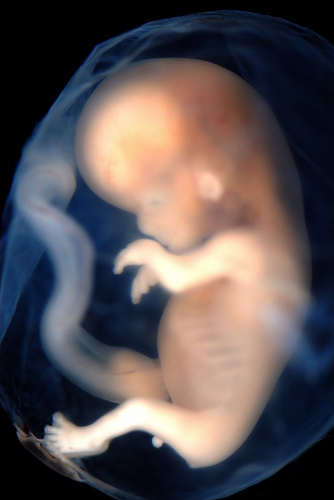
A 25% reduction in abortions among poor women – babies that will live instead of die. Pro-choicers consider this a bad thing, but what it means is that babies like the one below will not be torn to shreds by abortion instruments.

9 – 10 weeks
9 – 10 weeks
Share on Facebook

Former abortionist describes dismembering unborn babies

From a former abortionist, as told to Paul B Fowler:

“Instead of a loop shaped knife [as is used in a D&C], a grasping forceps (similar to pliers with teeth) is inserted into the womb, to grasp part of the fetus. Because the developing baby already has calcified bones, the parts must be twisted and torn away. This process is repeated until the body is totally dismembered and removed. Sometimes the head is too large and must be crushed in order to remove it. Bleeding is profuse.”

Paul B Fowler Abortion: Toward an Evangelical Consensus (Portland, Oregon: Multnomah Press, 1987) 192

He is describing abortions done by D & E in the 2nd trimester.


Share on Facebook