A British woman who had an abortion tells her story:
My decision to deny a child a future has in many ways been a personal life sentence for me. The first time I had sex I fell pregnant.
I’d been going out with my first boyfriend for seven months and we stupidly didn’t use protection, but I was so young I didn’t really understand the consequences.
I was petrified – especially when my boyfriend make it clear he didn’t want me to keep the baby. He said if I didn’t get rid of it, I’d never see him again. …
The weekend I went into hospital was awful. I was put on a ward with a group of pregnant women – everyone was so excited about having their babies but I felt guilty about terminating mine. Every hour or so the nurses would come back and ask if I was still sure I wanted to go ahead – it made the experience so much worse. …
No one apart from close family and my boyfriend knew about it, and if the topic ever came up in conversation, I would never admit to having had one. I was terrified people would think badly of me.
My guilt worsened when, aged 23, I met my first husband and had Katie. Every time I looked at her I thought of the baby I’d terminated.
I fell into a terrible depression and began to think anything that went wrong in my life was my punishment for having a termination and I turned to alcohol.
Eventually I pulled myself together and had counselling in my early 30s. It was the first time I’d spoken about how I felt. It made me realize that while I believe I made the right decision at the age of 17 – I really wasn’t capable of bringing up a child then – I could never destroy another potential life. …
I’m still not over my abortion – I even wrote a letter to the baby that might have been and buried it in the garden – it would be 19 now, and probably at university
NATASHA PEARLMAN; JENNY NISBET “ABORTION: THE LEGACY” The Daily Mail July 27, 2006 42.
Abby Johnson: If the woman asked you specifically what does the baby look like, or is the baby going to feel pain, is the baby going to feel anything during the abortion, what were some of the things that you guys were instructed to say to the women who asked these questions?
Jackie: At our clinic we were instructed to tell them a number of things. And a lot of it depended on the gestation of the pregnancy. Most of our patients were early in the pregnancy… Things like, that the central nervous system hadn’t developed yet so it wouldn’t feel anything, and the second one was for patients that were further along, that the baby feels what they feel. So if they choose to do the more expensive sedation method, you also limit the pain that the fetus would feel also. That’s what we were instructed to tell patients.
In this way, abortion workers were able to sell costly general anesthesia to late-term abortion patients who were afraid their babies would feel pain. Playing on the women’s fears, the facilities were able to make more money. General anesthesia is not only more expensive than local anesthesia, it carries with it much greater risks.
If endangering women’s lives and using their fears to increase profits wasn’t enough, the abortion workers were lying to the women. The theory that anesthesia given to the mother reduces the pain her baby feels was thoroughly debunked before the Supreme Court in the partial-birth abortion ban trials. The pain the preborn baby feels is not affected by the anesthesia given to the mother.
Written Testimony of Kathi A. Aultman, MD Senate Judiciary Committee Hearing March 15th 2016
Chairman Grassley, I would like to thank you for inviting me to participate in this hearing today. I have spent my entire career as a women’s advocate and have a keen interest in issues that impact women’s health. I come to you as someone who has done 1st and 2nd trimester abortions and who has treated women with the medical and psychological complications of abortions. I have cared for women and their babies throughout normal pregnancies, medically complicated ones, and those with fetal anomalies. I have taken care of women who decided to keep their unplanned pregnancies and those who aborted them. I have given birth vaginal vaginally twice and I have had an abortion. I also have a cousin who survived an abortion. I have testified on issues related to abortion in state courts and legislatures, and before the House Judiciary Subcommittee on the Constitution.
At the time I entered medical school I believed that the availability of abortion on demand was an issue of women’s rights. I felt that a woman should have control over her body and not be forced to bear a child she didn’t want. My commitment to women’s issues was strengthened as I was exposed to the discrimination inherent in medical school and residency at that time, and to the plight of the indigent women we served in our program. I also believed it was wrong to bring unwanted children into an overpopulated world where they were likely to be neglected or abused.
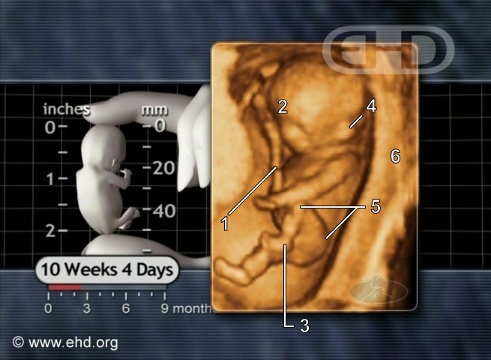
Foot of baby at 12 weeks
During my residency I was trained in 1st trimester abortions using the D&C with suction technique. I then sought and received special training in 2nd trimester D&E procedures during which the fetus is crushed and removed in pieces. After each procedure I had to examine the tissue carefully to account for all the body parts to make sure nothing was left to cause infection or bleeding. I was fascinated by the tiny but perfectly formed intestines, kidneys, and other organs and I enjoyed looking at their amazing cellular detail under the microscope. I realize it is hard to imagine someone being able to do that and be so detached but because of my training and conditioning a human fetus seemed no different than the chick embryos I dissected in college. I could view them with strictly scientific interest devoid of any of the emotions with which I would normally view a baby. I wasn’t heartless I just had been trained to compartmentalize these things.
If I had a woman come in with a miscarriage or a still birth and she had wanted the baby I was distraught with her and felt her pain. The difference in my mind was whether the baby was wanted or unwanted.
After my first year of training I got my medical license and was able to get a job moonlighting at a women’s clinic in Gainesville, Florida doing abortions. I reasoned that although the need for abortion was unfortunate, it was the lesser of two evils, and I was doing something for the wellbeing of women. I also could make a lot more money doing abortions than I could make working in an emergency room. I enjoyed the technical challenges of the procedure and prided myself on being really good at what I did. The only time I experienced any qualms about what I was doing was when I had my neonatal care rotation and I realized that I was trying to save babies in the NICU that were the same age as babies I was aborting, but I rationalized it, and was able to push the feelings to the back of my mind. My last year in residency I became pregnant but continued to do abortions without any reservations.
The first time I returned to the clinic after my delivery, however, I was confronted with 3 cases that broke my heart and changed my opinion about abortion. In the first case I discovered that I had personally done 3 abortions on a girl scheduled that morning. When I protested about doing the abortion, I was told by the clinic staff that it was her right to choose to use abortion as her method of birth control and that I had no right to pass judgment on her or to refuse to do the procedure. I told them it was fine for them to say but that I was the one who had to do the killing. Of course she got her abortion and despite my urging she told me she had no desire to use birth control. The next situation involved a woman who when asked by her friend if she wanted to see the tissue she replied “No! I just want to kill it!” I was taken aback by her hostility and lack of compassion towards the fetus.
The last case brought me to tears. This was a mother of four who didn’t feel she and her husband could support another child. How I hurt for that mother. What a terrible decision to have to make. She cried throughout her time at the clinic and that was the end of my abortion career. I had finally had made the obvious connection between fetus and baby.
I found out later that few doctors are able to do abortions for very long. Physicians are taught to heal, not harm. OB/GYNs especially, often experience a conflict of conscience because they are normally are concerned about the welfare of both their patients but in an abortion they are killing one of them.
Although many people view an abortion as just removing a blob of tissue, the abortionist knows exactly what he or she is doing because they must count the body parts after each procedure. Eventually the truth sinks in and if they have a conscience they can no longer do them.
My views also changed as I saw young women in my practice who did amazingly well after deciding to keep their unplanned pregnancies and those who were struggling with the emotional aftermath of abortion. It was not what I expected to see.
I will never forget one woman who had gone to the Orlando area for a late term abortion. She had not recovered from the horror of delivering her live 20+ week baby boy into the toilet. Her agony was compounded by the fact that her baby brother had died by drowning.
Another woman told me that she was seeing a psychiatrist because although she strongly believed in a woman’s right to choose abortion she couldn’t cope with the realization that she had killed her child. Some of my patients didn’t express any remorse until they realized they would never get pregnant either because of medical problems, advancing age, or personal issues. I personally didn’t have any concern or remorse about having had an abortion until after I had my first child. It was then that I mourned the child that would have been.
As a society we have shifted our priorities from basic human rights to women’s rights and have taught our young women that nothing should interfere with their right to do whatever they want with their bodies, especially when it comes to pregnancy. We have also done a good job of sanitizing our language to make abortion more palatable. We don’t speak about the “baby”, rather we talk about the “fetus”. The abortionist “terminates the pregnancy” rather than “killing the baby”. As medical doctors and as a society we have moved away from the idea that life is precious and closer to the utilitarian attitudes which wreaked so much havoc during the last century. In most ethical dilemmas we must weigh the rights of one person against the rights of another.
Even for the most staunch abortion supporter there is a line somewhere that they feel shouldn’t be crossed. I would agree that we need to give a women as much choice as possible in determining her future and what she does with her body but we must also recognize the truth that there are at least 2 people involved in a pregnancy and that at some point the rights of the weaker one deserve some consideration. Some people believe life begins at conception when the egg and sperm meet and should be safe guarded at that point. Others feel it isn’t until it is safely implanted it its mother’s uterus that it deserves protection. Many feel it should have some rights once it is viable or old enough to live outside the womb. Yet there are some who feel that the baby has no rights even in process of being born. Should a baby that can live outside the womb be given no consideration, no protection, and no rights, just because it is unwanted? Should we not at least have compassion on babies at 20 weeks gestation when their nervous systems are developed enough for them to experience pain and protect them from the excruciating pain of being dismembered or killed in other ways?
Hopefully we all agree that a mother should not be able to kill her 3 year old child; but what about an infant? There are some who advocate that a mother should have the right to euthanize her infant up until 3 months of age because there may be a defect that didn’t express itself at birth. I think most Americans would say that once a baby is born there is no question it should be protected and yet there are those who say that if it is unwanted but managed to survive an abortion it does not qualify for the same care that any other baby would get at the same gestation and it is OK to kill it. Is it the child’s fault that it is unwanted? Should it lose its rights simply for that reason? Doesn’t the government have a responsibility to protect that child even if its parents won’t? What if a baby is defective when it is born? We have laws to protect people with disabilities. Are we going to exclude babies, our most vulnerable citizens, from that protection? The problem is where does it stop? Where does a civilized society draw the line?
As legislators you have the burdensome task of writing the laws that govern our society and that the majority of people will accept. At the same time you must protect the most vulnerable among us. You are ultimately the ones who will determine where that line is drawn. It’s a difficult job. We are a people of many religions and traditions with different needs and wants.
In making your decision you should not forget that abortion generates a lot of money. Much of the power and influence behind the drive to prevent any restriction on abortion comes from those who make a profit on it and I am sad to say they have used a distorted view of women’s rights as a cover.
I have always thought of myself as a good person but at one point I was horrified by the realization that I had killed more people than most mass murderers. Today when I meet young men and women that I delivered, the joy of meeting them and knowing that I played a part in bringing them into the world safely, is clouded by the thought of all the ones I will never meet because I terminated their lives. I would not want to be in your shoes and have the burden of knowing that I could have prevented the deaths of thousands even millions and did nothing. I would encourage you to vote for both of these bills.
“And what of the children of unwanted pregnancies? Many are born to single mothers or families that are scarcely able to support them. Many others are victims of abuse or neglect. …
We do not mean to callously suggest that these children would have been better off if they had never been born. What we do mean to say is that if every woman had a choice about whether to allow each embryo to develop into a child, we would have better social services and happier families.”
To abort because a baby may be abused is illogical, as abortion itself is child abuse. To brutally tear apart a baby because he or she may not live in a “happy family” is wrong.
I’d been with my boyfriend for five years and we’d recently got engaged. When I realised I was expecting I was so excited, but he was horrified and said that at 22 he was too young to become a father.
Devastated, I returned home to my parents and they put pressure on me to have an abortion
My mother said I was too young and irresponsible, and my attempts to fight were futile.
Within a week, I’d been booked into a hospital and had an abortion.
I’m not saying it was the wrong decision, but it definitely wasn’t my decision – I really wanted to have the baby and that choice was taken out of my hands. As a result, I felt cheated and angry at everyone….
For a long time I regretted the abortion because of the terrible sense of guilt, but I have to be philosophical about it. I now believe that baby just wasn’t meant to be, and I am back in control of my life.
NATASHA PEARLMAN; JENNY NISBET “ABORTION: THE LEGACY” The Daily Mail July 27, 2006 42
On former clinic worker, the late Joan Appleton, and her healing.
So each morning — in order to aid her spiritual and psychological healing — Appleton imagines a child. “I name it. I pray for it. I ask a life for it,” she said. “I’ll do this for the rest of my days.”
In addition, Appleton said, she goes to abortion clinics twice a week and talks to the babies in the womb rather than to their mothers.
“I tell them I’m sorry they have to die today. I hope they’ll forgive us and go to God,” she said.
From a Chinese woman who enforced the one child policy in China:
“My first assignment directly concerned with abortion was to interview pregnant women who were brought into the clinic.… The only thing that really concerned the clinic director was how far along she was, as that determined the kind of abortion procedure that would be used. At the same time, I was to try and obtain her consent for the procedure she was about to undergo. The abortion would be performed in any case, I was told, but it was easier on everyone concerned if the patient first gave her permission…
Most of the women I saw were married… Many had been subjected to weeks of high-pressure tactics and had only reluctantly come around. More often than not, they arrived at the hospital accompanied by one or two unsmiling officials from the Women’s Federation. “Hurry up and finish what we have started,” I was urged more than once by such escorts, “before she changes her mind and gives us more trouble.”
At the time I saw nothing unethical about my assignment… I had repressed my earlier qualms about the morality of the new policy. It made good economic sense to me that China had to control its population in order to modernize. But at the same time I remained generally sympathetic with what these sad—faced women were going through… As things were, I was convinced that I was doing them a kindness by helping them to accept, as I had, the inevitable.
I was very good at this kind of manipulation, for I set out to make friends with each new patient… I would chat with her about her job and her family. When she began to relax a little in my company, I would bring the conversation around to the question. “Well, you appear to have exceeded your allotted number of children,” I would begin in my most sympathetic manner. She would answer yes. “I, too, once conceived an over quota child,” I would confide to her. “I, too, had to undergo remedial measures. I know it is a difficult thing to do. But it is necessary for the sake of our fatherland. Are you willing?”
Many were already defeated, and, when the question was put to them, would nod wordlessly, tears streaming down their faces. Others I was able to persuade. “You’ll have another chance to have a baby in a few years,” I would say soothingly. I didn’t really believe this, for the one child policy was getting stricter and stricter, but the desperate women to whom I was speaking sometimes did.
A few, when I asked if they consented to the operation, burst into bitter laughter. “Why ask me?” One scoffed. “I don’t have any choice. The population control workers in my unit have been after me for months… “Reflect on your mistake!” Only if I undergo “remedial measures” with they stop pressuring me and my husband.”
From time to time we would get a “pleader,” as they were scornfully referred to by the clinic staff. These women were the toughest to deal with, for they begged shamelessly and unceasingly. “Please spare the life of my child!” These women would cry out. “Please allow my baby to live. My husband and I want this baby very much.” Some even got down on their knees and began knocking their heads on the floor in supplication. “This is our last chance to have another child. Please… I beg you!”
Their pleas for mercy rang out like accusations and left a bitter taste in my mouth. My usual arguments were ineffective with pleaders, and I was reduced to pleading in my turn. “Please don’t make things even more difficult for us,” I would say. “We are only following orders. We don’t have any more choice than you do. We have no way to escape our responsibilities.” Despite my best efforts, I was frequently unable to induce these women to accept calmly their child’s fate. Some went into the operating room still begging, making everyone uneasy and uncomfortable.
At least where these pleaders were concerned, my sympathy soon gave way to irritation. Why couldn’t they understand that we clinic workers were not personally responsible for our actions? The doctors were only following orders. I was only a minor functionary. Besides, I, too, had been compelled to have an abortion. I, too, had only one child. Why should anyone be allowed to have more children than I? I hardened my heart again such women and began rebuking them. “Why do you insist on having a second child?” I asked. “Don’t you know that it is unfair for those who have only one?”
Stephen W Mosher A Mother’s Ordeal: One Woman’s Fight against China’s One Child Policy (Orlando, Florida: Harcourt Brace & Company, 1993) 251 – 253
This is the story of a Chinese woman named Aiming:
“After the birth of her second child, she was visited by the head of the local Woman’s Federation. “She wanted me to wear an IUD or agree to sterilization,” Aiming recalled. “I refused. At the time the official limit was two children, but this was not strictly enforced. I still had to prove myself, you see. In the countryside people look down on you if you cannot produce sons. I wanted the people in my husband’s village to respect me. My husband didn’t beat me after I gave birth to girls, as some women are beaten by their husbands. But I could tell he wasn’t happy. I wanted to give my husband a son…”…
When Aiming became pregnant in October 1978, she knew she could not openly carry this baby to term. She would have to conceal her condition from the Women’s Federation as long as she could, then go into hiding when she was exposed. As soon as the weather turned cold, she donned a bulky winter coat two sizes too big for her. She wore it indoors and out for the next six months. It was not until early May, when the arrival of warm weather forced her into cooler clothes, that she was discovered to be pregnant. “The local head of the Women’s Federation was very unhappy to learn that I was already seven months along,” Aiming laughed. “She immediately designated me a “primary target for remedial measures.”
Months before, Aiming and her husband had devised a plan for this moment. A room had been rented in a remote hamlet a couple of miles from the mine. It had been stocked with clothes, bedding, and other essentials. This would be Aiming’s hideout until she gave birth. All Aiming had to do was travel there, and she would be safe.
Aiming had planned her escape route carefully but had not reckoned on how quickly the Women’s Federation would move. The night before Aiming was to travel to the mine, she and Mother Wei were awakened at 1:00 AM by the sound of someone banging on the front door. They looked out through the bars of their bedroom window to see the Women’s Federation head at the door. She was backed by five militia men armed with rifles. A horse-drawn cart stood down the street. Aiming knew at once that they had come to take her to the commune medical clinic, by force if necessary.
“I bolted for the back door,” Aiming recalled, “wearing only my nightshirt. Behind me I heard Mother Wei loudly arguing with the head of the Women’s Federation through the door. “What do you want at such an hour?!”
“Open the door! This is a matter of state business!”
“I ran across the alley way and hid myself quickly inside a pigsty. I did not want to wake up the dogs of the village. I waited and listened to see what would happen when they found out that I was missing.”
As soon as Mother Wei opened the door a crack, the militia men forced their way inside. “Where is she?” Aiming heard the head of the Women’s Federation shout. “
“I don’t know,” Mother Wei’s voice came back coolly. “She left some time ago.”
“We’ll see about that,” the official responded. “Search the bedrooms,” she ordered the militiamen. There was the sound of trunks being opened and furniture being moved. After a minute the voice of the official could be heard again. “Where did she go?” She shouted, angry that her quarry had eluded her. Mother Wei’s response was too soft to make out, but the official’s strident voice could be heard loud and clear: “In that case we will wait here for her until she returns.”…
Aiming knew she couldn’t stay in the pigsty. At any minute the head of the Women’s Federation might order a search of the village. Besides, she was being tormented by great clouds of mosquitoes, undeterred by her thin nightshirt or her careful efforts to wave them away. She considered setting out for her distant hiding place under cover of darkness, but abandoned the idea for fear that the roads were being patrolled. Instead, she decided, she would leave the confines of the village and conceal herself in the surrounding paddy fields. There, where it was safer, she would wait out the militiamen…
In a minute she had passed out of the village onto the narrow pathways that divided the individual paddies, placing her feet carefully on the muddy, slippery ridges to avoid a fall. She came to a small rock outcropping about 100 yards from the village – close enough to see what the militiamen were up to but providing enough cover to avoid being seen – and squatted there to wait for the dawn. “There were even more mosquitoes in the rice patties than in the pigsty,” Aiming recalled wryly. “The mosquitoes stung me until I was covered with welts. Maddened by the constant bites, I got down from the rock into the patty itself, squatting down in the cool water, feeling my feet sink into the mud below. I smeared thick mud over the exposed parts of my body. The cool wetness helped to relieve some of the itching, but as soon as it dried the mosquitoes would return, biting me through the layer of mud. I felt a tickling on my legs and kept having to slap off hungry leeches. I was miserable, hungry, and tired. I refused to give in to self-pity, though. I was not going to give myself up, no matter what happened.… If they discovered me, I was ready to fight to the death for the life of my son.”
She stayed in the paddy field for two days until the militiamen left,
“Aiming hid inside Mother Wei’s house that night and the following day, resting and regaining her strength. Then she set out under cover of darkness for her hiding place. It took most of the night to walk to the county seat. From there she took the morning bus to the market towns nearest her destination, covering the last 5 miles through the hills to the hamlet on foot. She was at the end of her strength when she arrived at her hiding place. Her husband, who got word through a friend that she was coming, was waiting for her. She collapsed into his arms, exhausted by but triumphant.
For several days after Aiming’s disappearance, the head of the Women’s Federation busied herself striking other “primary targets for remedial measures.” Nine women from the Village of the Three Brothers and surrounding communities – all five or more months pregnant – were arrested during successful midnight raids and taken to the commune medical clinic for abortion and sterilization. Then she turned her attention back to the still missing Aiming…
She and two assistants invaded Mother Wei’s house like an occupying army, arriving early each morning and staying until late each night. Throughout the day they took turns browbeating her about Aiming.”
Other times they would threaten her with heavy fines…
Aiming had her baby.
“A week after Aiming returned home, the militiamen came again, this time in broad daylight. Aiming’s husband was at the mine. “I thought they were coming for my son,” Aiming recalled. “I gave him to Mother Wei in panic and told her to escape out the back door. But it was me they were after. They grabbed me and put me on a cart. I was so surprised that I put up no resistance.”
Aiming was taken under guard to the commune medical clinic. There, on orders from the head of the Women’s Federation, she was given a tubal ligation the same day…
“They carted me off like a pig to the slaughterhouse. But then… Then I thought of our little treasure. I decided it was not too high a price to pay.”
Stephen W Mosher A Mother’s Ordeal: One Woman’s Fight against China’s One Child Policy (Orlando, Florida: Harcourt Brace & Company, 1993) 237 – 240
Pro-choice writer Joyce Arthur says the following in her essay “Know Your Enemy” (Pro-Choice Action Network)
“It [Abortion] means valuing quality of life over quantity of life. Access to legal, safe abortion is a blessing, because it benefits women, families, and society…. To choose not to give birth when there’s little foundation for that child’s well-being is a moral and caring act.”
In the world of many pro-choicers, abortion is an act of kindness because it spares an unborn baby suffering. There is no reference to the suffering the unborn baby may go through during an abortion.
A Chinese woman describe the lengths to which a family went to have their “illegal” child.
“Not all illegal pregnancies I heard about during our stay in the Village of the Three Brothers ended in tragedy. One of our visitors… told of how he and his wife defied orders to have an abortion. Their first child had been a girl, and they were desperate to have a son. “I declared to our village Party secretary that we were determined to keep this child,” he said. “He said that we would pay a heavy price for violating the one child policy. “To keep this baby,” I boldly replied, “we will pay any price.”…
“The officials levied a fine of 5000 yuan,” he continued. “We were shocked speechless. 5000 yuan is roughly 20 times our yearly income. But still we obstinately refused an abortion. We put our heads together and managed to come up with about 500 yuan – most of that amount borrowed from my brothers. “We will make installment payments for the rest,” we said. The officials laughed at our offer and carried our pig to the slaughterhouse and our chickens to the butchers. Then they returned for our furniture, auctioning it off in the village square to the highest bidder. We were left with nothing but bare walls and floors. The officials would’ve sold our house, too, but for the fact that it was built condominium style, sharing walls with the homes of my brothers on both sides.
After all our possessions had been sold, the officials told us that we were still 3000 yuan in debt. A struggle meeting was called. I was publicly denounced for having violated the party policy on having children, and for not paying the 3000 yuan we owed the village. How could we pay that debt? We had nothing left but four walls and the clothes on our backs.…
I refused to admit any wrongdoing… “Are you guilty or not guilty?” He asked me. “Not guilty,” I said. They roughed me up a little bit, but they dared not be too harsh with me. After all, my three brothers were in the audience. And most people in the village were secretly sympathetic with our desire to have a son.…
Moneywise it has been very difficult for us… We’ve had to take down the doors in our house and use them as beds. But, no, I’m not sorry.”
Stephen W Mosher A Mother’s Ordeal: One Woman’s Fight against China’s One Child Policy (Orlando, Florida: Harcourt Brace & Company, 1993) 232 – 234