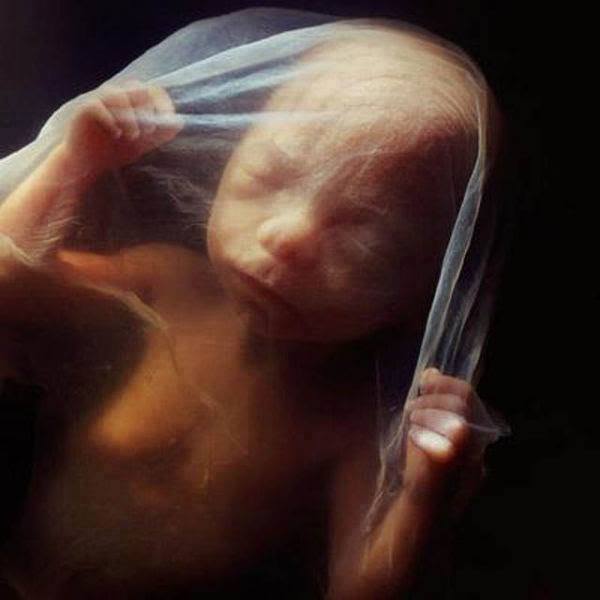
20 years of research proves that unborn babies feel pain

“Over the last 20 years, medical technology and scientific research, by way of ultrasonography, fetoscopy, fetal electrocardiograms, and fetal electroencephalograms, have demonstrated the remarkable responsiveness of the human fetus to pain, touch and sound… The majority of babies aborted by this [partial-birth abortion, a late term abortion] procedure are alive and feel pain by the end of the procedure… The fact that anesthesia is now routinely used on preborn children during fetal surgery is an obvious commentary on the unborn child’s capacity to feel pain.”

Sheila Carey–Kuzmic, M.D., F ACOG, Pediatric Specialist, Board certified in Westerly, Rhode Island

Fetal Pain and Partial-Birth Abortion, Physicians Ad Hoc Coalition for Truth

Phoebe Lee Casualties of Indulgence: from Life to Aborted (New York: Writer’s Showcase, 2001)  1231-122

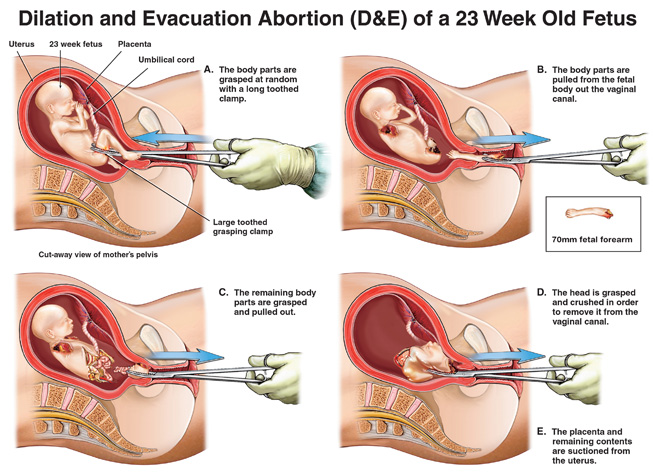
In a partial-birth abortion, the baby was delivered feet first and then her skull was punctured. This was very painful for the baby. Partial-birth abortion is now illegal. Abortions laid in pregnancy are now done by D&E, where the baby is dismembered. This is just as painful for the child, if not more so.
de

Share on Facebook

Sir Albert Lilley, Father of Fetology, on unborn baby’s pain

An interview with Sir Albert Lilley, a scientist who is often called the “Father of Fetology” on fetal pain:

Question: In the case of an 8- to-10-week fetus, if you apply pressure will it tend to try to get out of the way?

Answer: … as the famous work of Dr. Davenport Hooker shows, in his many thousands of feet of film, babies at this maturity are responsive to touch.

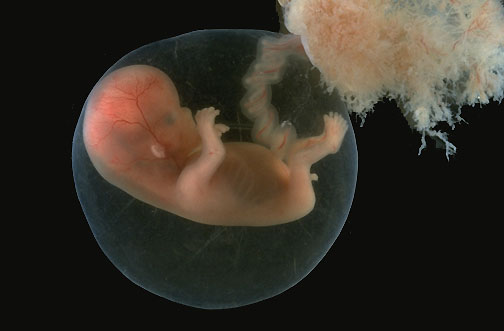
9 week old preborn baby

The fetus also responds violently to painful stimuli-needle puncture and injection of cold or of hypertonic solutions- stimuli which you and I find painful, children will tell you are painful, and the neonate, to judge from his responses, finds painful….

What's left behind after an abortion at 9 weeks
abortions at 9 weeks

I have been told by advocates of abortion that we have no proof that the fetus actually feels pain. Strictly, they are quite correct. Pain is a peculiarly personal and subjective experience and there is no biochemical or physiological test we can do to tell that anyone is in pain – a phenomenon which makes it very easy to bear other people’s pain stoically, which is an important point for obstetricians to remember. By the same token we lack any proof that animals feel pain. However, to judge from their responses, it seems charitable to assume they do. Were this not so there would be no point in having an organization like the Society for Prevention of Cruelty to Animals, and I for one would be unhappy to think we would withhold from the human fetus a charitable consideration we were prepared to extend to animals.

Question: The question, then, of pain felt by the fetus – it is your personal opinion, I gather from what you say in your paper, that in effect the fetus does feel pain?

Answer: I can only say that the fetus responds violently to stimuli that you and I would find painful. Bertrand Russell once remarked that a fisherman had told him that fish had neither sense or sensation, but how he knew that the fisherman would not tell him.

“Do Unborn Children Feel Pain?” Abort73.com Retrieved 9/30/2015

Share on Facebook

British Medical Journal on fetal pain

“The fetus needs to be heavily sedated by sedating the mother before intrauterine manipulations such as transfusions… The changes in heart rate and increase in movement suggest that these stimuli are painful for the fetus.”

“What the Fetus Feels,” British Medical Journal January 26, 1980, 233

Share on Facebook

Abortion provider talks to court about baby’s pain

24 weeks. Babies around that age were killed by partial-birth abortion

From testimony about pain felt by aborted babies during the partial-birth abortion ban trials:

Judge Richard Casey in New York asked Dr. Marilynn Fredriksen what she tells her patients: “Do you tell them whether or not it hurts?” he asked. She stuttered, “Who am I — what am I … .” “The patient,” Judge Casey continued. “The woman, the mother.” “It doesn’t hurt her, no,” said Dr. Fredricksen. Judge Casey pressed on, “Do you tell whether or not it will hurt the fetus?” Her response, “The intent [is] that the fetus will die during the process of uterine evacuation.”

“Ma’am, I didn’t ask you that,” Judge Casey persisted. “You will deliver the baby partially and then insert a pair of scissors in the base of the fetus’ skull. … Do you tell them whether or not that hurts the fetus?” In response, Dr. Fredricksen snapped, “I have never talked to a fetus about whether or not they experience pain.”

A pain specialist in the California trial, Dr. Kanwaljeet Anand, said, “There will be pain caused to the fetus. And I believe it will be severe and excruciating pain.”

CATHY CLEAVER RUSE “Forum: Abortion trials and tribulations” The Washington Times April 24, 2004

Read more here.

Share on Facebook

Experiment shows that preborn babies can feel pain

On whether preborn babies feel pain.

 “Data in the British Medical Journal, Lancet, gave solid confirmation of [fetal] pain. It is known that the fetal umbilical cord has no pain receptors such as the rest of the fetal body. Accordingly, they tested fetal hormone stress response comparing puncturing of the abdomen and of the cord. They observed:”

“The fetus reacts to intrahepatic (liver) needling with vigorous body and breathing movements, but not to cord needling. The levels of these hormones did not vary with fetal age.’

M. Fisk, et al., Fetal Plasma Cortisol and B-endorphin Response to Intrauterine Needling, Lancet, Vol. 344, July 9, 1994, Pg. 77

Share on Facebook

Scientists propose forceps extraction cause babies headaches

“It cannot be comfortable for the fetus to have a scalp electrode implanted on his skin, to have blood taken from the scalp or to suffer the skull compression that may occur even with spontaneous delivery. It is hardly surprising that infants delivered by difficult forceps extraction act as if they have a severe headache.”

Valman & Pearson, “What the Fetus Feels,” British Med. Jour., Jan. 26, 1980

Share on Facebook

Unborn babies may feel pain at 18 weeks

18 weeks
18 weeks

As early as 18 weeks, stress hormones are released by an unborn child injected by a needle, just as they are when adults feel pain. Hormone levels in those babies decrease as pain-relievers are supplied.

Garg, A &  Rovnaghi, C. “Fetal Response to Intra-Uterine Needling: Is It Pain? Does It Matter? Pediatric Research. V 51, No 1, 2002.

Share on Facebook

Babies feel pain when they’re being aborted, say scientists

When Ronald Reagan was president, he made a statement that pre-born babies being aborted suffered agonizing pain. Immediately, pro-choice groups attacked his words, claiming that it wasn’t true.

But twenty-six medical authorities, including two past presidents of the American College of Obstetricians and Gynecologists wrote a letter:

“Mr. President, in drawing attention to the capability of the human fetus to feel pain, you stand on firmly established ground…. That the unborn, the prematurely born, and the new-born of the human species is a highly complex, sentient, functioning, individual organism is established scientific fact…. Over the last eighteen years, real time ultrasonography, fetoscopy, study of the fetal EKG [electrocardiogram] and the fetal EEG [electroencephalogram] have demonstrated the remarkable responsiveness of the human fetus to pain, touch, and sound.”

 Letter to President Reagan, cited by John Willke in Abortion Questions and Answers (Cincinnati, Ohio: Hayes Publishing Co, 1988), 169.

Share on Facebook

Surgeon says preborn babies feel pain at 8-13 weeks

“As early as eight to ten weeks after conception, and definitely by thirteen-and-a-half weeks, the unborn experiences organic pain…. First, the unborn child’s mouth, at eight weeks, then her hands at ten weeks, then her face, arms, and legs at eleven weeks become sensitive to touch. By thirteen-and-a-half weeks, she responds to pain at all levels of her nervous system in an integrated response which cannot be termed a mere reflex. She can now experience pain.”

Surgeon Robert P. N. Shearin

The Abortion Providers,” a 1989 video available from Prolife Action League, 6160 N. Qcero, Chicago, E 60646, (312) 777-2900

Preborn baby at 9-10 weeks
Share on Facebook

Former abortionist says unborn babies feel pain

Former abortionist Dr. Robert Siudmack.:

The baby has a brain. It has a nervous system. It has nerve endings. And it doesn’t take a rocket scientist to put the dots together that obviously the baby has the capacity to feel sensation and pain. In fact, when we do ultrasounds on many of these babies, when we want to try to get it to move, we’ll jostle the woman’s abdomen and the baby does feel the sensations of movement and encouragement to move, and it, in fact, responds to that. Studies have also shown that the baby responds to music, it responds to sound. This is all a function of the baby’s nervous system. So yes, the baby does feel, and can feel pain.

Coral Springs Ministries  videos “The Truth about Abortion.” uploaded on January 15, 2009

Quoted in Sarah Terzo “Former abortionist: Life begins at conception, preborn feel pain” Live Action News Nov 13, 2015

Share on Facebook