Former abortionist on pain felt by preborn babies

Former abortionist Dr. Robert Siudmack:

The baby has a brain. It has a nervous system. It has nerve endings. And it doesn’t take a rocket scientist to put the dots together that obviously the baby has the capacity to feel sensation and pain. In fact, when we do ultrasounds on many of these babies, when we want to try to get it to move, we’ll jostle the woman’s abdomen and the baby does feel the sensations of movement and encouragement to move, and it, in fact, responds to that. Studies have also shown that the baby responds to music, it responds to sound. This is all a function of the baby’s nervous system. So yes, the baby does feel, and can feel pain.

“The Truth about Abortion.” Coral Springs Ministries pro-life video quoted in 

SARAH TERZO “Former abortionist: Life begins at conception, preborn feel pain” Live Action News NOV 13, 2015

Share on Facebook

Unborn baby can feel pain in abortion, says pediatric neurosurgeon

Expert testimony from Dr. Robert White, pediatric neurosurgeon, before U.S. Congress,  June 15, 1995 :

“By every measurable method, evidence suggests that the type of massive tissue destruction caused by all abortion methods at this stage [20+ weeks]  would be expected to be accompanied by substantial pain to the unborn child. “

Aborted baby torn apart at 20 weeks


Share on Facebook

Anesthesiologist: unborn baby can feel pain after 20 weeks

20-
20 week abortion. The baby was dismembered in the abortion procedure.

Commenting on legislation that would ban abortion after a baby can feel pain:

“[A] fetus after 20 weeks of gestation has all the prerequisite anatomy, physiology, hormones, neurotransmitters, and electrical current to close the loop and create the conditions needed to perceive pain.  In a fashion similar to explaining the electrical wiring to a new house, we would explain that the circuit is complete from skin to brain to back.”

Jean Wright, MD, anesthesiologist, Savannah, Georgia, specializing in Pediatric Critical Care Medicine at Memorial Health University Medical Center and previously Professor and Pediatric Chair of Mercer School of Medicine

Texas Right to Life “ Doctors Confirm Unborn Babies Feel Abortion Pain at 20 Weeks” LifeNews 3/13/13

Share on Facebook

Scientist testifies about fetal pain

Jean A Wright, M.D, testifies before a Senate subcommittee about fetal pain:

“… Very preterm neonates [newborns] have the neuroanatomic substrate and functional physiologic and chemical processes in the brain responsible for mediating pain or noxious stimuli (known as nociception)… 

Anatomic studies have shown that the density of cutaneous nociceptive nerve endings in the late fetus and newborn infant equal or exceed that of adult skin…

… [A] controlled study of intrauterine blood sampling and blood transfusions in fetuses between 20 and 34 weeks of gestation showed hormonal responses that were consistent with fetal perception of pain…

Preterm neonates born at 23 weeks gestation show highly specific and well coordinated physiologic and behavioral responses to pain, similar to those seen in full-term neonates, older infants, and small children…”

Statement of Jean A Wright, M.D., MBA, before The Subcommittee on the Constitution, Federalism, and Property Rights, Senate Judiciary Committee, on “The 25th Anniversary of Roe V Wade: Has It Stood the Test of Time?” January 21, 1998

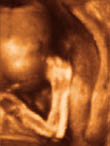
Above: foot of an unborn baby at 20 weeks – did this child feel pain when his foot was ripped from his body?

Read more about the pain unborn babies might feel during abortions here

Share on Facebook

Abortionist: baby reacts to needle in amniocentesis

23 weeks, legal to abort

“I do know that when we do, for instance an amniocentesis and put a needle through the abdomen into the amniotic cavity that the fetus withdraws so I certainly know based on my experience that the fetus will withdraw in response it a painful stimulus.”

Sworn testimony of Dr. Carolyn Westhoff, abortionist, in National Abortion Federation, et. al. v. Ashcroft, U.S. District Court, Southern District of New York, April 2, 2004. ExposeAbortion.com

Share on Facebook

Former Abortionist Believes Unborn Babies Feel Pain

The late Dr. Nathanson, former abortion provider and pro-choice advocate:

“I think the baby probably feels pain in all of them [abortion procedures] [although] the degree, the sophistication of the [pain] perception certainly varies with the length of gestation… [but] there is is really little question that pain is felt in some degree or other during an abortion.”

Initial transcript, The Ankerberg Theological Research Institute “Is Abortion Justifiable?”  Televised program, January 1990

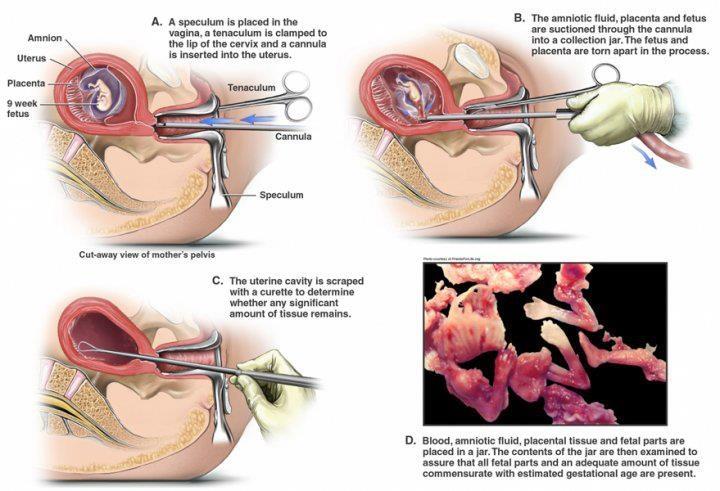
Here is a diagram of a first trimester suction abortion, the most common abortion procedure in the US

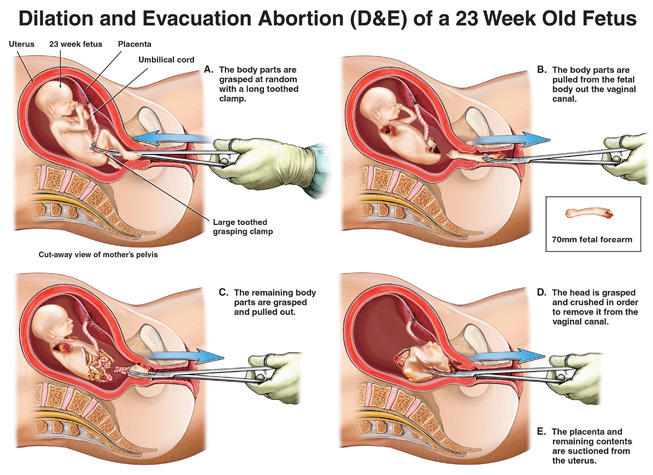
And here is a diagram of the most common second trimester abortion technique, the D & E:

In each, the baby is violently torn apart. Most likely, this dismemberment causes pain.


Share on Facebook

American College of Obstetrics and Gynecology On Unborn Babies and Pain

When President Reagan said that unborn babies feel pain during abortion in 1984, it provoked a reaction from pro-choice circles who denied this. A letter was written by a group of professors including two past presidents of the American College of obstetrics and gynecology, backing the fact that fetuses feel pain.

“Real-time ultrasonography, fetoscopy, study of the fetal EKG and fetal EEG have demonstrated a remarkable responsiveness of the human fetus to pain, touch, and sound. That the fetus response to changes in light intensity within the womb, DC, to cold, and to taste (by altering the chemical nature of the fluid swallowed by the fetus) has been exquisitely documented in the pioneering work of the late Sir William Lily – the father of fetology,”

page 96
J C. Wilke and Mrs Wilke Why Can’t We Love Them Both : Questions and Answers About Abortion (Hayes Publishing Company; 2000)

Share on Facebook

Professor of Anesthesiology On Fetal Pain Response

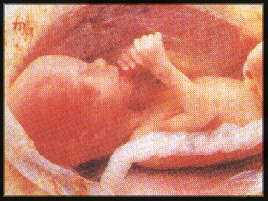
13 week-old unborn baby

Dr. Vincent J. Collins, Professor of Anesthesiology and author of “Principles of Anesthesiology: General and Regional Anesthesia”

“Fetal pain responses begin by 13 1/2 weeks gestation at the latest, and probably as early as eight weeks, based upon the development of the pre-born baby’s nervous system.”

Quoted by Brian Clowes in Marybeth T. Hagan  “Abortion: a Mother’s Plea for Maternity and the Unborn” (Liguori, Missouri: Triumph, 2005) 175


Share on Facebook

Doctor Testifies on Fetal Pain

On whether unborn babies feel pain:

Jean Wright, M.D., of Emory University School of Medicine, testified before a committee of the Virginia State Senate:

“Aspects of pain architecture begin as early as six to seven weeks, mature and are identified by their anatomy, their physiology, and the coordination of responses so that by 20-22 weeks of gestation, the evidence reveals a developed system of pain perception and response. … The ability to modulate or blunt the pain response does not develop until the last weeks of pregnancy and the first few weeks of infancy, leading us to believe that the pain perceived in the fetus is greater than that in the full-term infant.”

Paul Weyrich “Unborn Pain” Newsmax.com June 28, 2004

Can be found here.

Fore more quotes on when unborn babies feel pain, go here. 

Share on Facebook

Study in British Medical Journal: Unborn Babies React to Pain

From the British medical journal, Lancet, a study was done where scientists tested fetal hormonal stress responses. First they stuck the baby with the needle, then they hope to needle into the umbilical cord, which has no nerve endings.

They concluded:

“The fetus reacts to intrahepatic (liver) needling with vigorous body and breathing movements, but not to cord needling. The levels of these hormones did not vary with fetal age.”

MFisk, et al. “Fetal Plasma Cortisol and B – endorphin response to the Intrauterine needling,” Lancet, volume 344, July 9, 1994 PG 77

To read about more studies that confirm that babies in the womb feel pain, go here.

Share on Facebook