I remember assisting, once in particular, in the operating room at the clinic where I had been a medical assistant for six years. I was standing behind the doctor and could see everything as he was performing an abortion on a woman who was 20 – 22 weeks pregnant.
20 weeks
Late term abortions were usually a two-day process. On the second day the actual abortion was performed. The doctor first removed the laminaria and was then able to reach in with forceps to pull the baby out piece by piece. This procedure is very hard to do and requires a good deal of strength on the part of the doctor.
On that particular day, from my position I was able to see him extracting perfectly formed little arms, legs, toes, fingers, spine and finally the head.
I could see the baby’s face. I don’t know how to describe what I felt at that moment. I realized that we just killed a human being. But at the same time I thought: it is legal, so it must be all right. But my whole being was just screaming against what I just saw. I felt death. I was ashamed and confused as I was staring at the bloody parts of the baby. I can even say I felt the presence of the devil. It was very disturbing. My mind was so blinded by the darkness in it I was unable to do anything.
Sometimes I think about that day and feel that I should have run away, or tried to stop this madness. What were we doing, as medical professionals, as human beings? What happened to our hearts? Where was our compassion?
20 weeks
If this baby had been born prematurely at 20 – 22 weeks it would have had a chance to live. I thought, “People, think about what are you doing. What am I doing?” Think about the consequences of this abortion. Imagine this is you. Imagine you are in the most secure place you could be, in your mother’s womb. You have no idea how cruelly your life will end, how you will be torn to pieces. We betray our children. We interrupt their precious lives so abruptly, so unexpectedly. You think abortion brings relief, but instead it brings emptiness, shame, pain, regret, feelings of death. For six years abortion was the way I put bread on my table. For six years it was my life…
This is only the beginning of my story. My heart is burning more and more to tell everyone the truth. You are going to be hearing from me many, many times. I pray that God, the only God that we all have will open your hearts and give you wisdom and passion to stand up and speak up! WAKE UP, WORLD! WAKE UP!!!
I was a nurse practicing in North Carolina. I worked on a Gynecology/tumor unit at a teaching hospital. The unit included 4 prostaglandin abortion beds. The babies who were aborted were between 18-20wks of age. Most women were young, but occasionally there were patients whose babies had life threatening defects. I assisted the doctor in the initial placement of the prostaglandin. Then the women were left on the floor to deliver.
One thing that is often forgotten by people is that there is a big difference between a picture of a baby at a certain number of weeks pregnant, and seeing and experiencing a birth. There is a sensation of life, of a living thing. It is like the difference between a picture of a puppy and a real puppy. Even a movie does not capture the whole picture. All of your senses are involved.
After the second abortion I began changing my own thoughts about abortions and after a few more I could no longer participate. After several more years, my faith began to grow and with that my guilt increased. I spoke with a therapist and my parish priest. I asked for God’s forgiveness, but it took a while before I could let go of my guilt.
Now I want to do what I can to stop abortions.
Here is a picture of a prostaglandin abortion at 20 weeks:
This testimony is further evidence that most second trimester abortions are done on healthy mothers with healthy babies.
In an article in The Boston Globe, the author tells the story of a former abortion clinic nurse.
12 week unborn baby
She is now employed as a school nurse. She is mother of three.A woman of memory, conscience and deep regret that, combined with an eyewitness’s logic, cause her to wonder what wounds a culture suffers when it allows abortion to be obtained as easily as a flu shot. “I worked in the autoclave room. That is where they sterilize the trays and the instruments after the procedure,” she recalled the other day.
“When the doctors finished, they would bring in a small metal tray. There would be a plastic container as well as the instruments used to perform the abortion on the tray. “The instruments are called dilators. They are long metal sticks that are wider toward the end. Obviously, they are used to dilate the women.
“My job was to sterilize the instruments.
hands at 20 weeks
Then I would take the plastic container, which was filled with formaldehyde along with what they refer to as ‘the product of conception,’ and label it before sending it out to some lab. “After each abortion, the doctor would bring the tray to me, wrapped in sterilization paper, to be washed and labeled. I would clean the trays and utensils for the next procedure.
“We were not supposed to perform abortions past 12 weeks. But it would, and did, happen that some women were aborted at 16 to 20 weeks. “When that would happen, I would find that the tray contained blood, tissue and bone. That happened quite a lot and anyone who says it doesn’t is lying.
16 weeks
“What would you do?” she was asked. “With the tissue, bone and blood?” she wanted to know. “Right,” she was told.
She responded with a sigh
“I’d dump it in the sink, Just like it was a disposal.”
“The first time I saw it, I said, ‘Oh my God!’ And then I washed it away down the sink.
“Tissue, bone and blood,” she repeated. “That’s not life?”
Norma McCorvey, the “Roe” in the court case Roe Vs Wade, was instrumental in making abortion legal. She spent time working in abortion clinics in subsequent years. She later wrote a book about her experience.
Norma McCorvey Won By Love (Thomas Nelson, Inc: Nashville, TN) 1997 p 13
“I worked in several abortion facilities over the years. In fact, I even worked at two clinics at the same time, and they were all the same with respect to the condition of the facilities and that “counseling” the women receive. One clinic where I worked in 1995 was typical: light fixtures and plaster falling from the ceiling; rat droppings over the sinks; backed up sinks; and blood splattered on the walls. But the most distressing room in the facility was the “parts room.” Aborted babies were stored here. There were dead babies and baby parts stacked like cord wood. Some of the babies made it into buckets and others did not,….. The stench was horrible. Plastic bags full of baby parts, little tiny hands and feet visible through the jars, frozen in blood. The abortion clinic’s personnel always referred to these dismembered babies as “tissue.”
On page 58
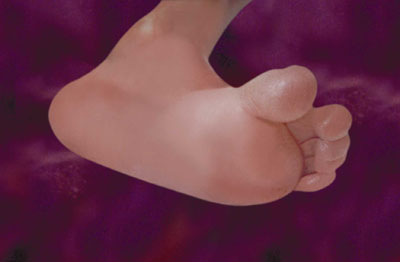
unborn baby’s foot at 14 weeks
“When a later abortion was performed, workers had to piece the baby back together, and every major part–head, torso, two legs, and two arms –had to be accounted for. One of our little jokes at the clinic was, “If you ever want to humble a doctor, hide a leg so he thinks he has to go back in.” Please understand, these were not abnormal, uncaring women working with me at the clinic. We were just involved in a bloody, dehumanizing business, all of us for our own reasons. Whether we were justifying our past advocacy (as I was), justifying a previous abortion (as many were) or whatever, we were just trying to cope–and if we couldn’t laugh at what was going on, I think our minds would have snapped. It’s not an easy thing trying to confuse a conscience that will not stay dead.”
Also, in her sworn deposition (Norma McCorvey A.k.a. Jane Roe of Roe v. Wade) Sworn to on 15 day of March, 2000:
While all the facilities [I worked in] were much the same, the abortion doctors in the various clinics where I worked were very representative of abortionists in general. The abortionists I knew were usually of foreign descent with the perception that the lax abortion laws in the United States present a fertile money-making opportunity. One abortionist, in particular, would sometimes operate bare-chested, and sometimes shoe less with his shirt off, and earned a six-figure income. He did not have to worry about his bedside manner, learning to speak English, or building a clientele.
While the manners of the abortionists and the uncleanliness of the facilities greatly shocked me, the lack of counseling provided the women was perhaps the greatest tragedy. Early in my abortion career, it became evident that the “counselors” and the abortionists were there for only one reason – to sell abortions. The extent of the abortionists’ counseling was, “Do you want an abortion? Ok, you sign here and we give you abortion.” [sic]. Then he would direct me, “You go get me another one.” There was nothing more. There was never an explanation of the procedure. No one even explained to the mother that the child already existed and the life of a human was being terminated. No one ever explained that there were options to abortion, that financial help was available, or that the child was a unique and irreplaceable. No one ever explained that there were psychological and physical risks of harm to the mother. There was never time for the mother to reflect or to consult with anyone who could offer her help or an alternative. There was no informed consent. In my opinion, the only thing the abortion doctors and clinics cared about was making money. No abortion clinic cared about the women involved. As far as I could tell, every woman had the name of Jane Roe.
Typically, most of the women would cry as soon as the suction machine was shut off, or, at some point. Sometimes I thought that they realized what had been done to their babies. Once, I heard a woman call her mother and say, “I just killed my baby. I’m so glad you never killed me!”
The doctors always hid the truth from the mothers. I would say about eighty-percent of the women would try to look down during the abortion and try to see what was happening. This is the reason the doctors would start with the scalpel: to make sure there was just blood and torn up “tissue” for the women to see. Specifically, I remember one woman who came in for an abortion, a pretty, sweet young woman about eighteen years old, with a teddy bear. During the procedure she looked down and saw the baby’s hand fall into the doctor’s hand. She gasped and passed out. When she awoke and asked about what she saw, I lied to her and told her it didn’t happen. But she insisted that she had seen part of her baby. A few weeks later, when she returned for her follow-up exam, she was a changed person: her sweetness had died and had been replaced with an indescribable hardness. I . could not look her in the eye. It took quite a few beers that night to make that particular day go away.
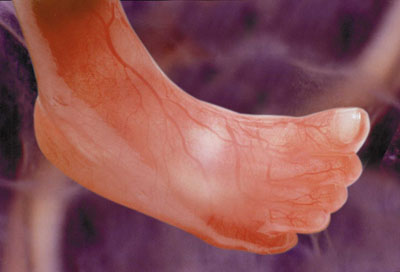
feet of unborn baby at 8 weeks
In all of the clinics I worked in the employees were forbidden to say anything that could talk the mother out of an abortion. The experience of abortion began to take its toll on me. While the abortionists’ counseling was non- existent, my counseling technique gradually became different depending on my mood and the stage of my career. In later years, I would sometimes take all the instruments that were used in an abortion procedure and purposely leave a little of the blood on some the instruments. Laying the instruments out on the little table in front of the woman, I would tell her that, “This is the first instrument that is going to be inserted into your vaginal area.” It would have just had a little smudge of blood, and I thought it was very dramatic. In retrospect, I don’t even know why I was doing these things. It was as if I was trying to talk these women out of the abortion– something we were forbidden to do. In other counseling sessions, I would demonstrate the position and warn her that the instruments were sharp, and that if she moved the doctor might slip, and puncture her uterus, and she would bleed to death. In other situations, when a woman asked me how much it cost, I asked her in response how much she wanted to pay to kill her baby. She replied, “They told me it wasn’t a baby.” I responded, “What do you think it is inside you, a fish?” Other times I would comfort them after the abortion by saying, “It wasn’t a baby. It was only a missed period.” Sometimes when I managed to make the women unsure, I would offer to refund their money except for the ultrasound.
……
After I saw all the deception going on in the abortion facilities, and after all the things that my supervisors told me to tell the women, I became very angry. I saw women being lied to, openly, and I was part of it. There’s no telling how many children I helped kill while their mothers dug their nails into me and listened to my warning, “Whatever you do, don’t move!” I can assure the court that the interest of these mothers is not a concern of abortion providers.
Because I was drunk or stoned much of the time, I was able to continue this work for a long time, probably much longer than most clinic workers. It is a high turnover job, because of the true nature of the business. The abortion business is an inherently dehumanizing one. A person has to let her heart and soul die or go numb to stay in practice. The clinic workers suffer, the women suffer, and the babies die.
Breedlove was the director of a for-profit abortion clinic in Dallas which did late-term abortions. She was the clinic director for two years before her pro-life conversion
“I called myself the administrator, but I was a 22-year-old LVN [Licensed Vocational Nurse] with no experience at all. My counselors were not trained as counselors. They were high-school graduates with no type of counseling degree at all. I would call them counselors. We gave the girls no alternative choices when I first started doing this…. On a typical day 20 girls were rushed though. It was almost like a factory line. They were just pushed through one at a time. They were given no personal attention …. A good doctor could do a suction abortion in three minutes. … [The women] were sent home and told to come back in two weeks. When they came back all we did was a urine test to make sure they were not still pregnant. The doctor would walk in and say, ‘Good news, you are not still pregnant,’ and then walk out without ever examining her.”
….
legs of a fetus/unborn baby at 11 weeks
The products of conception room: (POC)
“You would just look in the buckets and see arms and legs. I have horrible dreams about that now. It was something you would see in a scary movie.”
According to the author of the article:
“Some of the nine clinic workers actually refused ever to go back there. When Miss Breedlove would ask them to go measure a dead baby’s foot, a standard procedure, some would reply with a flat – no.”
foot of a fetus/unborn baby at 12 weeks
Mark Gabriel was a pro-life protester who was frequently thrown in jail:
“Around January I noticed a definite change,” [Breedlove] she says. Mark and other protesters started asking her to pray with them; something clicked in her and she started talking with them. “They would show me a lot of love. What I used to think was hate was actually love; they would be out there praying for me.”
“Every day I would go in the clinic and hear the same thing over and over again, and I started thinking about what they were saying; questioning my own self.”
She became friends with the protesters. Around this time, she started talking women out of having abortions at her clinic. She would show them the ultrasound and discuss with them the option of having the baby. She had not done this before.
“She started asking women to take a look at the screen with her. “You don’t want to abort this. C’mon, I have some people who will help you “ At that point she would walk them outside and introduce them to the protesters, who would take them to a nearby crisis pregnancy center.”
Partly due to the business lost due to Breedlove’s new attitude, the clinic went bankrupt.
Joe Maxwell with Roy Maynard in Dallas,“Driving Miss Norma“WORLD, August 26/September 2, 1995 – Volume 10 – Number 15
Former clinic worker Luhra Tivis discusses her role as an abortion counselor. Tivis was pro-choice when she started working at the clinic, but became uneasy with abortion based on the experiences she had working there.
“They decided they would train me to answer the phone. So I thought they were going to tell me how they wanted the information sheet filled out, and how to keep the phone record, and this and that. But what I was handed instead was a packet of information, materials to study, on how to be a high-pressure salesperson over the phone — you know, like telemarketing. How to convince somebody to buy your product. There was nothing in the material that had anything to do with the medical profession or helping women. I was very puzzled as to why they would be doing this. I hadn’t found out how lucrative it was yet. So I studied, and I tried to answer the phone the way they wanted me to, even up to the very end.”
Quoted by Rachel MacNair in Achieving Peace in the Abortion War” by Rachel M MacNair, Ph.D., published by the Feminism & Nonviolence Studies Association January 2009.http://www.fnsa.org/apaw/
In the film “Abortion: An Inside Look” Tivis said the following:
And one woman called and she said I’m calling for my daughter, I want to know how the procedure done and so forth and she said have you ever had a live birth? And it really shook me up to hear that question because I didn’t even think about that. So I asked my supervisor Elana, what should I tell her, which is she talking about?” And Elana told her “tell her we have never had a live birth at this clinic.” And I found out later that was a lie.
“From May to November 1988, I worked for an abortionist. He specializes in third trimester killings. I witnessed evidence of the brutal, cold blooded murder of over 600 viable, healthy babies at seven, eight and nine months gestation. A very, very few of these babies, less than 2%, were handicapped…
what an unborn baby looks like at 7 months
I thought I was pro-choice and I was glad to be working in an abortion clinic. I thought I was helping provide a noble service to women in crisis….I was instructed to falsify the age of the babies in medical records. I was required to lie to the mothers over the phone, as they scheduled their appointments, and to tell them that they were not ‘too far along’ Then I had to note, in the records that Dr. Tiller’s needle had successfully pierced the walls of the baby’s heart, injecting the poison what brought death…one day, Dr. Tiller came up the stairs from the basement, where the mothers were in labor. He was carrying a large cardboard box, and ducked into the employees only area of the office so that he wouldn’t have to walk through the waiting room. He passed behind my desk as I sat working on the computer, and he turned the corner to go around a short hall. He called out for me to come and help him. the box was so big and heavy in his arms that he couldn’t get the key into the lock. So I unlocked the door for him, and , pushing the door open, I saw very clearly the gleaming metal of the crematorium- a full sized crematorium, just like the one’s used in funeral homes. I went back to my computer. I could hear Dr. Tiller firing up the gas oven. A few minutes later I could smell burning human flesh. Mine was the agony of a participant, however reluctant, in the act of prenatal infanticide.”
Luhra Tivis “Where is the Real Violence?” Celebrate Life. Sept/Oct 1994
Note: this article was written before the murder of Dr. Tiller. Violence against abortion providers is morally wrong and hypocritical. The owners of clinic quotes vehemently oppose such actions.
I came into a company that was very well established. This particular company is one of the largest in the nation, it does operate abortion clinics to this day, 12 clinics across the United States. When I came into this industry, I was asked during my initial interview, “Are you pro-choice?” Well, of course I said yes, even though I really hadn’t thought much about it. The next question I was asked is “Can you handle the fact that this is a business?” and of course I fit right in, I have a business background, I have a medical background as well. There was no mistaking the fact that I was here to make them money. No one ever said to me, “I hope you’re pro-choice because we want you to help these women. I never felt that.
Well I had this noble cause because that because that I had worked in medicine I was used to sterile environment that I could bring that knowledge into the abortion industry and I could try to turn that clinic around so that we could give quality health care to women.
Well that sounds real nice, the only problem was that the industry, instead of me changing it, it changed me.
The first thing I did was clean up the clinic. At least on the outside. But soon I realized it was gonna cut into my bottom line. Because you see every time we bought a piece of equipment, we like you had absolutely no life support equipment, we had no crash cart we didn’t have any of those things in the clinic, and the state of Georgia where I’m from and where I operated this particular clinic, we were regulated by the state for the state didn’t require that we had any life support, didn’t require that we had any recovery room equipment though we did perform abortions under general anesthesia.
Because I was beginning to see things the way the abortionist sees things which is the more abortions we perform the more money I’m going to make. That was the bottom line.
I began, to see these women, I never saw them as women. If you want to know the truth, I never saw them as women. To me, if they were so stupid that they would come in and believe our lies, they deserved exactly what we were gonna give them. And that’s exactly the way I treated each and every woman.
14 weeks
But in our clinics, our doctors, those were not their patients. That’s common around the country. These doctors don’t care about their patients. We could see a separation, OB/GYN’s that worked in their own private practice and then they’d came to our clinic, if one of our patients had a problem afterward they called me. That’s common. I, like Joy, I’m not a medical doctor , I’m not trained to evaluate a woman’s problems, postoperative hemorrhaging, etc., I have no skills to enable me to make that diagnosis and to prescribe the method of treatment, but that was required of me and I did it for three years. When they called me after hours and said, “I’m hemorrhaging, what can I do?” It was my problem, not the doctors. I was the person on call, I was one who called in all the drugs, I was the person who prescribed the medication.
[discussing another clinic worker who is required to shred medical records of a patient who died] We had a personal shredder in my office for that purpose. There would not have been a medical record if the DA had shown up on the my doorstep the next morning.
The state of Georgia is one of those states that is very heavily regulated or technically very heavily regulated, meaning that they are subjected to an annual inspection by a governing body, they also, we have surprises inspections, they do come in without being announced, other than the first inspection. However, some of the material I brought with me and that I was holding up and showing you this morning are actual deficiencies, listed by this governing arm, such as patients who have a cardiac arrest, although their patient records indicate that they were ready, that they were healthy, that they were ready to be discharged from the clinic.
….
In the future, I believe, that we are going to have to deal with a generation of women who have Hepatitis B, who are HIV positive, because they’ve contracted if through an abortion procedure. If you reuse a vacuum aspiration cannula, you’re going to infect the next person. But when you get busy in a clinic, there is no time to sterilize instruments. I’m sorry. You wash them, you repack them, and you reuse them. And then, when the state comes in to look at your logbook, they have these nice little strips that you just stick on the autoclave and you put a date on there and you put a time, and we stick them in by the handful, and then we take them out and we show that we ran fifteen loads that day. When we didn’t.
There are a number of regulations, and the regulations are only as good as the enforcing arm behind it. I also have an original memorandum from the Georgia Department of Human Resources, which is our governing body that states that they realize that there were some criminal violations that were detected in these clinics as well during their routine inspections. However, because they are not given the authority to act upon criminal codes, it basically has to be dismissed. There is no action taken. So it does, the rules and the regulation varies very widely from state to state, most of them are in name only, and unless we begin to push our legislators and say that we want some accountability for the agencies that are responsible for inspecting abortion clinics, you’re really not going to see a change. You can write laws all day long that make people feel good and give you a warm, cozy feeling, but if there is no enforcement, there is no law.
8 week old unborn baby
Incomplete abortions, those happen very very frequently. I kept a file in my office, it was separate, it was under lock and key and absolutely no one had access to that but me. Those were our “problem patients.” Those were pulled out, they were purged from the normal filing system because we did not want an inspector to come in and routinely pull records and pull those records. Those were the women that we knew we sent home bleeding, the women that we knew we sent home with a problem. They were the ones that we knew we were going to hear from again.
You see when I came that we did have it, to the clinic, we did have a complication log book. Well, I asked the staff, I said how- would you explain to me how you gather the data for your statistics? They said well, we guess. I said, Ok. You guess at how many patients have complications after an abortion. So I tell you this because when you stop and look at CDC statistics, other statistics that you come across showing just how safe legal abortion is, you need to understand who reports those statistics.
I have a memorandum that came from our national director of this particular company, and in that memorandum she states, “You do not report it if it’s not a hospitalization. I don’t care how many times you perforate a uterus, you pack them, you massage the uterus, you give them some [medicine] and you send them home, but you don’t report it.
One incident in particular, when I was working in the clinic. We had a young girl, she was actually 14 years of age, and this particular Doctor came in to me and he said, “Hellen, I perforated her uterus and I pulled the bowel through. What do I do?” I knew what he meant. He wasn’t asking me what he should do as a doctor., he was asking me what do I do to make sure that this stays under wraps. So the decision was made. Poke it back in and sent her home. Because I’m going to tell you something, life or death means nothing in the clinic. If you do not respect the life of the unborn, how can you respect the life of the mother and why? It doesn’t happen.
Whether she lived or died I do not know. And I wish I could stand here and even tell you that I cared, but I didn’t. Because you see I wasn’t there to care about women. I knew that in the abortion clinic, there are women exploiting women. And I was one of them.
There are a lot of things that go on in a clinic that you would not tolerate if it happened in any other branch of medicine, and I say that speaking as one who is still in the medical industry. But it’s important that you understand to what lengths people in the industry will go to preserve their image. There is nothing that is too low. I say this because I want you to understand that when I worked in the industry there were no delusions of helping anyone. I helped myself to the money. I helped myself to a position of power. And I didn’t care how many dead bodies I had to crawl over to get there. I walked into the laboratory every day. I saw dead babies every day for three years. I played with many of them. I never saw human life. And I never cared. If I could see 50 I was so happy, because you know what that meant? It meant I’m really gonna have a good bonus in my next paycheck.
You see we did work from a tight script, but because we understood that if we could gain control of that conversation immediately, and then we could start telling her a little bit about us and what we were saying to her is, “I care about you. I am in control. I am the adult, I’ve done this before. I am the answer to your problem, no matter what it is.” It was a very, it was sales, it was a marketing tool.
I had one counselor though, who approached me and said, “I’d like to start a postabortion syndrome counseling session.” Well of course I said, “we can’t do that, because there’s no such thing as post abortion syndrome.” This was a counselor who was hearing from a lot of hurting women. But I quickly set her straight, “I don’t know where you got your statistics, but they are wrong. There is no such thing. If a woman calls you and says, “I feel terrible. I’m hurting. I’m empty. Something’s wrong,” we were trained to tell her, “if you have a problem, you had it before you had the abortion. The abortion has nothing to do with it. Now, if you need our services again, feel free to call us back, otherwise you need to speak to someone else.”
So you see, there’s a process that happened and it happens to other people who work in the industry, regardless of what your position is, that’s not, that irrelevant to the issue, the industry is motivated, it is driven by money. But there is this secret, which nobody talks about, which is we have to pretend, at least pretend, for the sake of image, that we care about someone. Because we, if people really saw us for the way we are, and could really see our heart, abortion would not have the level of respect that it seems to have in the community and this country at large….
Behind closed doors, we used to joke about the term pro-choice. In our clinic, the only choice you have is what clinic gets your business. There is no choice
This testimony is excerpted from the film “Abortion: The Inside Story” by the Pro-Life Action League
The following testimony comes from The Pro-Life Action League’s Abortion: The Inside Story conference:
“It is difficult work abortion for any length of time and continue to believe that it is a safe procedure. Even with the best doctors, abortion days are filled with minor and sometimes major complications. I watch Dr. William P perforate a woman’s uterus and then lie about the severity of the perforation. The most horrifying complication that I witnessed was a woman who stopped breathing during the abortion. Dr. Michael Sussman just walked out of the room when he was finished. Despite my telling him that our client was not breathing, he left me alone with her. When Dr. Sussman was forced to return we didn’t even follow emergency protocol for that situation. It was a miracle that this woman didn’t die.
Although workers can be protected from seeing the babies butchered bodies, there is no inoculation to make clinic workers immune to the smell of blood, and the smell of blood permeates the clinic on killing days. Generally there is one clinic worker in charge of the babies. No one at Planned Parenthood wanted this job. I did not particularly want this job. However, I did not want to see the babies treated disrespectfully. I did not want to hear Janice callously say she was taking the kids and putting them into daycare….
I began to wonder if we were really caring of these women, or if we were just working for another corporation whose only interest was the bottom line.
The average clinic worker does not know that there are medical malpractice suits against the clinic where she works. Planned Parenthood does not encourage talk of complications or mistakes. Planned Parenthood workers are not informed of the injuries and deaths that happen within clinics in the same affiliate.
When someone would show me a picture of an aborted baby and say, “to me this is abortion,” I would agree with them. When someone begged me not to kill my baby, I’d look at them and say, “oh, I’m not here to kill my baby. I’m here to kill other people’s babies.”
Catherine Anthony Adair worked in a Planned Parenthood clinic. She left her job and now is a part of the pro-life movement. Here is an interview that Clinicquotes did with her.
What were your feelings on abortion before you got the job at the clinic?
I really didn’t have any feelings on it, I was much more concerned about feminism and women’s rights, and I felt that abortion, as a politic issue, was part of the feminist framework of forwarding women’s rights. I didn’t have any understanding that abortion could/did have any negative implications for women, and I certainly didn’t consider the baby involved. Looking back, I can see that my own abortion I had several years before working at Planned Parenthood greatly affected my views in abortion. I had found it highly traumatizing, and my way of dealing with the emotional aftermath was to bury it and not deal with my emotions. Instead, I turned to radical feminism.
How did you decide to work there, what led up to that decision?
I was finishing college and looking for a job when I saw Planned Parenthood was looking for clinic workers. I jumped at the chance because to me Planned Parenthood represented the feminist movement.
When the women came in for an abortion, did they receive counseling before hand?
The clinic where I worked was almost exclusively an abortion clinic. Abortions were performed all day, every day. The counseling occurred after the woman had paid for her abortion. The counseling was not meant to be an opportunity to discuss the woman’s decision to abort. It was merely a pre-operative screening. We went over her health questionnaire she filled out in the waiting room, I took her blood pressure and pulse, described the abortion procedure, and made sure she chose a birth control method to use when she left the clinic.I never once asked what had led the woman to choose abortion – the attitude was that she was already there so she must be sure. We did have to ask her if she was aware she could continue her pregnancy and give the baby up for adoption, but we didn’t get into any options counseling. We weren’t under any pressure to sell abortions, they had already been paid for by the time they came into the counseling room.
We never discussed fetal development. The baby was referred to as the”contents of the uterus” or a “clump of cells.” on the rare occasion a woman asked about the size of the baby, I would tell her it was about the size of the tip of my pencil, regardless of how many weeks into her pregnancy she was.At the time I worked for Planned Parenthood ultrasounds were only done if the woman was unsure of the dates of her last menstrual period,or if the doctor ordered one.
ultrasound at 8 weeks
Women were not given the option of viewing the ultrasound.
Did you ever witness an abortion procedure? What did you see?
I was a medical assistant in the room for hundreds of abortions. I witnessed the baby being suctioned out of the uterus and watched blood and tissue work it’s way through the tube into a metal bowl. The baby was dismembered during the process. The nurse would account for the baby parts and put it into a baggy, which I then put in a box with the other aborted babies. We then had to count them at the end of the day to ensure we had all of them to go to the lab.
When I saw a second trimester abortion, I saw dismembered arms and legs, with perfect feet and hands.
legs of an eleven week old unborn baby
What (if any) services did the clinic offer to post-abortion women? Was there a follow up appointment or any counseling offered?
We did not offer any post-abortive services, except for the occasional patient who chose to have her 6 week follow-up at the clinic. Most women saw their own doctor. There was absolutely no talk of any kind of mental health help or counseling, because that would have been tantamount to admitting that women suffer emotionally after abortion and Planned Parenthood is always going to deny that.
What led to you leaving the clinic?
I left the clinic for several reasons. First, I had become very disillusioned. I realized that Planned Parenthood was not the feminist place I thought it was. I realized it was racist, classist, and demeaning for women. I also was having terrible nightmares and anxiety attacks. One of my recurring nightmares was me floating through space in a sea of baby limbs torn from their bodies. In the dream I couldn’t breath or escape – I would wake up screaming. I couldn’t deal with it emotionally, so I left and I didn’t talk about my experience for over a decade.
Though I’d been with Planned Parenthood for eight years, I had never been called into the exam room to help the medical team during an abortion, and I had no idea why I was needed now. Nurse-practitioners were the ones who assisted in abortions, not the other clinic staff. As director of this clinic in Bryan, Texas, I was able to fill in for any position in a pinch, except, of course, for doctors or nurses performing medical procedures. I had, on a few occasions, agreed at a patient’s request to stay with her and even hold her hand during the procedure, but only when I’d been the counselor who’d worked with her during intake and counseling. That was not the case today. So why did they need me?
Today’s visiting abortionist had been here at the Bryan clinic only two or three times before. He had a private abortion practice about 100 miles away. When I’d talked with him about the job several weeks before, he had explained that at his own facility he did only ultrasound-guided abortions — the abortion procedure with the least risk of complications for the woman. Because this method allows the doctor to see exactly what is going on inside the uterus, there is less chance of perforating the uterine wall, one of the risks of abortion. I respected that about him. The more that could be done to keep women safe and healthy, the better, as far as I was concerned. However, I’d explained to him that this practice wasn’t the protocol at our clinic. He understood and said he’d follow our typical procedures, though we agreed he’d be free to use ultrasound if he felt a particular situation warranted it.
To my knowledge, we’d never done ultrasound-guided abortions at our facility. We did abortions only every other Saturday, and the assigned goal from our Planned Parenthood affiliate was to perform 25 to 35 procedures on those days. We liked to wrap them up by around 2 p.m. Our typical procedure took about 10 minutes, but an ultrasound added about five minutes, and when you’re trying to schedule up to 35 abortions in a day, those extra minutes add up.
I felt a moment’s reluctance outside the exam room. I never liked entering this room during an abortion procedure — never welcomed what happened behind this door. But since we all had to be ready at any time to pitch in and get the job done, I pushed the door open and stepped in.
The patient was already sedated, still conscious but groggy, the doctor’s brilliant light beaming down on her. She was in position, the instruments were laid out neatly on the tray next to the doctor, and the nurse-practitioner was positioning the ultrasound machine next to the operating table.
“I’m going to perform an ultrasound-guided abortion on this patient. I need you to hold the ultrasound probe,” the doctor explained.
As I took the ultrasound probe in hand and adjusted the settings on the machine, I argued with myself, I don’t want to be here. I don’t want to take part in an abortion. No, wrong attitude — I needed to psych myself up for this task. I took a deep breath and tried to tune in to the music from the radio playing softly in the background. It’s a good learning experience — I’ve never seen an ultrasound-guided abortion before, I told myself. Maybe this will help me when I counsel women. I’ll learn firsthand about this safer procedure. Besides, it will be over in just a few minutes. I could not have imagined how the next 10 minutes would shake the foundation of my values and change the course of my life.
I had occasionally performed diagnostic ultrasounds for clients before. It was one of the services we offered to confirm pregnancies and estimate how far along they were. The familiarity of preparing for an ultrasound soothed my uneasiness at being in this room. I applied the lubricant to the patient’s belly, then maneuvered the ultrasound probe until her uterus was displayed on the screen and adjusted the probe’s position to capture the image of the fetus.
I was expecting to see what I had seen in past ultrasounds. Usually, depending on how far along the pregnancy was and how the fetus was turned, I’d first see a leg, or the head, or some partial image of the torso, and would need to maneuver a bit to get the best possible image. But this time, the image was complete. I could see the entire, perfect profile of a baby.
It looks just like Grace at 12 weeks, I thought, surprised, remembering my very first peek at my daughter, three years before, snuggled securely inside my womb. The image now before me looked the same, only clearer, sharper. The detail startled me. I could clearly see the profile of the head, both arms, legs, and even tiny fingers and toes. Perfect.
And just that quickly, the flutter of the warm memory of Grace was replaced with a surge of anxiety. What am I about to see? My stomach tightened. I don’t want to watch what is about to happen.
I suppose that sounds odd coming from a professional who’d been running a Planned Parenthood clinic for two years, counseling women in crisis, scheduling abortions, reviewing the clinic’s monthly budget reports, hiring and training staff. But odd or not, the simple fact is, I had never been interested in promoting abortion. I’d come to Planned Parenthood eight years before, believing that its purpose was primarily to prevent unwanted pregnancies, thereby reducing the number of abortions. That had certainly been my goal. And I believed that Planned Parenthood saved lives — the lives of women who, without the services provided by this organization, might resort to some back-alley butcher. All of this sped through my mind as I carefully held the probe in place.
“Thirteen weeks,” I heard the nurse say after taking measurements to determine the fetus’s age.
“Okay,” the doctor said, looking at me, “just hold the probe in place during the procedure so I can see what I’m doing.” The cool air of the exam room left me feeling chilled. My eyes still glued to the image of this perfectly formed baby, I watched as a new image entered the video screen. The cannula — a strawshaped instrument attached to the end of the suction tube — had been inserted into the uterus and was nearing the baby’s side. It looked like an invader on the screen, out of place. Wrong. It just looked wrong.
My heart sped up. Time slowed. I didn’t want to look, but I didn’t want to stop looking either. I couldn’t not watch. I was horrified, but fascinated at the same time, like a gawker slowing as he drives past some horrific automobile wreck—not wanting to see a mangled body, but looking all the same.
My eyes flew to the patient’s face; tears flowed from the corners of her eyes. I could see she was in pain. The nurse dabbed the woman’s face with a tissue.
“Just breathe,” the nurse gently coached her. “Breathe.” “It’s almost over,” I whispered. I wanted to stay focused on her, but my eyes shot back to the image on the screen.
At first, the baby didn’t seem aware of the cannula. It gently probed the baby’s side, and for a quick second I felt relief. Of course, I thought. The fetus doesn’t feel pain. I had reassured countless women of this as I’d been taught by Planned Parenthood. The fetal tissue feels nothing as it is removed. Get a grip, Abby. This is a simple, quick medical procedure. My head was working hard to control my responses, but I couldn’t shake an inner disquiet that was quickly mounting to horror as I watched the screen.
The next movement was the sudden jerk of a tiny foot as the baby started kicking, as if it were trying to move away from the probing invader. As the cannula pressed its side, the baby began struggling to turn and twist away. It seemed clear to me that it could feel the cannula, and it did not like what it was feeling. And then the doctor’s voice broke through, startling me.
“Beam me up, Scotty,” he said lightheartedly to the nurse. He was telling her to turn on the suction — in an abortion the suction isn’t turned on until the doctor feels he has the cannula in exactly the right place.
I had a sudden urge to yell, “Stop!” To shake the woman and say, “Look at what is happening to your baby! Wake up! Hurry! Stop them!”
But even as I thought those words, I looked at my own hand holding the probe. I was one of “them” performing this act. My eyes shot back to the screen again. The cannula was already being rotated by the doctor, and now I could see the tiny body violently twisting with it. For the briefest moment the baby looked as if it were being wrung like a dishcloth, twirled and squeezed. And then it crumpled and began disappearing into the cannula before my eyes. The last thing I saw was the tiny, perfectly formed backbone sucked into the tube, and then it was gone. And the uterus was empty. Totally empty.
I was frozen in disbelief. Without realizing it, I let go of the probe. It slipped off the patient’s tummy and slid onto her leg. I could feel my heart pounding — pounding so hard my neck throbbed. I tried to get a deep breath but couldn’t seem to breathe in or out. I still stared at the screen, even though it was black now because I’d lost the image. But nothing was registering to me. I felt too stunned and shaken to move. I was aware of the doctor and nurse casually chatting as they worked, but it sounded distant, like vague background noise, hard to hear over the pounding of my own blood in my ears.
The image of the tiny body, mangled and sucked away, was replaying in my mind, and with it the image of Grace’s first ultrasound — how she’d been about the same size. And I could hear in my memory one of the many arguments I’d had with my husband, Doug, about abortion.
“When you were pregnant with Grace, it wasn’t a fetus; it was a baby,” Doug had said. And now it hit me like a lightning bolt: He was right! What was in this woman’s womb just a moment ago was alive. It wasn’t just tissue, just cells. It was a human baby.
And it was fighting for its life! A battle it lost in the blink of an eye. What I have told people for years, what I’ve believed and taught and defended, is a lie.”