“I looked in the paper and saw a doctor’s office in need of a bilingual receptionist, someone who could schedule appointments for patients – it was perfect for me. I didn’t realize it was an abortion clinic.
…..
As happens with a lot of abortion clinic employees who are hired to do one thing but are recruited into another, my scheduling position evolved into doing work in the lab. “Lab” is where we sorted through the parts of the aborted child to make sure they were all accounted for and nothing was left inside the patient.
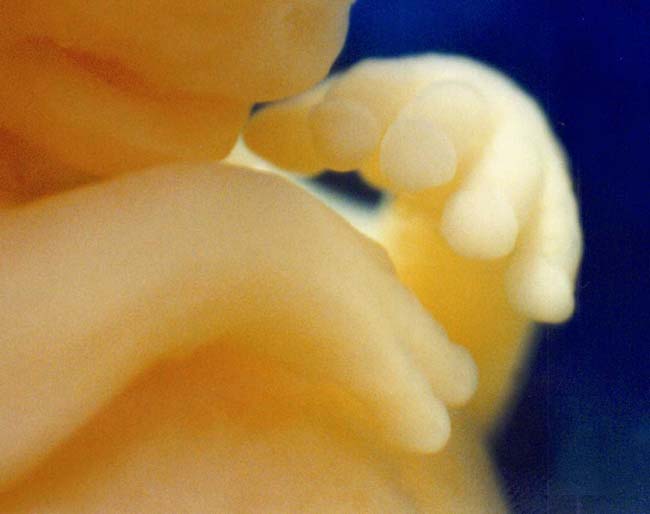
84 day old unborn baby
I also did counseling and somehow stomached the excuses women had to abort – for many it was because the baby was a girl and they wanted a boy while others it was because of a fetal defect and others because they didn’t want another child.
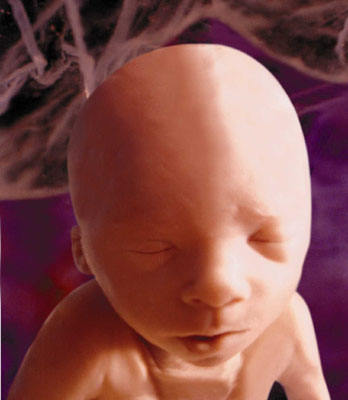
10 weeks
My conscience bothered me at times and I would secretly try to change the patient’s mind during counseling.
One woman came in who was pregnant with twins and already had another child. I just couldn’t counsel her to choose abortion and told her that there are other options. She chose to keep the twins and saw me a couple years later and told me how grateful she was for my advice and that her children were her joy.
As time went by I learned every position in the clinic and the doctor trusted me. However, he was always in a bad mood and rude to patients and employees. He referred to the larger women as cows or whales. I hated how he treated everyone and left but went back because I needed the money.
….
I tried to soothe my soul by comforting these women during their abortions or helping them with rides to the airport or bus and even had a few stay at my home because they had no extra money for hotels.
But I saw more things that made me question why I was working there. I saw the doctor increasing prices for no reason, making pregnancies look larger on the ultra sound to charge more. I saw him charge women for being overweight, on medication by a primary doctor, for having had previous C-sections, for having a tilted uterus, and many other reasons he just made up.
But even worse than lying to the women or dealing with a cranky boss was what I saw during the abortions. I was the doctor’s right hand person in the operating room and just like those employees of Dr. Gosnell, I saw the abortionist puncture the soft spot in the baby’s head or snip its neck if it was delivered alive.
22-24 weeks
She then goes on to describe how she got a flyer about ATTWN, Abby Johnson’s ministry to clinic workers, and responded to it. Read the rest of this testimony:
And Then There Were None is a pro-life group that reaches out to women and men who work in abortion clinics. They encourage them to leave, and when they do, they help them find new jobs and give them emotional support and sometimes material help.
Angie worked at a Planned Parenthood clinic that did not do abortions, but she was touched by abortion all the same. Here is excerpt from her testimony:
I was a Women’s Health Nurse Practitioner, a wife and mother of two kids in college. Heavily involved in ministry at church, I knew my husband had become distant. That led to a separation and ultimate end of our 23 year marriage. During my separation, I was led to a job at Planned Parenthood in Denton. I guess it was naive on my part, but I figured if I wasn’t working in the actual clinic that did the abortions, maybe it was an acceptable place to work.
It was there that my eyes were opened to the atrocities and the realities of abortion for the first time. It happened one day when a young women came in 20 weeks pregnant and bleeding. I examined her, listened with the monitor for the babies heartbeat, and realized it wasn’t beating. I sent her to the Emergency room where they found that the baby had died. A few days later, Planned Parenthood’s supervising Nurse Practitioner came to my office inquiring why I had used a fetal heart Doppler to allow my patient to hear her babies heartbeat. When I said it was part of the routine prenatal exam, she said “not at Planned Parenthood it isn’t!”We do not allow the patients to hear the heartbeats of their baby because it may sway their decision. When I commented that it was probably good in this instance, because the patient got to the Emergency Room where she needed to be, she questioned why I did not send her to Dallas for an abortion. I said, “You would have done a sonogram and told her that her baby was dead.” She said, “no we wouldn’t have, by the time we do the sonogram, she has already signed consent for the abortion. We don’t tell them if it is dead or alive, or twins, or triplets. It was at that point that I knew I could no longer be a party to this kind of travesty.
12 weeks sonogram
I was so shaken, I went across the street to a pregnancy resource center and told them who I was and what had happened. It was as if they already knew me. They said they thought there was a “plant” next door at Planned Parenthood, because of all the girls that had been referred there over the last few months. It was then as they prayed and cried with me, that I began to see how in spite of myself, God was using me for His purposes.
….
Several weeks later, I was in a state of despair. I had no job, no insurance, and I felt like God had abandoned me. What was my purpose? Just as I was at my lowest, I was awakened early in the morning. It was as if God were speaking audibly to me. All I could think was “Save the Babies.” I called a local pregnancy center that day and spoke to the director. It just so happened their nurse manager was ill, and not sure if she would return. I started volunteering the next week, was trained to do sonograms and hired as the nurse manager 3 months later. ….
. Now, every day I can’t wait to go to work and see who God will place in my path this day. As I watch the women and see the look on their faces as they witness the miracle of a little living, breathing, human being squirming on the sonogram, it makes me see a little bit more of His purpose for my life. They hear the little heartbeat, see the fingers, the toes, the humanness of their baby. They begin to bond and most decide to choose life. It makes me ever so grateful that God gave me a second chance. A second chance to “choose life.
When a woman has a late term abortion, the clinic will send her back to her hotel room with a “delivery bag.” It includes a red biohazard bag, gauze, towels and umbilical cord scissors. Many times the woman will deliver in her hotel room before she can make it back to the abortion facility. They then ask her to cut the umbilical cord, clean herself up and place her dead baby in the biohazard bag. She is then instructed to bring the back up to the abortion clinic so it can be destroyed.
This is abortion, guys. Please pray for conversion.
Linda Couri worked for Planned Parenthood first as a volunteer and then as an employee. she had an abortion herself before working at Planned Parenthood. An article (TIM GRAVES “From Planned Parenthood to Pro-Life” National Catholic Register Aug 24, 2011) says the following:
For Couri, her abortion at the Planned Parenthood business revealed that “there is nothing joyful about abortion. Some women are complacent, but most just bare-knuckle their way through it.”
….
“Throughout the next decade, she thought little about the abortion and her complicity in ending the life of her unborn child, “tucking it away in a comfortable, intellectual place.” Like many post-abortive women, the experience led her to get involved in pro-abortion political activism. Indeed, Couri contends that the movement to defend legal abortion is fueled by post-abortive women.
Couri became a volunteer, and later an employee, of Planned Parenthood. She worked in Champaign, Ill., about a three-hour drive from Chicago, and she presented sex-education classes in schools.
As the only mental-health professional on staff, she also counseled girls seeking abortions. But, according to Couri, she actually focused on preparing these young women for their abortions by reviewing the steps of the procedure. The counseling part of the interview mostly consisted of her asking patients: “Do you know what you’re doing?” “Is this what you want to do?”
Memories culled from those “counseling” sessions still haunt Couri. One woman, a married university professor with three children, was clearly struggling with the decision. She could have gone either way. In the end, she had the abortion, and Couri never saw her again.
nine – 10 weeks – many abortions are done at this age
Now, Couri expresses “a lot of regret when I think of her. I could have dissuaded her from having an abortion, and I didn’t.”
Truth be told, while working at there, Couri had become conflicted about the morality of abortion: She supported Roe v. Wade, but she also believed the unborn child was a human being and that abortion destroyed the child’s life.
During one counseling session with an unmarried 16-year-old, Couri offered a range of options: Keep the child and rear him herself, put the baby up for adoption, or have an abortion.
Then the girl asked, “If I have an abortion, am I killing my baby?”
Couri responded, “‘Kill’ is a strong word, and so is ‘baby.’ You’re terminating the product of conception.”
seven weeks
Couri was haunted by guilt and was uneasy about the girl’s abortion. Her questions had triggered doubt in Couri’s mind. the article goes on:
Yet, in her heart, Couri knew better, and she later shared her concerns with her supervisor.
Most Planned Parenthood staffers are women, Couri noted, and many, like her, will privately concede that they have mixed feelings about abortion:
“You can’t be a woman and not be conflicted about it.”
Her supervisor suggested that the 16-year-old’s choice for abortion would be the lesser of two evils. For Couri, the telling point was that abortion was acknowledged as an “evil.”
Couri began attending mass. Her pro-abortion friends and coworkers made fun of her. She wore her Planned Parenthood badge to church, and was still working there. When a priest who was counseling her brought up her involvement with PP, she reacted with hostility. But later, at a retreat, she decided to leave PP. Eventually, she began to suffer what she called a “nervous breakdown” and went to the church for help. When she got involved with Project Rachel, she became pro-life and is now a pro-life speaker.
Another thing that made her question her stance and eventually led to her leaving was stated in another article:
She read journals where women recorded their feelings right after abortions and was amazed that many of them were upset and said, “I’ve killed my baby.”
A woman who worked for an OBGYN who performed abortions told the following to author Cheryl Chew:
“During this time my duties involved preparing the patients for the procedure. I was instructed to counsel with them if they had any questions. If they were having an abortion, I was to reassure them about their decision by telling them that it was all right and that “they were just getting rid of a blob of tissue.”
eight-week-old unborn baby
My final duties were to clean up after the surgery. It would pain my heart and torment my soul when I would have to clean up after an abortion. There, at the end of the stirrup table, was a bin where the doctor would toss the small, crushed body parts of the fetus after he dislodged it from the mother’s womb. I could see the bloody, tiny crushed bodies with their small arms, tiny fingers, and legs that sometimes got torn away from their bodies.
Seeing this procedure done several times a day, one can become immune and numbed to the death of the fetus. In order to survive, I had to accept this aspect as just part of my job, not wanting to fully realize the consequences of what I was doing. I would go home at night and have nightmares, because I was the one who had to dispose of the little mangled and crushed bodies and place them in the incinerator.
Since these procedures were done under the veil of secrecy, there was no other way to dispose of the body parts but to burn them at the end of the day. I had to watch the doctor as he would insert the forceps into the cervix to puncture the uterus and then crush the fetus in his efforts to dislodge it from the womb. I felt so guilty when I had to collect the baby’s body parts and then burn them.”
Judy said that the doctor she worked for was a heavy drinker. He eventually died in an alcohol related car accident. It could be surmised that he was often drunk when he performed abortion procedures.
Cheryl Chew Make Me Your Choice: Compelling Personal Stories of Struggle and Healing for Those Who Have Had or Dealt with Abortion (Shippensburg, PA: Destiny Image Publishers Inc., 2006) 93 – 94
“Some former abortion clinic workers have been won over to the pro-life side because of the love they experienced from people who demonstrated against their clinics. Norma McCorvey, former lead plaintiff as Jane Roe of Roe V Wade, is one. The case of another, Judith Fetrow, is striking because she initially experienced hostility from pro-life demonstrators at the Planned Parenthood abortion clinic where she worked. On one occasion, she was so upset by her work that she decided to leave the clinic. But on her way out, demonstrators started shouting at her, “Murderer! The blood is on your hands!” Fetrow felt as though “someone had kicked me in the stomach,” so she went back to the clinic and “back to work.”
But a sidewalk counselor named Steve reached out to her, chatting with her in a friendly way. “It took some time,” Fetrow recalled, “it took enormous dedication, and it took the patience of a saint. But over several weeks we developed a friendship across the lines, based on trust.” Fetrow again left the clinic, but this time she did not return.”
Story recounted in Mary Meehan spring/summer 2000 The Ex-Abortionists: Why They Quit. Human Life Review 26 (2/3), 7 – 28, 8 and 21 in Rachel M MacNair and Stephen Zunes. Consistently Opposing Killing: from Abortion to Assisted Suicide, the Death Penalty, and War (Bloomington: Author’s Choice press, 2011) 135
“I walked into the surgical suite and headed toward the foot of the exam table. I was stopped and told to sit in a chair by the door because, they said, nearly everyone who watches the first time, can’t take it and either get sick or faint. Once you make it through one abortion, you are allowed to gradually move closer to the patient, therefore seeing more of the procedure.”
Susan Thayer, former abortion practitioner, relating her first experience watching an abortion
Jill Stanek tells her story about babies born alive after abortions:
I had been working for a year at Christ Hospital in Oak Lawn, Illinois, as a registered nurse in the Labor and Delivery Department, when I heard in report that we were aborting a second-trimester baby with Down’s syndrome. I was completely shocked. In fact, I had specifically chosen to work at Christ Hospital because it was a Christian hospital and not involved, so I thought, in abortion. It hurt so much that the very place these abortions were being committed was at a hospital named after my Lord and Savior Jesus Christ. I was further grieved to learn that the hospital’s religious affiliates, the Evangelical Lutheran Church of America and the United Church of Christ, were pro-abortion. I had no idea that any Christian denomination could be pro-abortion!
But what was most distressing was to learn of the method Christ Hospital uses to abort, called induced labor abortion, now also known as “live birth abortion.” In this particular abortion procedure doctors do not attempt to kill the baby in the uterus. The goal is simply to prematurely deliver a baby who dies during the birth process or soon afterward.
To commit induced labor abortion, a doctor or resident inserts a medication into the mother’s birth canal close to the cervix. The cervix is the opening at the bottom of the uterus that normally stays closed until a mother is about 40 weeks pregnant and ready to deliver. This medication irritates the cervix and stimulates it to open early. When this occurs, the small second or third trimester pre-term, fully formed baby falls out of the uterus, sometimes alive. By law, if an aborted baby is born alive, both birth and death certificates must be issued. Ironically, at Christ Hospital the cause of death often listed for live aborted babies is “extreme prematurity,” an acknowledgement by doctors that they have caused this death.
It is not uncommon for a live aborted baby to linger for an hour or two or even longer. At Christ Hospital one of these babies lived for almost an entire eight-hour shift. Some of the babies aborted are healthy, because Christ Hospital will also abort for life or “health” of the mother, and also for rape or incest.
In the event that an aborted baby is born alive, she or he receives “comfort care,” defined as keeping the baby warm in a blanket until s/he dies. Parents may hold the baby if they wish. If the parents do not want to hold their dying aborted baby, a staff member cares for the baby until s/he dies. If staff did does not have the time or desire to hold the baby, s/he is taken to Christ Hospital’s new Comfort Room, which is complete with a First Foto Machine if parents want professional pictures of their aborted baby, baptismal supplies, gowns, and certificates, foot printing equipment and baby bracelets for mementos, and a rocking chair. Before the Comfort Room was established, babies were taken to the Soiled Utility Room to die.
One night, a nursing co-worker was taking a Down’s syndrome baby who was aborted alive to our Soiled Utility Room because his parents did not want to hold him, and she did not have time to hold him. I could not bear the thought of this suffering child dying alone in a Soiled Utility Room, so I cradled and rocked him for the 45 minutes that he lived. He was between 21 and 22 weeks old, weighed about 1/2 pound, and was about 10 inches long. He was too weak to move very much, expending any energy he had trying to breathe. Toward the end he was so quiet that I could not tell if he was still alive. I held him up to the light to see through his chest wall whether his heart was still beating. After he was pronounced dead, we folded his little arms across his chest, wrapped him in a tiny shroud, and carried him to the hospital morgue where all of our dead patients are taken.
“I grew up the oldest of four in a loving family in the midwest. My father is a retired MD, my mother was an RN,. I grew up feeling loved, regularly attending the Presbyterian Church, collecting pets and plants. Loved living things and the outdoors. Fascinated with science. Became an RN myself, and started my career in the ICU.
Later I was a traveling nurse, so I could see some of the world. Settled for a time in Florida, had a boyfriend. That friendship ended badly, and I decided to get a fresh start in Colorado, where one of my best friends from nursing school lived. At that time, there were many nurses, but not many jobs. I saw an ad for a “Women’s Reproductive Health Clinic.” It was a day position, four days a week. Day jobs are not always easy to find for nurses, and that sounded good to me. I quickly discovered it was an abortion clinic. I did not have strong feelings about abortion at that time…my parents are quite liberal politically, and had supported Planned Parenthood with their time and money. I always felt abortion was not something I could ever do myself….but if someone else wanted/needed to…well, that was her right. So, in the clinic environment of friendly, warm, supportive female employees (with the exception of the often prickly physician) I pushed down any negative feelings I had about the “procedures” and learned how to be an abortion clinic nurse. I learned how to prepare women for procedures, set out sterile instruments, turn on suction machines. And of course, I had to always be sure the little cloth drape was around the glass bottle that held the “products of conception” after the suction abortion.
Another unfortunate staff member had the job of examining those bottles’ contents, to be sure all the parts were there and nothing was retained in the patient’s uterus. A macabre jigsaw puzzle if you will. Gradually, I learned how to assist with “late cases” which at that time were pregnancies from weeks 16-24. These were much more involved, requiring ultrasound, two days of laminaria, and removal of amniotic fluid to be replaced by concentrated urea. Then…after a few hours, the RN would listen for heart tones. We had to be certain the “heart tones” had stopped before the procedure was “completed”. I never witnessed “partial birth” abortion while I was employed there for two years. It became more and more difficult to ignore my feelings when we had particularly egregious situations, such as the young, wealthy married couples expecting twins who, after careful
16 week twind
research, determined twins would not fit their lifestyle. So they aborted their 17 week old babies. And the woman who was having abortion #5…birth control was too much bother for her. I still didn’t feel strongly against abortion, but decided to move on to other employment. Interestingly, I ended up being a nurse in a Level 3 ICU Nursery, where premature babies are cared for. I loved it there. But I am not sure the irony had hit me yet, or maybe my denial system was still to strong. Somehow along the way, I would occasionally listen to Dr. James Dobson on Christian radio. Oh, how he irritated me when he talked about the sacredness of unborn life, all life! How aggravating that was to hear! He just didn’t understand! He was a man, after all! Still…I even accompanied my sister in law, and a good friend, when they had abortions, because it was “the wrong time” for them. But gradually, our great God was turning my heart. He was melting the ice that kept me from feeling the pain and reality of abortion. I had gotten married to a wonderful man, and we had our first daughter. And not long after, I realized how indescribably precious parenthood was. It was a new, scary feeling, to discover…I was one of THEM! The Pro Life people! How strange to have your identity change. I realized that none of the arguments “for abortion” that I used to believe in had any merit at all. I felt very sad for my friends back at the clinic, who still lived in blindness.
I will be forever sorry for my participation in the abortion business. I know I am forgiven by Jesus, but the sad burden will forever be on my heart, and I am not sorry about that. I deserve to “feel” that, I do not believe “guilt” is necessarily a bad thing…and it helps motivate me to work towards a world where unborn life is treasured, and no one considers abortion to be a viable option.”
Note: Religious beliefs expressed in testimonies are not always endorsed by website owner