Free Research Paper on Abortion

Please feel free to copy and use this research paper for your own purposes. But don’t turn it in as a research paper for school, word for word, because you will be caught committing plagiarism. But you may republish or redistribute online or in print as you like.

******

Abortion: Right or Wrong?

Abortion. The very word stirs up controversy- thoughts of clashing protesters, emotional decisions, and political conflict.  Everyone has heard the slogans and sound bites.  Some people have strong beliefs about whether abortion should be available on demand. Others feel caught between the warring factions of “right to life” and “a woman’s choice.”  But what happens when we strip away the rhetoric?

There are people who have been where the news cameras never go- in the procedure rooms and pathology labs behind the closed doors of abortion clinics.  Reading what these doctors have to say is the closest we can come to truly understanding abortion.

Surgical abortion in the first trimester is done by a procedure called Suction Dilation & Curettage.  This is how Planned Parenthood, a pro-choice organization and the biggest abortion provider in the country, describes this procedure on its website:

“Either a hand-held suction device (MVA) or a suction machine (D&C) gently empties the uterus. A separate curette may be used to help remove the tissue that lines the uterus.”(1)

A uterus ‘gently emptied’ of ‘tissue.’ Who could be against such a simple procedure?  But abortion providers know that the reality is very different.

Former abortionist Dr. David Brewer witnessed his first abortion when he was in medical school. This is how he describes the experience:

“I can remember…the resident doctor sitting down, putting the tube in, and removing the contents [suctioning them into a jar]…. My job afterwards was to go and undo the jar, and to see what was inside. I didn’t have any views on abortion; I was in a training program, and this was a brand new experience…. I opened the jar and took the little piece of stockingnette stocking and opened the little bag. The resident doctor said ‘Now put it on the blue towel and check it out. We want to see if we got it all.’ I thought, ‘that’ll be exciting-hands on experience looking at tissue.’ I opened the sock up and put it on the towel, and there were parts of a person in there. I had taken anatomy… I knew what I was looking at. There was a little scapula and an arm. I saw some ribs and a chest, and a little tiny head. I saw a piece of a leg, and a tiny hand and an arm…. Well, I checked it out and there were two arms and two legs and one head and so forth, and I turned and said “I guess you got it all.’ (2)

Abortionists often re-assemble the parts of the baby to make sure nothing is left inside the woman’s body.  Any pieces left behind could cause an infection.

A medical student interning at Planned Parenthood also describes the ‘tissue’ from a ‘gently emptied’ uterus in the first trimester:

“I completely wasn’t expecting it, but there were fetal parts. Like hands. And legs. And kidneys. It was pretty shocking.  But, of course, after the initial shock, I was fine. I was actually fascinated by it. Until I saw one with a face.” (3)

When arguing against abortion, many pro-choice people point to a newly conceived fertilized ovum or a collection of cells. How could such a thing be a person? Putting aside for a moment the debate as to whether life begins at conception, it is clear that the average abortion is performed on a fetus that has advanced far beyond the “ball of cells” stage.

Sue Hertz spent a year observing at one abortion clinic. She writes:

“It was easy to shrug off an aborted pregnancy as nothing more than a sack of blood and globs of tissue- as many pro-choice activists did, if one never saw fetal remains…” (4)

She then describes these remains:

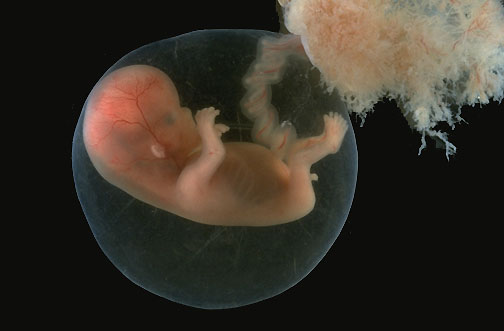
“…an eleven-week-old [aborted baby] harbored tiny arms and legs with feet and toes.  At twelve weeks, those tiny hands had tiny nails…pieces of face- a nose and mouth, or a black eye….were sometimes found in the aftermath.” (5)

Hertz also quoted abortion providers expressing frustration at the rhetoric of their pro-choice supporters. Although dedicated to providing abortions and promoting abortion rights, the clinic workers in Hertz’s book see the carnage of abortion first hand and know it is not something to take lightly.

Another doctor describes his experience:

“In my second year of residency I spent two months on a pathology rotation… and I had to come face-to-face with the contents of those sacks. We were studying the embryology of the ovary…The jumbled-up mass of tissue was easily identifiable as the torn and shredded body of a tiny human being… half of the aborted fetuses were males….” (6)

The doctor could tell the gender of the aborted child. Toward the end of the first trimester, female unborn children already have developing ovaries (and wombs) of their own.

What about later abortion? Abortions in the second trimester (and sometimes the third) are done in a variety of ways, but the most common is Dilation and Evacuation or D & E.   In this type of abortion, the doctor inserts laminaria (sticks made of a seaweed compound) into the woman’s body.  These slowly expand and open the cervix, the lower ‘neck’ of the womb.  A few hours or a day later the woman comes in for the procedure.  Planned Parenthood describes the operation as follows:

“The uterus is emptied with medical instruments and suction….”(7)

In reality, an abortionist uses forceps to literally tear the child apart.  A D&E is described in The American Journal of Obstetrics and Gynecology:

“Of the various ways to perform an abortion after the midpoint of pregnancy, there is only one that never, ever results in live births….However, it is particularly stressful to medical personnel. That is because D&E requires literally cutting the fetus from the womb and, then, reassembling the parts, or at least keeping them all in view, to assure that the abortion is complete…”(8)

A doctor describes a D&E in plainer terms:

“You are doing a destructive process.  Arms, legs, chests come out in the forceps. It’s not a sight for everybody.”(9)

Author Peter Korn, in his book Lovejoy: A Year in the Life of an Abortion Clinic, describes a D&E this way:

“Still holding the forceps, [abortionist] Lane begins pulling, tearing apart the fetus. The first three tugs yield indistinguishable tissue. The fourth brings out more solid mass, which [clinic worker] Anneke, from her position in the back of the small room, immediately recognizes as the trunk of a fetus…. Tiny hands and feet, extracted next, are the most recognizable…. The pieces of the fetus and the placenta are placed by Lane on a surgical tray at his side.”  (10)

These ‘fetuses’ are in fact babies that are fully-formed when they are dismembered.

The carnage of a D & E takes an emotional toll on providers and horrifies observers. Many pro-lifers believe that if a television station would show the procedure (preferably at a time when children are unlikely to be watching television) people would flock to the pro-life movement in droves.

One observer describes a D&E:

“Time after time, the resident plunged the Bierer [forceps] into the woman’s womb, removing a leg, then an arm, then the liver, then the placenta, which the doctor ranted about, because this can make the fetal head extraction more difficult. The last step that I saw was the collapse of the skull and the removal of the brain matter.”(11)

And author B.D. Colen describes a D&E abortion he witnessed this way:

“After dilating, or opening, the cervix, the physician used a curette, the gynecological version of a sharpened spoon, to cut the fetus into pieces he would then remove with forceps. A large petri dish sat on an instrument stand to the right of the girl’s feet…from time to time during the procedure the physician would tap his forceps on the edge of the dish – and into the muck would drop a foot, or a hand, or a piece of rib cage.”(12)

He then goes on to say:

“Having seen what I saw, I cannot for a moment abide the disingenuousness of those who argue that a fetus is not human, or those who convince themselves that abortion is not killing…”(13)

Clinic workers are also often troubled by what they see.

In her book “Abortion at Work: Ideology and Practice in a Feminist Clinic” pro-choice author Wendy Simonds devotes a chapter to the emotional impact of abortion work on providers. A clinic worker is quoted explaining why abortions in the second trimester are so difficult to cope with:

“Because it looks like a baby. That’s what it looks like to me. You’ve never seen anything else that looks like that. The only other thing you’ve ever seen is a baby…You can see a face and hands and ears and eyes and, you know…feet and toes…(14)

Second trimester Dilation and Evacuation abortions are protected under Roe V. Wade. They cannot be restricted in any state for any reason.  Why do women have abortions this late in pregnancy?  According to the CDC, most women who have abortions at this stage are healthy mothers with healthy babies.  In fact, less than ten percent of all second trimester abortions are performed on infants who are not healthy. (15) So what are the reasons?  Some may be women who didn’t realize they were pregnant or who were unable to decide what to do about their pregnancies. Another group includes young women and teenagers who were able to deny and/or hide their pregnancies until they began to show. (16)

The Alan Guttmacher Institute, a research organization founded by Planned Parenthood, conducted a study of women having abortions at various times in pregnancy.

The most common reasons are:

21% Woman can’t afford the baby

21% Unready for the responsibility

16% Concerned about how having a baby would affect their lives

Only 1% of abortions were done because the woman was a victim of rape or incest and only 6% were influenced by health concerns. (17)

Third trimester abortions account for only a small percentage of abortions performed in the United States. However, there are over 3500 abortions a day, and as many as 8,000 abortions in the third trimester in any given year.   Most people are not aware that women can get an abortion in the third trimester for almost any reason. Roe Vs. Wade did stipulate that states could ban third trimester abortions unless a woman’s health was endangered by her pregnancy. However, in the Supreme Court case Doe Vs. Bolton, the concept of “health” was defined so broadly that it allows for almost any abortion. All a woman has to do is complete paperwork asserting that the abortion is detrimental to her mental  health and she can have a late abortion in any state in the country.

Abortions at any stage take a toll on everyone involved- the mother, the father, the clinic workers, and the doctor.  For example, one abortionist from Planned Parenthood discusses his ambivalence:

“This can burn you out very, very quickly…not so much by the physical labor as the emotional part of what’s going on. When you do an ultrasound, particularly if you have children, and you see a fetus there, kicking, moving, living, doing things that your own child does, bringing its thumb to its mouth, and things like that- it’s difficult. Then, after the procedure, sometimes we have to actually look at the specimen, and you see arms and legs and things like that torn off…It does take an emotional toll.”(18)

Faced with the reality of abortion, some doctors harden their hearts.  As one abortionist is quoted saying:

“Abortions are very draining, exhausting, and heartrending….I’ve done a couple thousand … The only way I can do an abortion is to consider only the woman as my patient and block out the baby…”(19)

Others confront the evil of abortion and quit.  Some of these doctors have become powerful voices in the pro-life movement.  Dr. Paul E. Jarrett, Jr, stopped doing abortions. The turning point came when he began one abortion with suction, then switched to forceps after the baby’s foot became caught in the instruments:

“And as I brought out the rib cage, I looked and saw a tiny, beating heart. And when I found the head of the baby, I looked squarely into the face of another human being- a human being that I had just killed. I turned to the scrub nurse and said, “I’m sorry.” But I just knew that I couldn’t be part of abortion any more.(20)

When you began reading this article, you may not have known the reality of abortion.  Now you do.  What choice will you make? Will you harden your heart? Or will you resolve to oppose the killing of these babies?  All people- abortionists, activists, ordinary people, you and I- may one day be held accountable for the choices we have made.  What will you do?

For more quotes from abortion providers go to http://www.clinicquotes.com

Notes

1.  Planned Parenthood Website

2.  David Kuperlian and Mark Masters, “Pro-Choice 1990: Skeletons in the Closet” New Dimensions Magazine October 1990

3.  From the blog “Never a Straight Answer” Thursday Jul 7, 2005 Entry: “I Love Uteri”http://gdeuce13.blogspot.com/2005/07/i-love-uteri.html

4.  Sue Hertz Caught in the Crossfire: A Year on Abortion’s Front Line ( New York,: Prentice Hall Press, 1991)  104

5.  Ibid.

6.  Speech by Dr. McArthur Hill at “Meet the Abortion Providers” Convention. Can be found at http://www.priestsforlife.org/testimony/hill.htm

7.  Planned Parenthood Website

8.  The American Journal of Obstetrics and Gynecology 1976 Sept 1, 126(1) 83-90.

9.  Dr. William Thompson, quoted in Liz Jeffries and Rick Edmonds “Abortion: The Dreaded Complication”The Philadelphia Inquirer, Aug. 2, 1981.

10.  Peter Korn. Lovejoy: A Year in the Life of an Abortion Clinic (New York: Atlantic Monthly Press, 1996)  235-236

11.  Margaret A. Woodbury, “A Doctor’s Right to Choose” Salon Magazine July 24, 2002

12.  D. Colen “A High, But Necessary, Toll” Newsday May 12, 1992

13.  Ibid.

14.  Wendy Simonds Abortion at Work: Ideology and Practice in a Feminist Clinic (New Brunswick, NJ: Rutgers University Press, 1996) p 88

15.  Dena Kleiman. “When Abortion Becomes Birth: A Dilemma of Medical Ethics Shaken by New Advances”New York Times Feb 15, 1984

16.  Ibid.

17.  “Reasons Why Women Have Induced Abortions: Evidence from 27 Countries” Family Planning Perspectives, Vol. 24 (August 1998). The Alan Guttmacher Institute, “U.S. Women Who Obtain Abortions: Who and Why?” Family Planning Perspectives, Vol. 4, (July/August 1988).

18.  Abortionist Dr. Ed Jones (pseudonym) Nancy Dey. Abortion: Debating the Issue (New York: Enslow Publishing, 1995) 49

19.  John Pekkanen. M.D.: Doctors Talk About Themselves (New York: Delcorte Press, 1988) 90-91

20.  Nat Hentoff. “A Pro-Life Atheist Civil Libertarian” Free Inquiry Vol 21, Issue 4, Fall 2001, 16


Share on Facebook
In preantibiotic era, legal abortion was no safer than birth

“In the pre-antibiotic era prior to World War II, sepsis was the principal cause of maternal mortality.  Even during this period, hospitals which did not perform abortions had maternal mortality rates that were no higher than other institutions where so-called “therapeutic abortion” was practiced.”

Professor of Medicine Dr. Eugene F. Diamond. According to Diamond, the situation is the same today, even with modern antibiotics, lending credence to the belief that abortion is not, in fact, safer than giving birth. (Read about some of the complications of abortion, Physical and emotional.)

Judie Brown “The Facts about Abortion: The Life Guide Volume 3 (Stafford, Virginia: American Life League, Inc., 1998) 36 to 37

Of course, now most abortions (over 90%) are performed in clinics. But 40 years before Roe versus Wade, when abortion was extremely restricted but still available in some cases, hospitals that legally performed them had death rates comparable to hospitals that only handled births. Both birth and abortion carried the same risk in this time period. Abortion did not save lives, even when performed legally.

Share on Facebook

Female infanticide in India takes horrible toll

Author Miriam Jordan described this state of affairs in India in a 2000 article:

“In poor and backward places such as Bihar, however, where sonograms are still a rarity, it’s cheaper to kill a newborn girl that to travel to a city and pay for a gender test and an abortion. And Bihar’s gender rate is among the most lopsided in the country. The 1991 census in Bihar showed 912 women for every thousand men, down from 1054 women in 1901. In the district where Dewa is located, the ratio in 1991 was 819 women to 1000 men.

In some pockets of Bihar and  Rajasthan, another poor state, the female to male ratio is a meager 600 to 1000. Last August, one village in Rajasthan witnessed its first Hindu wedding procession to a bride’s home in 110 years, because no other girl had been allowed to survive.

Miriam Jordan “Brief Lives” Wall Street Journal, May 9, 2000

Share on Facebook

Pro-choice activist laments pro-life “public opinion” victory

Lynn Paltrow, executive director of National Advocates for Pregnant Women [a project of the pro-abortion Women’s Law Center] described how the pro-choice side has been lacking passionate activists for their cause.

“There’s no radical left anymore screaming, `Free abortions on demand!'” The anti-abortion right scored its first public-opinion grab in 1995, with the bold war over so-called “partial-birth abortion.”

Sharon Lerner “A New Kind of Abortion War”, The Village Voice 12/26/2001

Share on Facebook

Sidewalk counselors from Catholics United for Life save lives

An article appeared in The Fresno Bee about Catholics United for life, and pro-life sidewalk counselors, that describes some of the women that were helped.

9-10 wkd
9-10 wkd

“Martha, twenty-one, an unmarried mother of four children (ages five, two, one, and three months). She met the sidewalk counselors as they she [sic] entered a clinic, on her way to abort her fourth baby. Unemployed and on welfare, Martha said she didn’t think she could “handle” another child.

But, she explained, “Molly [a sidewalk counselor] came up and she told me if God didn’t think I could handle another, He wouldn’t give it to me.”

Martha decided against an abortion, but she needed help. She and her children were sleeping on the floor of her sister’s house. She said Catholics United for life gave her family a place to live. It paid the first months’ rent, in addition to purchasing furniture and food.”

And another woman:

14-week-old baby,
14-week-old baby,

“Mary, twenty-four, unmarried, living in California with her brother, had a well-to-do family back home in Latin America. Her brother suggested an abortion because an illegitimate child born to another member of the family had caused major problems.

At the abortion clinic, the sidewalk counselors assured Mary that they would help her with medical care and living expenses if she went through with her pregnancy. Mary and her brother, who had accompanied her to the clinic, both agreed for her to continue with the pregnancy.

Mary said she was relieved. “When I left the house, I didn’t really want to do it. I asked God if I’m not supposed to do it, show me – and that’s when I met these guys [the sidewalk counselors.]”

A third woman. These were all at the same clinic

“Deborah, twenty-seven, married, mother of four children (ages six, four, one, and two weeks) Deborah said her husband didn’t always provide money for the family to live on, necessitating her to work in the fields. The news that a fourth baby was on the way posed a major problem. “When you’re pregnant, they won’t give you a job anymore,” she explained.

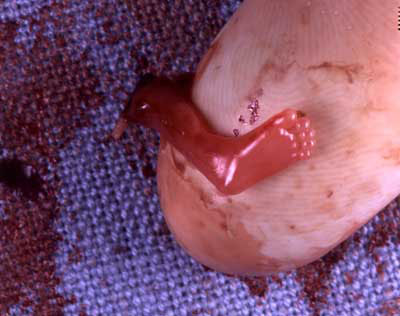
Foot of an aborted baby at 9 weeks.

At the abortion clinic, Deborah said the counselors from Catholics United for life, showed her pictures of aborted fetuses….“I was of the belief that a baby is unformed until three months, that before that it was a little ball. But they explained that it was formed from the beginning.”

Catholics United for life gave Deborah financial help.

“Pro-Life Counselors, Pound the Pavement to Dissuade Abortion” The Fresno Bee, Sunday, January 23, 1983

Sidewalk counselors save lives every day. These babies are now in their late teens or twenties. Some may even have children of their own. The good pro-lifers do lasts generations.

Share on Facebook

A terrible scene of postabortion women in China

Representative Chris Smith told the following story at the Hearing before the Subcommittee on Africa, Global Health, and Human Rights of the Committee on Foreign Affairs, House of Representatives, 112th Congress, First Session. September 22, 2011:

“Over the years, I have chaired 29 Congressional human rights hearings focused in whole or in part on China’s one child per couple policy. At one, the principal witness, Wuijan, a Chinese student attending a US university, testified how her child was forcibly murdered by the government. She said, and I quote in part:

“The room was full of moms who had just gone through a forced abortion. Some moms were crying. Some moms were mourning. Some moms were screaming. And one mom was rolling on the floor with unbearable pain.”

Then Wuijan said it was her turn, and through her tears, she described what she called her “journey in hell.”

Read one Chinese woman’s testimony about the 5 abortion she was forced to have here.

Share on Facebook

One pro-life activist successfully thwarts abortion clinic

In 1997, a friendNick Frankovitch, sent me this email:

“A woman from the Bronx used to come down to the upper West side on Saturdays to demonstrate in front of the abortion clinic near Lincoln Center. She drew a small following over time. They would carry the usual signs (e.g., Abortion Kills Children). They weren’t particularly Gandhi like, but they weren’t particularly vicious either. From all descriptions, the woman from the Bronx seemed to be an unpretentious, working-class Hispanic woman who had strong feelings about unborn children.

The landlord of the building in which the clinic was located began to receive complaints from neighbors – tenants and other merchants (it’s a very toney, high rent neighborhood) so he elected not to renew the clinic’s lease. The clinic sued for discrimination. They lost. Then the clinic went all over the Upper West Side looking for a space. No landlord would rent to them. Representatives of the clinic claimed that at meetings with prospective landlords and community leaders everyone would be sporting their pro-choice buttons and voicing their strong support for the work the clinic was doing. Then they would vote against renting space to the clinic on their block. I believe the clinic then ended up working out of space in a Planned Parenthood clinic further downtown (although as of last fall they began running ads in the Columbia student newspaper, I believe the new address is on the Upper West Side again.)

The significance of this story, as a local weekly newspaper pointed out issue after issue, was that it was happening in a neighborhood where virtually everyone and their dog was pro-choice. The newspaper articles emphasized complaints that these upper West sider’s were hypocritical and weak kneed, caving in to fears of lower property values, etc. I wrote a letter to the editor pointing out that the story also points to the ambivalence beneath all the official pro-choice rhetoric. Most people who think abortion should be legal agree with the woman from the Bronx that it’s a sad thing, and they would rather the abortion clinic be far enough away that they don’t always have to be thinking about what takes place there.

So one person, acting under conviction, was able to close the clinic (at least temporarily) almost single-handedly, just by standing in front of it and speaking plainly about abortion. And just as important, her action had the effect of bringing to light the demonstrations against abortion that even people who call themselves pro-choice carry on silently in the back of their mind.

Never underestimate what one person can do. 


Share on Facebook

Abortion Survivor: I Was Born in a Bedpan

An article in HLI reports (the newsletter of Human Life International, a Catholic pro-life group) held a conference for people who survived abortions – not the women – but the babies, who were born after an unsuccessful abortion attempt. Some quotes from the article:

Joshua Vanderveden
Joshua Vanderveden

“We weren’t given alternatives. Nobody offered me any choices,” said Linda Noie whose son Joshua Vandervelden survived her attempt to have him aborted 13 years ago. Linda and Joshua told the media and conference attendees how they now live next door to, and picket at, the abortion mill where Linda underwent an abortion procedure.

Joshua was asked by a reporter what his reaction was to the pro-abortionists’ criticism that he was being exploited. “I’m glad to be alive,” he replied.…

Pat Case of Southern California described how her mother tried three times to abort her. Not aware of this fact, Pat struggled for years with low self-esteem, at one point attempting suicide. During her period of recovery, she learned of her mother’s attempts to abort her – and the reason for her poor self-image.

While it may be a stretch to connect the unknown abortion attempt with Case’s psychological problems, brothers and sisters of aborted babies have reported suffering similar emotional trauma.

Marilyn Miller’s mother tried to abort her in the seventh month of pregnancy, but the attempt failed. “I was born in a bedpan,” she told the Canadian media. Now 43, Marilyn is a behavior modification specialist from Pennsylvania who has two teenage children of her own.…

A favorite of the media and conference goers was Lauren Pulliam, a beautiful, charismatic and highly kinetic 17-month-old charmer from the Houston, Texas area. Lauren’s grandmother, Patricia – a counselor at Birthright – described her daughter Kristin’s abortion procedure after receiving “counseling” at a Planned Parenthood abortuary. When the abortion failed, Christa became fiercely determined to keep her baby.”

Vernon Kirby “Abortion Survivors Take Center Stage” HLI Reports June 1992

There were other abortion survivors from different countries such as Czechoslovakia, Hungary, and Columbia.

Read more about survivors of abortion procedures here.


Share on Facebook

Book Review: Life Choices: The Teachings of Abortion

Even though I’m pro-life, I read pro-choice books to get another perspective and to learn as much about the issue as possible.I don’t have a lot of qualms about giving a bad review to this one. The book was basically New Age mumbo-jumbo. It was written by a clinic worker who tries to present abortion as being a holy experience that allows a woman to learn about herself and experience the spiritual power of pregnancy. The book was full of long passages of New Age rhetoric that didn’t make a whole lot of sense:

“The soul energies we contact around some pregnancies might be coming in to help women learn how to make choices. With regard to the continuum between nonphysical and physical life, they could probably go either way. Does this sound like a self-serving rationalization to assuage guilty feelings? Perhaps, but I think not. If anything, thinking about the spiritual life of pregnancy allows women to face difficult feelings like fear and guilt while embracing gentler possibilities. As we learn to care for and respect ourselves, we become capable of bringing life through our bodies that is a promise of being loved and cared for the physical world.”

Despite her pro-choice bias, the author lets slip a few times that she knows that abortion is killing:

“The choice to allow death to occur through abortion is an expression of women’s creative life-giving power in action.… For most women choosing to have an abortion is a loving, caring act… It is our sense of responsibility for life that usually plays a central role in decision-making about pregnancy.”

Yeah, killing the baby really is a loving and caring act.

9 week, first trimester when most abortions take place

She also admits that abortion is hard for many women:

“Consciously controlling the process of pregnancy and deciding to turn back pregnancy often produces a mix of feelings, which includes sadness and loss.… The arrival of the menstrual period during the 1st few months after an abortion reminds a woman that she is no longer pregnant. For some women this is a cause for celebration. For others it precipitates a drop into sadness, and is a painful reminder of the loss of the pregnancy… If the feeling of emptiness goes on for a long time, a woman might become at risk for depression.”

Really, the book seem to be the clinic worker’s attempt to sugarcoat abortion and make it out to be a profound spiritual experience (?) that benefits women when the reality is something far different.

Share on Facebook

Disappearing Daughters by Gita Aravamudan: A Review

Very, very powerful. So much information, so much heart rending information. It really illustrates how bad the situation is in India. I like the fact that the person who wrote this did so much research, interviewing so many people who were involved in sex selection abortion. It also touches on infanticide and the history of infanticide in India. The discovery she makes is surprising – that sex selection abortions are commonest among the most educated women and men. She also went into the consequences of having a society that is skewed with more men than women, with men unable to find wives. It talked about polyandry, and about villages buying brides and then treating them as slaves and son producing machines. I am very glad that this author wrote this book, with so much information, but I’m not sure what to do about the problem.

Share on Facebook