‘I dream about it…the abortions affect me personally. I know some day I will deliver and think of that. It’s changed my ideas.’
Second Trimester Abortion: Perspectives After a Decade of Experience (Berger, Brenner, Keith, eds, Martinus Nijhoff Publishers, 1981), in the chapter “Psychological Impact on Patients and Staff,” p. 245.
In London, about 3,000 abortions a year are carried out between 20 and 24 weeks. Doctors have argued that abortions should not be performed this late:
“There is an ethical problem that baby A can be terminated at 24 weeks’ gestation in one unit while baby B in a different unit, who was accidentally born before 24 weeks, may survive.”
Andrew Rowland, a trainee paediatrician
24 weeks
Part of the push to lower the abortion limit was the new ultrasound technology which could produce images like this one, taken at 24 weeks:
But other doctors disagree about lowering the legal limit for abortions. Retired obstetrician Wendy Savage said of the pictures:
20 weeks
“What we have seen are advancements in imaging. This may have raised emotions but they are not scientific evidence of the foetus developing any more rapidly.”
REBECCA SMITH BMA votes to keep the abortion limit; DOCTORS REJECT CALLS TO TIGHTEN 24-WEEK LAW. The Evening Standard (London, England) June 30, 2005
“I have been in the same unfortunate position as the nurses in the story…doing everything medically possible to save a one baby while monitoring 2-3 aborted babies that are only 2 weeks younger, waiting up to 8 hours for them to die. It is heart-breaking and you keep asking yourself why.”
Sarah Terzo “Babies born alive after abortions, part 3: nurses tell their stories”Live Action April 12, 2013
Many people are not aware that abortions in the late second and third trimester are legal, much less that they occur often. Read more about late term abortion in this section. Most late term abortions are done for elective, not medical, reasons.
Pro-choice feminist Wendy Simonds interviewed clinic workers who talked about how they felt when their clinic started performing abortions up to 26 weeks.
From one clinic worker:
“… We were so excited that women who were 26 weeks could get an abortion at our clinic and not have to go to Pavilion for a saline induction… But we were also extremely sensitive to what the increasing gestation was going to do to us as human beings… We’re just not hardened to the fact that abortion is hard. The women… are going to be in more pain… The abortions are going to be longer. The assistant is going to have to watch a much, you know, further abortion. And there’s a marked difference between 26 weeks and 21 weeks in terms of fetal development… We had [meetings] where we talked about our feelings… We talked about the ambivalence about wanting to provide this service and being really excited about it and being really nervous about handling the tissue.”
26 weeks
From another:
“so I felt like the women were getting a good procedure. And then I also felt… Thank God that were doing this!… I’m glad we’re doing it.”
Picture of an abortion around 26 weeks
A third clinic worker:
“I like that we go up to 26 weeks. For a while it kind of gave me some things to learn… Plus it gives a whole new dimension to working with those women who come in for later abortions. It’s, like, great because they almost can’t have an abortion. They’re almost about to have a baby, and they don’t want to. And they’re really appreciative.”
Wendy Simonds. Abortion at Work: Ideology and Practice in a Feminist Clinic (New Brunswick, New Jersey: Rutgers University Press, 1996) 62, 63
24 week abortion- two weeks before the cut off of when this clinic performs them
Pro-life writer Rachel McNair recounted the following:
“During a phone in radio interview a woman who underwent an abortion several years earlier insisted that she had made the right decision. Yet the pain in her voice was so obvious that I made reference to it without the remotest fear that there was anyone in the audience who would not [perceive] it. It was not just her tone of voice; she referred to the incident as “two hours of pain and humiliation.”
Rachel MacNair”Is Abortion Good for Women” Angela Kennedy , editor “Swimming Against the Tide: Feminist Dissent on the Issue of Abortion” (Dublin Ireland: Four Courts Press, 1997) 79 – 80
From an article that described questions and uncertainties abortion providers had about their jobs:
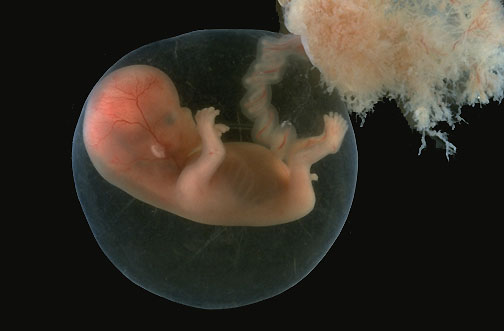
13 weeks
“Patients also sometimes ask to view the fetal remains. A Toronto physician said she didn’t know “how and whether we [should] protect the patient from the reality of the procedure.” She said she regularly hid the ultrasound screen and “whisked away” the “fetal products.” “She’s probably not prepared for what she is going to see,” she said of the patient.”
Diane M. Gianelli “Abortion Providers Share Inner Conflicts” American Medical News, 12 July 1999
see pictures of what the remains of abortions look like
Shane Krouse, MSU sophomore and State News columnist:
“If anything, a fetus is merely a parasitical creature that uses the mother as its host. Tapeworms are parasites that house themselves in the intestinal tracts of humans, feeding off the food the host consumes. Comparatively, a fetus is little more than a tapeworm. It is quite common for humans to annihilate parasites with medications or toxins, so why not allow for fetuses to suffer the same fate?”
MSU State News:Wad of cells does not equate to human life, abortion isn’t murder:7-26-2006