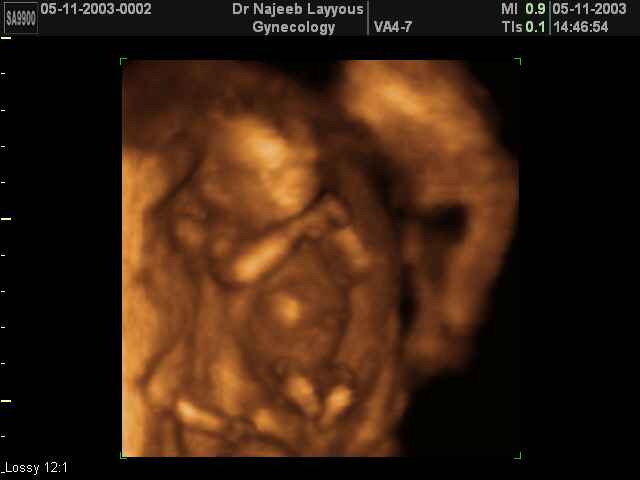
Stuart Campell, a former abortionist who developed 3-D ultrasound, describe the impact that seeing the unborn baby on the ultrasound screen had for him:
“I think you’re programmed into just doing it as a job. The doctor is not around to see the baby being expelled. My job was to inject the foetus’s heart. You’ve got a hundred other things to do that day so you just go ahead and do it. But with the traditional 2-D scanning I think you are less connected with the reality of what you’re doing than you would be with these new techniques.”
Eve Gartner, a lawyer arguing for Medicaid coverage for abortions:
“My impression is that people don’t really understand the fact that they will save more money by funding all Medicaid abortions than just paying for life-threatening cases. Twenty-five percent of those people who might have Medicaid-funded abortions have children instead…and then people are paying for pre-natal care, childbirth and probably public assistance for the child.”
Phil Greenberg (Life is a Poor Investment July 31, 1994) “To Life: A Collection of Editorials & Columns on Abortion, Life, and Choice” (Little Rock, Arkansas: The Arkansas Democrat Gazette, 1999) 73
Should the amount of money taxpayers can save determine the value of human lives?
“Justice Anthony M. Kennedy wrote some witnesses report “seeing the body of the fetus moving outside the woman’s body. At this point, the abortion procedure has the appearance of a live birth.”
“Reason To Shudder” By Richard Cohen “The Washington Post” Tues, Jul 4, 2000 A19
24 weeks, partial birth abortions were done around this timeShare on Facebook
Saline abortion were commonly done in the 1970s, 80s and early 90s. In these abortions, the abortionist injects a caustic saline solution in to the mother’s uterus. The saline solution burns the baby’s skin and poisons him over the course of several hours, and the woman then goes through labor to “give birth” to a dead child.
When these abortions were performed, doctors could inject the solution and then leave nurses to handle the actual “birth” and removal of the dead baby.
According to one doctor who did these types of abortions:
“If the abortion is well done, we don’t have to watch the baby die. So we inject a salt solution.”
Russell Sacco, abortion doctor,
“Infants Aborted Alive: Officials Wink at Laws” The Oregon Journal (March 14, 1982).
Note the use of the word “baby.” this doctor knows that abortion kills babies
Saline abortions were generally done in the second and early third trimester. Abortions are still done at this time, but usually by different methods.
“Is there an honest way to be antiabortion?… To me, no, there’s not. It’s like, is there an honest way to be anti – Semitic? Is there an honest way to be racist? There’s not. And, to me, abortion is one of those fundamental things in the same league.”
Wendy Simonds. Abortion at Work: Ideology and Practice in a Feminist Clinic (New Brunswick, New Jersey: Rutgers University Press, 1996) 111
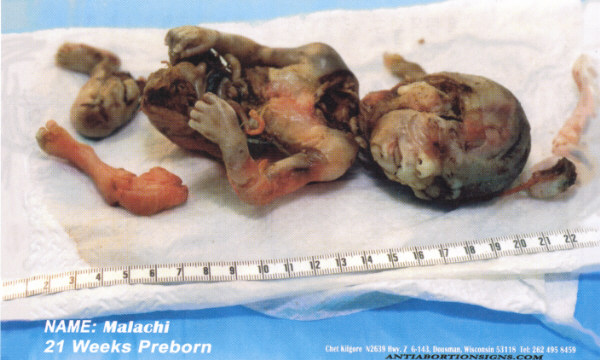
Yvette works in the clinic that does abortions up to 26 weeks. Below is a picture of an abortion at 21 weeks:
Is opposing the death of babies like this equal to racism and anti-Semitism?
“I am an atheist and a rationalist…Abortion is a traumatic life event; that is, it involves loss, it involves grief, it involves difficulties. And the trauma may, in fact, predispose people to having mental illness.”
Professor David M. Fergusson, Christchurch Health and Development Study, commenting on research he directed, interviewed on Australian Broadcasting Corporation (March 1, 2006).
“Soon after voluntary abortion became a legal reality, some authorities observed an unanticipated, strong emotional reaction by the staff. … Nurses found physical contact with the fetus particularly difficult; it reminded them of the ‘preemies’ just down the hall and made them uncomfortable as they thought about their own potential future pregnancies.”
Second Trimester Abortion: Perspectives After a Decade of Experience (Berger, Brenner, Keith, eds, Martinus Nijhoff Publishers, 1981), in the chapter “Psychological Impact on Patients and Staff,” p. 242, 245.
“And scattered throughout, in cabinets, in the basement, in a freezer, in jars and bags and plastic jugs, were fetal remains. It was a baby charnel house.” –
on abortionist Kermit Gosnell, Report of the Grand Jury, Court of Common Pleas, First Judicial District of Pennsylvania, Criminal Trial Division, MISC. NO. 0009901-2008, January 14, 2011, p. 2