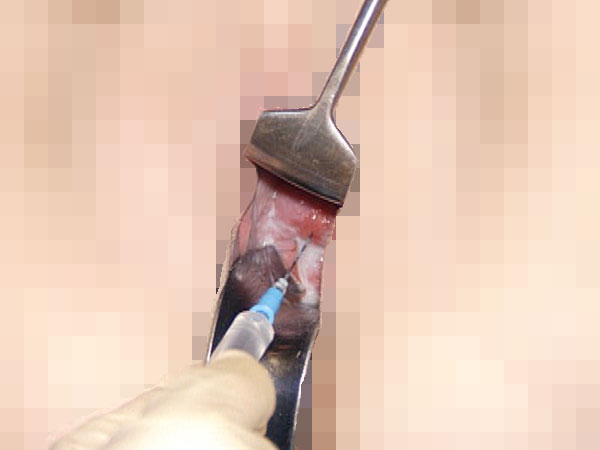
At 4-5 weeks, abortion can be done either by pill or by suction aspiration. You can learn more about abortions by pill here. This page deals with abortions by surgery. Abortions by suction are the usual type of surgical procedure at this time in pregnancy. They are done by first dilating a woman’s cervix , then injecting anesthetic into a woman’s vagina with a needle, then inserting a suction cannula and sucking out the embryo and placenta. then the uterus is scraped to remove any leftover material. Abortion providers call these the “products of conception.” The suction cannula either pulls apart the developing embryo or sucks it out whole, and it dies in the bottle of blood from the abortion.
The risks of an abortion at 4-5 weeks are the same as the risks of an abortion done later in the first trimester.
— Infection
— Damage to the cervix which can lead to later miscarriage
___ Scar tissue in the womb which can prevent a future pregnancy from implanting
—- perforation (cutting) of the uterine wall or cervix which may be mild or severe
—- Depression or guilt stemming from the abortion
See info from studies on abortion’s physical risks and psychological risks here.
An ultrasound is recommended to check whether you have a potentially fatal condition called an ectopic pregnancy. In this type of pregnancy, the baby forms in the fallopian tubes. If you have this condition and you have an abortion, the embryo won’t be removed. Instead, the embryo will continue developing in the tube, which will eventually rupture. This can cause fatal hemorrhaging.
The only way to rule out an ectopic pregnancy is through an ultrasound. If the abortion clinic you call does not provide ultrasounds before their abortions, consider going elsewhere. One place we you can get a free ultrasound is a crisis pregnancy center. Remember, if the abortion clinic does do ultrasounds before abortion, the clinic will charge you, whereas an ultrasound at a crisis pregnancy center is free. You can locate a center here.
These centers are staffed by volunteers who deal with women who have difficult pregnancies and are considering abortion. Some centers, such as CareNet, (US) are religiously affiliated. Birthright centers (international) are not. Either type of center will give you information about abortion either by pill or by surgery, information you may not get in the abortion clinic. Keep in mind that abortion clinics are only in existence because they sell abortions. Even if the staff there is well-meaning, they can only stay in business if they make enough profit. At Planned Parenthood, abortion accounts for one third of their annual income. Freestanding abortion clinics depend on selling abortions in order to stay open. Their doctors and managers get a high salary from abortions. In a way, going to an abortion clinic for advice is like asking a Subaro dealer if you should buy a Subaro or a Ford. Most likely, they will present abortion in a positive light. Sometimes it’s best to get as many perspectives as you can, which is why go to a crisis pregnancy center can be a good option to consider. Crisis pregnancy centers are staffed by volunteers. All of their services are free. They are charities that depend on donations from supporters, not money from those who go there. Therefore, they have no financial interest in the decision you make. Some pro-choice activists have said that pregnancy centers are set up to dissuade women from having abortions. This is only partly true. The women at these clinics are volunteers and some of them do have an anti-abortion mindset. Yet they will respect your decision. Going to a pregnancy centers does not mean you can’t have an abortion later. No one can prevent you from having an abortion if you choose to do so.
The embryo
This is a picture of an embryo at 5 weeks

It is just beginning to take on a human form.
Below is a picture of an embryo at 4 weeks. You can see the developing spine.

Here is some information about how developed these embryos are. This fetal development timeline traces the growth of an embryo from conception onwards.
Day 20 (less than one month): Foundations of the brain, spinal cord, and nervous system are already established
Day 21: The heart begins to beat
Day 28 (4 weeks old) The back bone and muscles are forming. Arms, legs, eyes and ears have begun to show.
Day 30: At 1 month (4 weeks) old , the embryo is 10,000 times larger than the original fertilized egg – and developing rapidly. The heart is pumping increasing quantities of blood through the circulatory system. The placenta forms a unique barrier that keeps the mother’s blood separate while allowing food and oxygen to pass through to the embryo.
Day 35 (5 weeks):5 Fingers can be discerned on the hand. The eyes darken as pigment is produced.
Day 40 (end of 5th week): Brain waves can be detected and recorded

Just because the baby does not look fully human does not mean that it isn’t one. As a matter of fact, referring to the embryo as “it” is inaccurate- sex is determined at conception. Therefore an embryo is already male or female. he or she may not look like a full term baby, but neither does a full term baby look like an adult. As we go through life, our appearance changes.
The decision to have an abortion is ultimately up to you. But keep in mind that abortion destroys a life that has already begun. It stops a heart from beating. It destroys a developing body, the body of the baby. And it can be damaging to your life and health. Even though deaths from surgical abortions this early are extremely rare, an infection can still be serious. Abortions by pill have caused over 14 deaths in the US alone.
Below is a picture of anesthesia being injected after dilation of the cervix. The woman’s legs are blurred out.
if you are pregnant and would like to talk, email me here sarath5775@gmail.com
Share on Facebook