Pro-Choice medical professional Urges the Use of Anesthesia for Babies Being Aborted

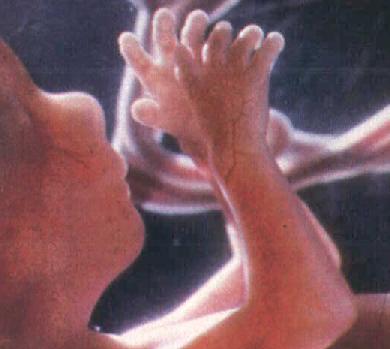
Unborn babies may feel pain beginning with the seventeenth week of gestation suggests Professor Vivette Glover of the Queen Charlotte’s and Chelsea Hospital in London, UK:

Professor Glover supports legalized abortion, but she asserts that

“one should not muddle the two. One should think about how one is doing [the abortion] in the most pain-free way.”

Professor Glover goes on to say:

“Between 17 and 26 [weeks] it is increasingly possible that it [the unborn baby] starts to feel something and that abortions done in that period ought to use anaesthesia.”

London Telegraph, August 28, 2000

Share on Facebook

National Right to Life Quotes Neurologist On Fetal Pain

“At 20 weeks, the fetal brain has the full complement of brain cells present in adulthood, ready and waiting to receive pain signals from the body, and their electrical activity can be be recorded by standard electroencephalography (EEG)”

– Dr. Paul Ranalli, neurologist, University of Toronto

“Pain of the Unborn: What does an Unborn Child Feel during an abortion?” National Right to Life Education Trust Fund, Washington D.C. 2004

20 weeks
Share on Facebook

Professor of Neurosurgery Says Unborn Babies Feel Pain

An unborn child at 20 weeks gestation

“is fully capable of experiencing pain… Without question, [abortion] is a dreadfully painful experience for any infant subjected to such a surgical procedure.”

– Robert J. White, MD., Ph.D. professor of neurosurgery, Case Western Reserve University

“Pain of the Unborn: What does an Unborn Child Feel during an abortion?” National Right to Life Education Trust Fund, Washington D.C. 2004

20 weeks
Share on Facebook

Scientific Evidence for Fetal Pain

The following quotes are from “Pain of the Unborn: What does an Unborn Child Feel during an abortion?” National Right to Life Education Trust Fund, Washington D.C. 2004:

“[The] Brain begins to take shape 18 days after conception, by 20 days forebrain, midbrain and hindbrain and spinal column starts to grow.”

Blackburn, ST. Maternal, Fetal, and Neonatal Physiology. 2nd ed (2003).

……

“Four or five weeks after conception, pain receptors appear around the mouth, followed by nerve fibers, which carry stimuli to the brain. By 18 weeks, pain receptors have appeared throughout the body. Around week 6, the unborn child first responds to touch.”

Blackburn, ST. Maternal, Fetal, and Neonatal Physiology. 2nd ed (2003).

Vanhatalo, S & van Nieuwenhuizen, O. “Fetal Pain?” Brain and Development. 22 (2000)

6 to 7 weeks

Share on Facebook

Study Recommends Anesthesia For Unborn Babies

In a 1994 study in Lancet, scientists determined that the unborn do feel pain by studying hormonal stress reactions in the unborn baby. They recommend that anesthesia be used when operating on unborn children and went on to say:

“This applies not just to diagnostic and therapeutic procedures on the fetus, but possibly also to termination of pregnancy, especially by surgical techniques involving dismemberment.”

Giannakoulopoulos X, Sepulveda W, Kourtis P, Glover V, Fisk NM. Fetal plasma cortisol and β-endorphin response to intrauterine needling Lancet. 344 (1994) 77-81.

Share on Facebook

Doctor Under Oath Testifies That Unborn Babies Feel Pain

Also consider the words of this expert. On April 6, 2004, U.S. District Court (District of Nebraska) Dr. Kanwaljeet Anand gave the following testimony before Judge Richard G. Kopf in the case of Leroy Carhart MD., et. Al. vs. Ashcroft

Q. So, Doctor, do you have an opinion as to whether the partial birth abortion procedure causes pain to the fetus?

A. If the fetus is beyond 20 weeks of gestation, I would assume that there will be pain caused to the fetus. And I believe it will be severe and excruciating pain caused to the fetus.

Q. What do you mean by severe and excruciating pain?

A. You see, the threshold for pain is very low. The fetus is very likely extremely sensitive to pain during the gestation of 20 to 30 weeks. And so the procedure associated with partial birth abortion that I just described would be likely to cause severe pain, right from the time the fetus is being manipulated and being handled to the time the incision is made and the brain or the contents, intracranial contents, are sucked out.

Quoted in Father Frank A. Pavone “Ending Abortion: Not Just Fighting It” (New Jersey: Catholic Book Publishing Corp) 2006 pgs 84-85

Share on Facebook

Scientists Verify the Existence of Fetal Pain

“Over the last 18 years, real-time ultrasonography, fetoscopy, study of the fetal EKG… and fetal EEG (electroeneephalogram ) have demonstrated remarkable responsiveness of the human fetus to pain, touch, and sound… Observations of the fetal electrocardiogram and the increase of fetal movements in saline abortions indicate that the fetus experiences discomfort as it dies. Indeed, one doctor who, the New York Times wrote “conscientiously performs” saline abortion stated, “when you eject the saline, you often see an increase in fetal movements, it’s horrible.”…”

This was from a letter that was written by a group of professors including two past presidents of the American College of obstetrics and gynecology, backing the fact that fetuses feel pain.

James K.Hoffmeier , editor, “Abortion: a Christian Understanding in Response” Grand Rapids, Michigan: Baker, 1987. P 167 to 168

Share on Facebook

Obstetrician Discusses The Pain Unborn Babies Feel

“You can tell by the contours on their faces that that aborted fetuses feel pain, said obstetrician Matthew Bulfin, M.D…he described a case of a 25 year-old woman administered a prostaglandin abortion, who expelled her fetus in the middle of the night. Before hospital nurses arrived, she witnessed “thrashing around and gruesome trauma on his face, and knew that the fetus had suffered.”

Story related by Dr. Matthew Bulfin

M.D. Group Claims that Fetuses Suffer Pain” American Medical News, February 24, 1984. Quoted in “Abortion: A Briefing for Canadian Legislators” National Public Affairs Office, Campaign Life Coalition, Suite 100 1355 Wellington St. Ottawa, ON K1Y, 3C2

Share on Facebook

Doctor: There Is “No Question” That the Fetus Feels Pain

“There’s no question the fetus feels pain…when we would put the needle into the uterus to withdraw the amniotic fluid and insert the corrosive saline, invariably the unborn child would be seen to move. It was not always in response to being directly struck by the needle. It seemed to have some inchoate sense of invasion of its territory, an unwelcome intrusion to its environment.”

Former abortionist Dr. Bernard Nathanson

Nathanson, Bernard, M.D. Borowski v. The Attorney General of Canada, Transcript of Evidence and Proceedings at Trial, Page 339. Regina, Saskatchewan, May 1983. Also quoted in “Abortion: A Briefing for Canadian Legislators”

Share on Facebook

Abortion Doctor Observes Fetal Pain

An abortion doctor who performed saline abortions said the following.

“All of a sudden one notices that at the time of the saline infusion there is a lot of activity in the uterus. That’s not fluid currents. That’s obviously the fetus being distressed by swallowing the concentrated salt solution and kicking violently — [that’s part of] the death drama.”

Richard Exley: Abortion: Pro-Life by Conviction, Pro-Choice by Default (Tulsa, Oklahoma: Honor Books, 1989) 56

Saline abortions are not done anymore, but they have been replaced by D & E abortions, where the baby is torn apart using forceps and taken out piece by piece. This process would still be painful for the baby.

19 weeks – a saline abortion would have been done at this point; D&E abortions are now done
Share on Facebook