Former Clinic Worker: Molly Graham

Molly Graham [pseudonym] had several abortions and then worked as an anesthesiologist for an abortion provider. She describes an incident where a baby was born alive:

“The last time I gave anesthesia for an abortion, it was to be a hysterotomy [a C-section abortion, where the baby is removed and set aside to die, seldom performed today,] because the woman was about 6 ½ to 7 months pregnant.

I put her to sleep as usual, the incision was made in the abdomen, then into the uterus, and a baby was pulled out – I mean a fully developed, moving, breathing baby. It hit me like a ton of bricks – the baby was put into a bucket of water and drowned.

I was shaken; I knew at that moment I’d stood silently by and condoned murder, not only this time, but many times before. I told my boss I would no longer give anesthesia for abortions and was removed from those duties.”

David C Reardon Aborted Women: Silent No More (Westchester, Illinois: Crossway books, 1987) 308

She later worked counseling women in a crisis pregnancy center.

Share on Facebook

Chicago abortionist on sales tactics

From the owner of an abortion clinic:

“We have to sell abortions. We have to use all the tactics we can because just like my other businesses [a trucking firm, a pollution control business, and a real estate sales office] we have competition. Now, we have to go by the rules, but rules have to be broken if we are gonna get things done.”

Pamela Zekman and Pamela Warrick “The Abortion Profiteers” Chicago Sun-Times November 12, 1978, 12

Share on Facebook

The Philadelphia Inquirer on babies born alive after abortions

During the 1980s and early 90s, the most common type of 2nd and 3rd trimester abortion was saline abortion, where a caustic salt solution was injected into the woman’s womb, slowly poisoning the baby and burning her skin. The woman would then go into labor and give birth to a dead baby. In some cases, however, the baby would be born alive.

Here is how one abortion clinic dealt with their live births:’

“At the time of delivery, it has been our policy to wrap the fetus in a towel. The fetus is then moved to another room while our attention is turned to the care of [the woman]. She is examined to determine whether complete placental expulsion has occurred and the extent of vaginal bleeding. Once we are sure her condition is stable, the fetus is evaluated. Almost invariably, all signs of life had ceased.”

Liz Jeffries and Rick Edmonds, “Abortion: the Dreaded Complication.” The Philadelphia Inquirer, August 2, 1981.

Baby aborted by saline. From priests for life
Share on Facebook

Abortion surgeons don’t scrub between patients

From a clinic worker:

“Our surgeons have a technique, even though I shouldn’t really say this, where they don’t really scrub between cases. They’ll scrub once and they’ll do a case and they’ll go next door to the next room and put on a new gown and gloves. Without scrubbing between. The surgery is only 3 to 5 minutes long… A person who is eight weeks in term only needs two minutes worth of surgery from a good doctor…”

Magda Denes, PhD. In Necessity and Sorrow: Life and Death in an Abortion Hospital (New York: Basic Books inc 1976)236

This is an old quote, but it shows how little regard abortionists had for their patients after legalization.


Share on Facebook

A Judge Speaks about abortion

In one of the partial birth abortion ban trials, Judge Arnold, who opposed any kind of ban on abortion, explained how a common D & E procedure was similar to a D &X (or partial birth) procedure.

“In a D&E procedure, the physician inserts forceps into the uterus, grasps a part of the fetus, commonly an arm or a leg, and draws that part out of the uterus into the vagina. Using the traction created between the mouth of the cervix and the pull of the forceps, the physician dismembers the fetal part which has been brought into the vagina, and removes it from the woman’s body. The rest of the fetus remains in the uterus while dismemberment occurs, and is often still living…”

Richard Smith “Candor and the Court: The Supreme Court will confront as never before the violent nature of mid-and late-term abortion”  America April 1, 2000

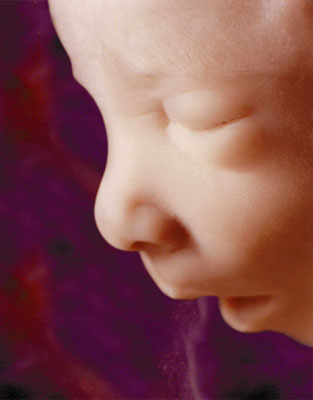
19 weeks. Candidate for this type of abortion

Read more about the D & E procedure, from a former abortionist.

See pictures of a D & E procedure. 

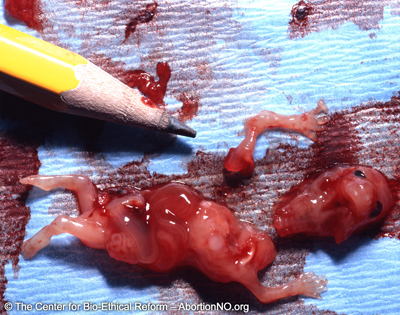
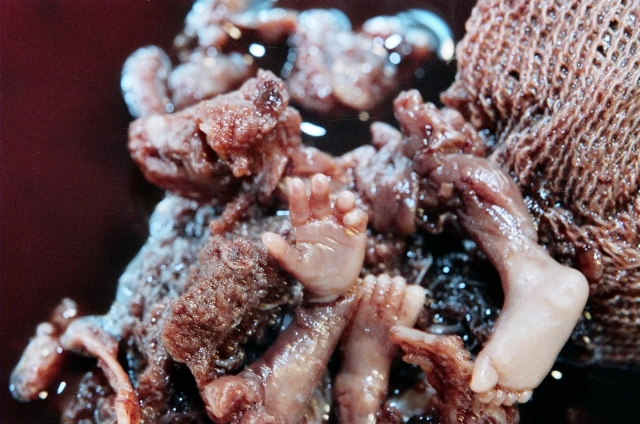
See remains of a babies aborted by D & E at 21 weeks


Share on Facebook

Kate Michelman calls abortion “a bad thing”

Sometimes even abortion lobbyists show a degree of uneasiness about what it is they are lobbying for. At the end of 1993 Kate Michelman, the head of the National Abortion and Reproductive Rights Action League, was interviewed by the Philadelphia Inquirer about NARAL’s new emphasis on the prevention of teen pregnancies. The reporter quoted Michelman as saying, “We think abortion is a bad thing.” Michelman complained that she had been misquoted, whereupon she was reminded that the interview had been taped. Nevertheless, NARAL issued a statement a few days later declaring that Michelman “has never said–and would never say–that ‘abortion is a bad thing.'” Michelman, who had reason to know better, sought only to “clarify” her remark in a letter to the Inquirer. “It is not abortion itself that is a bad thing,” she wrote. “Rather, our nation’s high rate of abortion represents a failure” of our system of sex education, contraception, and health care. But a month later Michelman herself, testifying before a House subcommittee on energy and commerce, insisted that “the reporter absolutely quoted me incorrectly,” and she later told a Washington Post reporter, “I would never, never, never, never, never mean to say such a thing.” Not until the Post reporter showed her the transcript did Michelman finally acknowledge–somewhat evasively –that she had said it: “I’m obviously guilty of saying something that led her to put that comment in there.”

George Mckenna, “On Abortion: A Lincolnian Position,” The Atlantic Monthly Sept. 1995

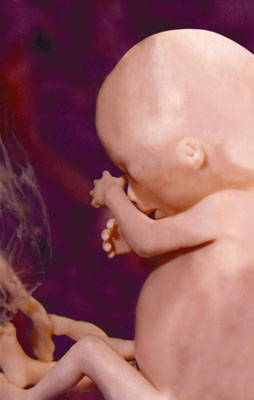
9 weeks
Share on Facebook

Abortionist On Guilt

From an abortion provider who is also a family doctor:

“As a family doctor, I have processed abortion guilt with so many women.”

Carole Joffe Dispatches from the Abortion Wars: the Costs of Fanaticism to Doctors, Patients, and the Rest of Us (Boston, Massachusetts: Beacon Press, 2009) 122

Although this abortion provider no doubt tells her patients not to feel guilty, her comment reveals that many of them do have those feelings after having abortions, and that abortion is a hard thing for women to deal with.

Share on Facebook

Woman takes aborted baby home in a jar

From one abortion provider:

 “She [the patient who just had an abortion] asked me if she could have the pregnancy… I gave it to her in a jar… She wanted to put it in the – River, at a place she knew that felt special to her. I told her I thought a goodbye ritual like that would help her move on. We had a long, long hug before she left.”

Carole Joffe Dispatches from the Abortion Wars: the Costs of Fanaticism to Doctors, Patients, and the Rest of Us (Boston, Massachusetts: Beacon Press, 2009) 121

Remains of an abortion at eight weeks

Share on Facebook

Woman aborts disabled baby

From a woman who had a down syndrome pregnancy:

“Unless the child was institutionalized, I would have to give up my teaching to be a full-time nurse, putting the entire financial burden on [my husband] Bud. We would have to begin saving immediately for that day, in our old age, when we could no longer care for the child at home. While we may have somehow coped had we never had the tests, Bud couldn’t fathom knowingly bringing these burdens upon us… I decided I must go through with the abortion to preserve my family.”

Maria Vida Hunt, McCall’s, July 1985

quoted in Bonnie Szumski , Abortion: Opposing Viewpoints (St. Paul, Minnesota: Greenhaven Press, 1986)

Tests for Down Syndrome are not accurate until 16 weeks, when the baby is fully formed. (see below)

16 weeks

Abortions at this stage are done by dismemberment- a doctor tears apart the baby with forceps, taking it out piece by piece.

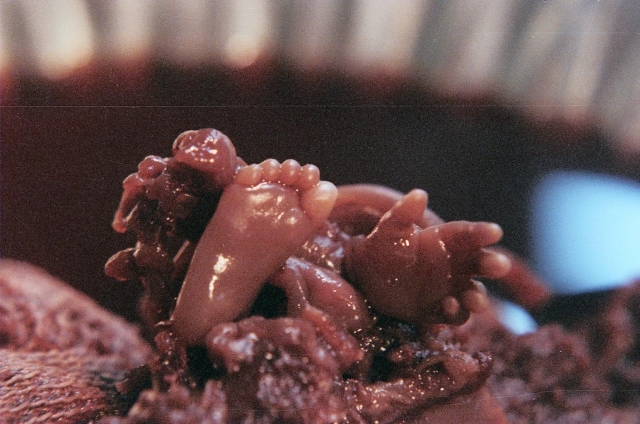
Remains of baby at 16 weeks

Was the suffering of the baby justified by the family’s right not to be inconvenienced? There is a waiting list to adopt even down syndrome babies.

Share on Facebook

Evicting the Human

Abortionist Michael Weiner, MD, Family Planning Associates [as he performed an abortion]:

“I am evicting the human from the incubator.”

American Journal of Obstetrics and Gynecology Sept 1, 1976, 126[1] 83-90.:

http://m.mccookgazette.com/story/1946917.html

he knew full well he was killing “humans.”

Share on Facebook