Therapist who works with postabortion women comments on graphic pictures

Whether or not to show graphic images is something pro-lifers disagree on. I do show them, but some equally dedicated prolifers do not. Many worry about women who have had abortions and how they would cope with seeing them. In this passage Theresa Burke, a therapist who works with post-abortion women, addresses this. This is taken from Priests for Life :

“Facing the truth and freeing oneself from deception is, in fact, integral to what healing is all about. That is why Dr. Theresa Burke, a psychologist who founded Rachel’s Vineyard, the world’s largest ministry for healing after abortion, and a ministry of Priests for Life, wrote that the use of graphic images, which impelled her into the fight against abortion, has an important place in the pro-life fight.

Through her extensive experience, Burke has seen the range of reaction such images can provoke. These images disturb not just the mothers and fathers of an aborted child, but the aunts and uncles and especially the grandparents. Yes, these images can wound those who have an abortion in their family, but so do more benign images, like the sight of a pregnant woman or an ultrasound or the cry of a newborn.

Burke acknowledges that some find it easier to attack the pro-lifer who shows the image than to look within at the grief and shame those involved in an abortion bury deep within their hearts. “Those that zealously defend abortion rights often respond to graphic images like a culture of eating disordered bulimics,” wrote Burke. “They simply throw up and out what they refuse to digest.” That much said, Burke reminds us, “The vivid truth spoken through a photograph that can resurrect trauma can also break denial.”

Theresa Burke and J Kevin Burke “Let’s Talk about Graphic Pictures” on the Priests for Life Page Looking Abortion in the Eye, Accessed September 11, 2014

Quoted in Rev. Frank Pavone Abolishing Abortion: How You Can Play a Part in Ending the Greatest Evil of Our Day (Nashville, Tennessee: Nelson Books, 2015) 170

Share on Facebook
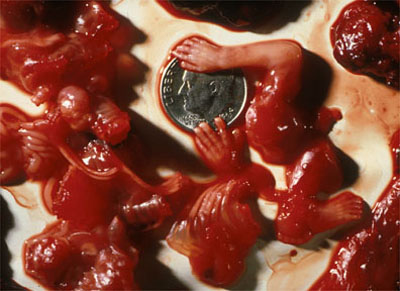
If it hadn’t been legal, I wouldn’t have done it

From a woman who had an abortion:

“If it hadn’t been legal, I probably would have had the baby then because I wouldn’t have wanted to risk putting my health in any risk… If it wouldn’t have been legal I probably just would just gone ahead and made the decision to have the baby.”

Sumi Hoshiko Our Choices: Women’s Personal Decisions about Abortion (New York: Harrington Park Press, 1993) 90

Many women would not have illegal abortions if legal abortions weren’t available. This is only one example.

Share on Facebook

Woman who had abortion: My baby was at peace with it

From Dana, who had an abortion:

“I had established quite a connection with the baby. I thought it was a girl, I had named her, and I had my little relationship going with her. I talked to her all the time. The night before I kind of started this process of talking to her and telling her what was going on. And telling her, asking her how she felt about it. This may sound a little strange. And she understood, and she’s at peace with it, she wasn’t angry. She said to me that we would meet again, that she will come back in my life someday.…

And so [the abortionist] came and gave me a shot. It was a great drug. It was just so perfect. As soon as he gave me the shot, I just wanted to stay with… Like I stayed with her and made sure we were doing it together. So he gave me the shot and I took a deep breath and at the top of my lungs, screamed! [she laughs.] Freaked everyone out! But it felt great.

I said goodbye to her as she was leaving, and our goodbye was beautiful, and we both totally understood and were at peace with it. And that was the most important thing for me. I felt like I had… Like I was with her to the very end. Then I just started sobbing. I just let myself really let go. It wasn’t from fear or anger. Grief, and be in as much pain as I wanted to be in. And when I cried, I’ve never cried as deep before.…. And it felt really good to be screaming, to cry, and just be there with all the pain…

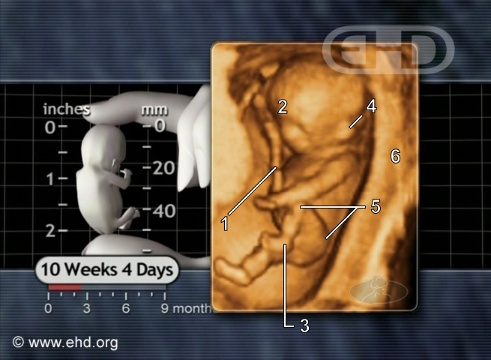
Abortion at 10 weeks. This is what happened to her baby.

I hear Jim crying, so I started opening my eyes. And there he was sobbing. Not crying, he was sobbing. I’ve seen him cry before, but he was choking and gasping and sobbing. And it made me feel so good, that he was feeling some pain over it. So we were there crying together for a little while… I was just really glad he was crying like that; then I felt like I wasn’t alone with it.…

I’ve been continuing to grieve when I need to, and allow myself to do that. There’s a part of the [religious] services, that if you want to mourn, you get up and say it. And I’ve been getting up to do that. At that time I picture her in my head, and it’s an opportunity to say hello to her, and so I feel like I’m continuously in contact with her…

Every time like I’m up in an airplane, in a cloud, I kind of see her. It’s a little strange, but I see her, clear as a bell, looking, little blonde Sarah. Sitting up there, happy as can be. She is like my little angel. I talk to her. So I allow myself… By being sad about it once in a while, as I’m continuing to talk with her and keep her a part of my life, it’s kind of evened out the whole grieving, the whole sadness about it. And I know she will come back into my life.”

Sumi Hoshiko Our Choices: Women’s Personal Decisions about Abortion (New York: Harrington Park Press, 1993) 108 – 109, 111

Share on Facebook

Abortion is more ethical than letting child be unhappy, says writer

From one pro-choice author:

“True, women are amazing and have tremendous capacity for love, overcoming overwhelming obstacles and, when forced to, changing their lives to provide for children. But when an alternative exists, why not take? It seems logical that when the pregnancy is unwanted or will be an emotional or economic burden on the woman, abortion is clearly a more ethical choice than placing both herself and the child in a desperate or unhappy situation.”

Sumi Hoshiko Our Choices: Women’s Personal Decisions about Abortion (New York: Harrington Park Press, 1993) 3

Is this (abortions at 9 weeks) really more ethical than allowing a child to be unhappy?

week 9


Share on Facebook

Abortionist describes dangers of abortion

An abortionist talks about the dangers of abortion and why nonmedical personnel shouldn’t do them.

Abortion, particularly early suction curettage, gives the impression of not being a very difficult procedure. …However, impressions can be misleading. Ninety-nine times out of one hundred, everything goes very smoothly. But it’s that one time that can be associated with complications, some of which are very serious, even deadly. Surgical abortion in and of itself is not that difficult to do, although there’s a bit of an art to it and is more challenging in the second trimester, particularly since it is essentially a “blind” procedure when ultrasound is not used, which is how it’s generally done. The real skill comes in with regard to preventing, recognizing and managing those infrequent complications. I used to tell residents that anyone can teach a monkey how to operate; the real skill in surgery involves clinical judgment. The same is true of surgical abortion—it is feasible for nonclinicians to do it, but without question the risks are greater in terms of infection, incomplete abortion and uterine perforation, and even more importantly, it’s not clear to me how effectively those complications would be recognized and managed. ..

all of us who are well-trained to provide abortions and who have considerable clinical experience still have complications. About once a year, the average experienced abortion provider may perforate a uterus. Indeed, a pregnant uterus is much more easily perforated than a nonpregnant one….… if the best abortion providers still have occasional complications, nonclinicians who may provide such procedures on an infrequent basis will undoubtedly have a higher incidence of complications. …

Estimation of gestational age is critical. In trained hands, this doesn’t require ultrasound, but even some skilled gynecologists have blown it, thinking they were dealing with an 8-week pregnancy when they really had a midtrimester pregnancy on their hands…

Tracey-Kay Caldwell. “Dr. Toub Discusses the Safety of at Home Abortions” Bella Online, 2013

Share on Facebook

Abortion clinic escort mad at pro-lifers for offering to help woman

From an abortion clinic escort:

The crazy protesters (ie the women) had just arrived though, and once they saw us out back with a young woman who had obviously been crying, one of the crazies (Rosary Lady) started saying, very loudly, “You don’t have to do this,” and such forth. Well, PM very snarkily replied “We’re not.” Rosary Lady then tried to get them to go next door to the “Mother Child Welcome Centre” but PM told her, in an unimpressed tone, that they had already been. That was when their ride showed up. Before they got in the car, PM turned to me and said, in an explanatory way (as if she owed me an explanation!) that Patient was too far along in her pregnancy and that’s why they hadn’t been able to get an abortion.

It was a strange experience. First of all it was the closest I’ve ever come to crying at this job, and secondly I think it’s the maddest I’ve ever been at a protester. She should have stopped her bullshit when she heard that they weren’t going through with it. She’s not having the abortion – what more do you want? Do you have to try to brainwash her as well?

Hail and Bubbles, Part One Anti–choice Is Anti-Awesome April 17, 2007

In fact, most crisis pregnancy centers offer women tangible help with their pregnancies- everything from baby items and diapers to a place to live. This was the help they were offering the woman.

If there is nothing wrong with a woman changing her mind, why was the escort close to tears at a woman not getting an abortion?

Share on Facebook

Abortion provider talks to court about baby’s pain

24 weeks. Babies around that age were killed by partial-birth abortion

From testimony about pain felt by aborted babies during the partial-birth abortion ban trials:

Judge Richard Casey in New York asked Dr. Marilynn Fredriksen what she tells her patients: “Do you tell them whether or not it hurts?” he asked. She stuttered, “Who am I — what am I … .” “The patient,” Judge Casey continued. “The woman, the mother.” “It doesn’t hurt her, no,” said Dr. Fredricksen. Judge Casey pressed on, “Do you tell whether or not it will hurt the fetus?” Her response, “The intent [is] that the fetus will die during the process of uterine evacuation.”

“Ma’am, I didn’t ask you that,” Judge Casey persisted. “You will deliver the baby partially and then insert a pair of scissors in the base of the fetus’ skull. … Do you tell them whether or not that hurts the fetus?” In response, Dr. Fredricksen snapped, “I have never talked to a fetus about whether or not they experience pain.”

A pain specialist in the California trial, Dr. Kanwaljeet Anand, said, “There will be pain caused to the fetus. And I believe it will be severe and excruciating pain.”

CATHY CLEAVER RUSE “Forum: Abortion trials and tribulations” The Washington Times April 24, 2004

Read more here.

Share on Facebook

Abortionist describes crushing baby’s head

From a summary of testimony partial-birth abortion ban:

Dr Carolyn Westhoff, testifying in the New York trial, spoke of how it is “necessary to insert our forceps, open them as wide as possible to try to capture the head within the opening of the forceps and then crush the head using external force applied against the head.” She admitted there is “usually a heartbeat” when she performs a partial-birth abortion, and that even when she collapses the skull, the baby is still “living.”

CATHY CLEAVER RUSE “Forum: Abortion trials and tribulations” The Washington Times April 24, 2004

You can read the more here. 

D&E abortions, which are performed today also require the baby’s skull to be crushed.

Below: this is the age when many of these babies are aborted

22-24 weeks
22-24 weeks. 
Share on Facebook

Fetal surgeon talks about abortion

From a fetal surgeon who operates on babies in the womb:

“I’ll tell you a truly interesting ethical problem. We have ten surgeons in this lab whose only focus the majority of the time is the fetus as a patient. We’re all operating on fetuses, trying to do our best to protect them, yet when we’re done with the operation that fetus could be still be legally aborted.”

Monica J Casper The Making of the Unborn Patient: a Social Anatomy of Fetal Surgery (New Brunswick, New Jersey: Rutgers University Press, 1998) 14

Share on Facebook

“Cheerleader for abortion” doula describes her job

From an “Abortion doula” who helps women through their abortions:

“Basically, my job is to love people unconditionally in 5-10 minute increments, which is about how long a first-trimester procedure takes. Depending on the clinic that we’re in, we will go into the room with the patient, we’ll help them get settled, get comfortable. Depending how long it takes the doctor to come into the room, we might be making small talk with them. Sometimes, people don’t want to talk at all, which is totally fine. People usually don’t want to talk about their emotions, if they have any, around the procedure, which is also obviously fine. Then, the doctor comes in, the procedure happens, [and] we’re right next to the patient during the procedure, again offering physical support if the client wants that, or verbal support… Then, they go into the recovery room, and that’s pretty much the end of our relationship with that person. …

For a lot of people, the procedure is not a big deal. But…some people are going in with some really conflicted and painful emotions. Sometimes, they wanted a pregnancy, but they just don’t have the resources to continue… A few times, especially with people who are very religious or just really conflicted with the decision, I think it’s been really helpful for them to have someone say “You’re not a bad person, you’re making the right decision, and I care about you.” One of the great things I learned from one of our founders [is that] when people ask her, “Do you think God will forgive me?” she responds, “Well, do you believe in a forgiving God?”

I think care is a basic right, and being loved is a real, universal human need.“

Michelle Kinsey Bruns “Meet The Women Who Make Abortions Possible” Refinery 29 JAN 22, 2015

Unfortunately preborn babies, like the ones below,are not considered people to be loved.

16 weeks 88

See what a preborn baby at 16 weeks looks like after an abortion.

left-knee-and-hip-flexion

See what a baby aborted at 10 weeks looks like (scroll down)

One can also wonder if this ‘cheerleader for abortion” will be there for the woman days, weeks, months, or years later when they are suicidal because of their abortion.

Share on Facebook