Today, it is illegal to perform experiments on living aborted babies in the US. The issue of fetal experimentation has faded into the background. But it wasn’t always that way. There was a time, shortly after Roe V Wade, when babies who survived abortion not only were allowed to die, they were sometimes experimented on until they died. And experimentation on living aborted babies is legal in some countries.
Dr. Jerald Gaull, then chief of pediatric research at New York State Institute for Basic Research in Mental Retardation on Staten Island, was quoted defending this practice:
“Rather than it being immoral to do what we are trying to do, it is immoral it is a terrible perversion of ethics to throw these fetuses in the incinerator as is usually done, rather than to get some useful information.”
“Operations on Live Fetuses.”San Francisco Chronicle, April 19, 1973, page 20.
The book the article was cited in gives the following information:
Dr. Jerald Gaull, …was making periodic trips to Finland “to experiment on aborted but still-living fetuses.” He severed the nerve connections between brain and body, then surgically removed the brain, lungs, liver and kidneys for study and dissection.
Beyond Abortion, A Chronicle of Fetal Experimentation* by Suzanne M. Rini, (Avon, NJ: Magnificat Press, 1988) pp.32
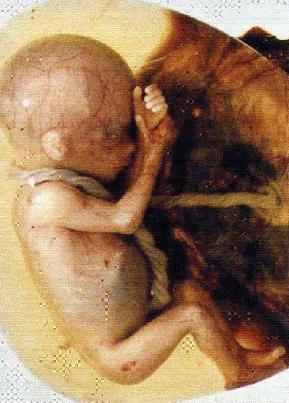
22 to 24 weeks – a baby capable of being born alive and experimented on
I encourage anyone who wants more information on this to read Rini’s book.
The March 15, 1973 Washington Post reported that Dr. Gerald Gaull, Chief of Pediatrics at the New York State Institute of Basic Research in Mental Retardation,
“… injects radioactive chemicals into fragile umbilical cords of fetuses freshly removed from their mother’s womb in abortions. While the heart is still beating, he removes their brains, lungs, livers, and kidneys for study.”
Joan Wester Anderson. “Beyond Abortion Fetal Experimentation, New Upjohn Drug Delivers Perfect Fetus for Laboratory Use.”Our Sunday Visitor, April 13, 1975, page 1. Also reported in the WashingtonPost, April 15, 1973.
This is an old quote, but such atrocities still take place today.
The National Institute of Health meeting held a meeting that discussed the ethics of experimenting on human embryos.
Panel consultant Charles McCarthy said that perhaps experimenting on these developing human lives is respecting them – somehow. In his own words:
“using or involving an embryo in research may, in and of itself be a mark of respect” even if involves destroying and discarding the embryo.
Panelist Brigid Hogan agreed:
“Perhaps the way you can show the most respect to an embryo is to do the very best possible research with it from a scientific point of view.”
Yes, poking and prodding and splicing and injecting chemicals into a developing human embryo is more respectful than allowing it to be implanted so it could grow into the baby it’s meant to become. Sometimes you just can’t explain this kind of twisted thinking.
Richard Doerflinger , “the Human Embryo Research Panel: Creating Life to Destroy It”
From the pamphlet “Fetal Experimentation: Violating Ethical Standards” Life Cycle, March 1996
A terrible proposal- using the egg cells from the ovaries of dead aborted babies to help infertile women have children- children whose biological mother would be an aborted child.
“Dr. Robert Gosden of Edinburgh University has requested permission to use aborted human fetal ovarian tissue to restore the fertility of sterile women. The technique involves taking ovarian cells from aborted fetuses (babies) and extracting the ova (egg cells). The ova would be cultured to maturity, fertilized by in vitro methods, and then implanted into the recipient mother… A paper written by Dr. Gosden in the April 1992 Journal of Assisted Reproduction and Genetics reviews the outline of this research (i.e., how and why it will work for humans!) a full two years before his research proposal became news. This paper bases his proposal on prior work in which Dr. Gosden has extensively performed mouse fetal tissue transplants studies to restore the fertility of sterile mice. These studies included using mice fetal tissue to restore fertility to sterile mice, restore endocrine function to mice without ovaries, and freezing and storing mouse fetal ovarian tissue for later successful implantation. Dr. Gosden’s work promises to harvest eggs from aborted fetuses at the 12 to 16 week stage. They would then fertilize the eggs by in vitro methods and implant them into previously sterile women.… it would restore the fertility of women who have prematurely undergone menopause, thereby giving them extended years of childbearing.”
Lawrence Roberge “Transplantation of Aborted Fetal Ova: a Short Analysis” Wanderer, August 4, 1994
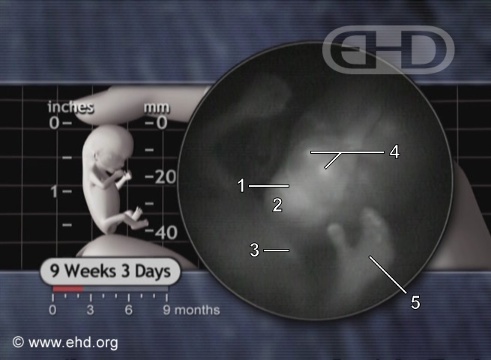
14 weeks. The baby at this stage has very developed ovaries.
Another writer commented on this:
“Remember all the adopted children who grew up and strongly desired to seek out their birth parents? That is, adults who tried legal and other methods to obtain the identity of the true biological parents. Will this technology spawn a generation of “genetically adopted” children who will wonder who their real mothers are? What will these children grow up and feel? Will they wonder and strive to find out (by legal and other means) who the tissue donor (the aborted fetus) was? Will they strive to find their grandmother (the mother of the aborted fetus)? As their “grandmother” will be the one who aborted her “mother,” would this aggravate the “grandmother’s” post abortion trauma? Yes, this may sound confusing, but consider how confusing it will be for the “children” and “grandmothers”!
A pro-choicer defended the proposal in another article:
“Certainly there may be many emotions associated with the knowledge of being conceived outside sexual intercourse… [A] study concluded that “the majority [of children produced via IVF] were performing above the norm for the chronological age but were subject to a “significantly higher incidence of… behavioral and emotional problems…..
“There is no medical evidence which suggests that fetal ovaries or eggs are inferior to the eggs present in a healthy adult female.…
Furthermore, given the success of adoption and the similarities of adopted children to FEC, one can reasonably conclude that concerns of psychological harm resulting from a child knowing his genetic mother was an aborted fetus are overestimated.”
Jonathan M Berkowitz “Mummy Was a Fetus: Motherhood and Fetal Ovarian Transplantation” Journal of Medical Ethics 21:298 – 304 (October 1995)
Yet another writer defended the proposal:
Also, from Gina Kolata, New York Times, January 6, 1994
“Dr. John Fletcher [an ethicist at the University of Virginia in Charlottesville] said most of the ethical questions [concerning fetal ovary transplants] pale beside the good that can be done for infertile couples. For example, he said, even though a child might be troubled to learn that it’s genetic mother was an aborted fetus the child would almost certainly rather have been born from the featus’s eggs than not to have been born at all.
“The idea that you would be filled with self-loathing if 50% of your genes are from the ova of an abortus seems to me highly questionable,” he said.
There was a National Institute of Health meeting that discussed the ethics of experimenting on human embryos.
Diane Irving, professor of philosophy , DeSales School of Theology, referred the panelists to her 400 page dissertation, which analyzed 23 articles claiming that “human personhood appears at some point after conception.” When she began her research, she expected to agree with the articles. However:
“To my own amazement, I discovered that in all 23 arguments, the science was incorrect, the philosophy was historically incorrect or indefensible and none of the conclusions followed logically from the premises.”
Richard Doerflinger , “the Human Embryo Research Panel: Creating Life to Destroy It”
Professor Mary B Mahowald of Case Western Reserve University, has written that it is “morally defensible” to remove organs or tissues from “nonviable” fetuses (in the first 6 months of development in the womb) while they are still alive,
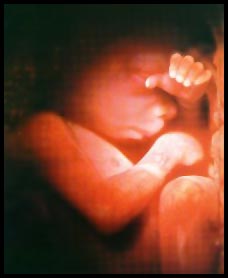
20 weeks
“if dead fetuses are not available or are not conducive to successful transplants.”
Mahowald acknowledged “added concerns” because of the children’s “possible sensitivity to pain,” but said that “this concern may be satisfactorily addressed on a practical level using anesthesia.”
Mahowald Mary B., J. Silver, R. A. Ratcheson “The Ethical Options in Transplanting Fetal Tissue” Hastings Center Report 17 (1). P 11
On the eve of Roe versus Wade, a New York doctor states that in other countries, aborted babies could be experimented on. This is a reason, he believes, to support legalized abortion and fetal research.
17 weeks
“In Mexico and Scandinavia an aborted fetus is an aborted fetus. It can be treated like a removed organ. We might as well make some logical use of it.”
Dr. Kirt Hirschhorn, Mount Sinai Hospital, NYC
Quoted in the National Observer, March 21, 1973 p4; cited in “The Facts of Life,” Life Messengers
“Since we know we are going to destroy, dismember and discard the fetus in a procedure known as abortion, it seems a small indignity to expose it to rubella vaccine just prior to that termination. The medical ethic ‘do no harm’ would, of course, be violated — but we have already violated that principle when we accepted the concept of abortion. The ultimate harm of destroying the fetus trivializes that which precedes it.”
William Gaylin and Marc Laape (president and associate for biological sciences at the Hastings Institute) Fetal Politics: The Debate on Experimenting with the Unborn.” Atlantic Monthly , May 1975.
Experimentation on living human babies (in the womb or outside the womb) is illegal now but wasn’t always. In the past, living aborted babies have been subject to medical experimentation.