20-22 weeks. Typical age for this type of abortion
“It is, in my experience and my opinion, less risky to put a hole in the base of the skull. Because the contents of the skull are liquid the skull contents may often drain out spontaneously as soon as there is a hole in the skull.”
Dr. Carolyn Westhoff, abortionist, in sworn testimony in National Abortion Federation, et. al. v. Ashcroft, U.S. District Court, Southern District of New York, April 2, 2004. She is describing a partial-birth abortion, where the skull is punctured in the brains are drained or sucked out. This procedure is now illegal, and abortions at that stage are done by dismemberment D&E
Margaret A. Woodbury, A writer for Salon magazine, describes two abortions that she witnessed in an abortion clinic. The 1st abortion was done on a woman who was 23 weeks pregnant. It was a “partial-birth” abortion, which are now illegal.
“This was the most difficult procedure to watch, mostly because of the pain experienced by the least sedated of the women. As the doctor, with a resident by his side, slid most of his hand deep into the patient’s vagina, she moaned horribly and could not remain still. Only when the anesthesiologist administered a drug to increase her sedation could things proceed.
The doctor, using only his fingers, pulled a foot into view and then another. “OK,” he said, “now I have the sacrum.” Letting the resident take over, the doctor instructed: “Pull down. Down! Not Up! Down! All right, now the shoulder, then twist. Then the other shoulder.”
20 weeks – 3 weeks younger than the baby being aborted in this story
At this point, only a few minutes had passed. The fetus was perfectly limp, its tiny feet and hands flaccid as they immediately darkened from oxygen depletion. In the three intact D&X procedures I witnessed, not once did I see even a glimmer of response from the fetuses — the anesthesia having passed through the placenta into their bloodstreams.
Once the entire fetal body was out of the womb, the doctor quickly made an incision into the base of the skull that remained lodged against the woman’s cervix and inserted a suction catheter into the perforation to drain the brain matter and allow the full removal of the fetus. The placenta came next and the doctors finished suctioning the uterus to drain any remaining blood.
Below: 22-24 weeks
Woodbury then describes one of the D&E abortions that she witnessed. These abortions are still legal in are the most common procedure used in the 2nd trimester:
20 – 22 weeks
“Both D&E procedures I observed started in exactly the same manner as the three abortions earlier in the day, but the doctor in these cases quickly determined that intact extraction would not be possible because neither woman’s cervix was dilated enough. Once that decision was made, the resident inserted a long-handled metal instrument into the woman’s uterus — called a Bierer forcep — and began what the doctor called “blind” pulling. I watched as the doctor instructed the resident to “Stop and feel where you are! Put your hand on the abdomen. No, you’re not getting it! Watch out! Don’t get the cervix.”
24 weeks
Time after time, the resident plunged the Bierer into the woman’s womb, removing a leg, then an arm, then the liver, then the placenta, which the doctor ranted about, because this can make the fetal head extraction more difficult. The last step that I saw was the collapse of the skull and the removal of the brain matter.
….
Back in his office, the doctor demonstrated how powerful a grip can be used with the Bierer forceps. He clamped them down on a surgical scrub gown I held in my hands. “Pull,” he instructed. I pulled. “Really, really pull!” he yelled. I really, really pulled. The only way to break the bond between forceps and cloth was to tear the cloth; I inwardly winced as I realized that in the operating room the cloth could be a uterine wall, and with one misplaced pull by the forceps, a perforation could occur.
“This is why I hate overuse of forceps,” the doctor commented. “Things tear.” Rubbing a hand across his forehead, the doctor looked straight at me: “There are only two kinds of doctors who have never perforated a uterus,” he added, “those that lie and those who don’t do abortions.”’
At first, Woodberry denies that she was emotionally affected by witnessing the abortions:
“… even as one foot was pulled off, I could see no response, no reflexive spasm, nothing. …There was no discernable response by the fetus. And in the operating room there was no emotional one from me.”
The reason that there was no reaction from the baby may have been because some abortionists inject poison into the womb (usually digoxin) to kill the baby prior to dismemberment. Unfortunately, most abortionists do not bother to do this extra step, and most babies were killed by this method are dismembered alive.
Later, Woodbury says:
Seeing a potential human collapsed and torn in a dish was disturbing; watching a very human woman, knowing she would be the one to carry the wounds, hurt too”
Margaret A. Woodbury “A doctor’s right to choose” Salon WEDNESDAY, JUL 24, 2002
Diagram of the D&E procedure
Remains of the baby aborted by this method at 20 weeks:
Q. And the potassium chloride injection is an ultrasound guided procedure that assures the death of the fetus, right?
A. Yes.
Dr. Marilynn C. Frederiksen, abortionist, in sworn testimony in National Abortion Federation, et. al. v. Ashcroft, U.S. District Court, Southern District of New York, April 6, 2004
An abortionist was asked under oath about what he tells his patients:
[F]rankly, your Honor, I think we sugar coat some of the other options and we share this with patients. They might ask, well can you give intracardiac … injections … or …could we do an induction termination and avoid this? But the honest truth is, how do we know that taking this huge instrument and poking it into the baby’s heart and injecting a poison hurts any less than my rapidly cutting the umbilical cord or transecting the spinal cord with my scissors? “
Sworn testimony of Dr. Cassing Hammond, abortionist, in National Abortion Federation, et. al. v. Ashcroft, U.S. District Court, Southern District of New York, April 1, 2004
“Or how do we know that poisoning the environment that the baby is in with digoxin is any more painful or less painful than my doing a very rapid D&E?”
Digoxin is a powerful poison used in abortion which kills the baby after it is injected. Sometimes it takes hours for the baby to die. A D&E abortion is where the baby is torn apart via forceps. It is not hard to imagine they both would be painful for the baby.
Dr. Cassing Hammond, abortionist, explains how aborted babies may suffer if they are born alive during an abortion.
“And if the baby delivers and is living in the sense of a medical induction, we’re assuming because nature takes it course that it’s not painful. But if the baby slowly tires and stops breathing and dies by asphyxiation it is reasonable to assume that even for a normally born fetus, a normally formed fetus, that this may also involve pain.”
Testimony of Dr. Cassing Hammond, abortionist, in National Abortion Federation, et. al. v. Ashcroft, U.S. District Court, Southern District of New York, April 1, 2004.
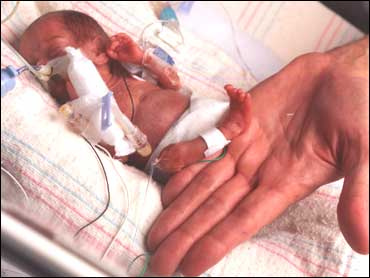
Rumaisa Rahman was born premature. Abortions are legal in many parts of the United States at the same age as he was in this picture.
Babies born alive after abortions are not as rare occurrences people like to think. In some cases, abortions are deliberately done that way, although technically this is against the law. Read about babies born alive after abortions here
“It is difficult to grasp the head; it is round, it slips out of the instruments that we generally use. Either those instruments or the head can be extruded outside the uterus and cause perforation.”
Testimony of abortionist Dr Timothy Johnson, National Abortion Federation, et. al. v. Ashcroft, U.S. District Court, Southern District of New York, March 31, 2004
“They delivered the fetus intact until the head was still trapped behind the cervix, and then they reached up and crushed the head in order to deliver it through the cervix.”
Testimony of abortionist Dr Timothy Johnson, National Abortion Federation, et. al. v. Ashcroft, U.S. District Court, Southern District of New York, March 31, 2004.
“At first I was very upset by the [abortions]. I’m not one to see blood and mess and things like that. But I have since gotten so excited about it that I thought about going back to nursing school. When you think about it on a certain level, it’s a really interesting thing that is happening. It’s fascinating, when you can think about it clinically and not get involved in the people, or the babies. What happened when I was first working here was that I just thought about the baby and that was very upsetting. I’m very pro-abortion… I think I must’ve overcompensated, you know, overreacted and tried to look at like, really get into it, and not shy away from it. And several times I saw a really beautiful things happen, I mean it’s physically beautiful… Sometimes you can see the vagina opening up in the entire thing coming at once.”
Magda Denes, In necessity in sorrow, New York: basic books, 1976