Novelist Pearl S. Buck speaks about life and death

‘…I fear the power of choice over life or death at human hands. I see no human being whom I could ever trust with such power–not myself, not any other. Human wisdom, human integrity are not great enough. Since the fetus is a creature already alive and in the process of development, to kill it is to choose death over life. At what point shall we allow this choice? For me the answer is–at no point, once life has begun. At no point, I repeat, either as life begins or as life ends, for we who are human beings cannot, for our own safety, be allowed to choose death, life being all we know.”

Novelist Pearl S. Buck

Foreword to Robert E. Cooke and others, ed., The Terrible Choice: The Abortion Dilemma (New York: Bantam Books, 1968), ix-xi, x.

7 wk dia

Share on Facebook

Man tells story of postabortion grief

On LifeSiteNews, a man gave his testimony of regret after his girlfriend Kelly had 2 abortions. Here is an excerpt.

“We became pregnant three months into our relationship. Kelly and I both grew up attending church and knew how our parents felt about sex outside of marriage, so that seemed to leave very few options for us. Kelly convinced herself she had to have an abortion so that we could try to hide what, honestly, our parents already knew was going on. Her friend took her to have the abortion, and we never discussed it.

Within one month, however, we found ourselves pregnant again, and we aborted the second child just as quickly to hide our shame.  This time, I took her to the clinic.  As I sat there in the waiting room, I could hear crying and saw women come out with tears running down their faces.  This scared me because I was told “this was just a small procedure and it wouldn’t hurt Kelly or the tissue at all.”  In my heart, I knew this was a baby, not tissue.

When Kelly came out, she was groggy and looked to be in a lot of pain, which made me furious about the lies we had been told. As we drove home, neither of us said a thing.  We sat in silence as I contemplated our decision.  Sadly, because of my inability to be a man, I put it all aside and we went on with our relationship.

Kelly and I eventually got married, but many years after the abortions I realized I was in pain.  My inability to protect those I was entrusted to care for created a domino effect of bad choices.  …  I self-medicated my pain with pornography and alcohol and searched for ways to find my voice …. I was a broken man with a broken wife, two children in heaven, and was trying to pick up the pieces of what my indifference had done. I watched Kelly find healing from the abortions and eventually decided I needed help, too. The healing process made me realize that I was meant to be a Daddy to those two children and that my silence never allowed me to be that for them.”

Read the whole testimony here. 

Matt Clinger The curse of Adam’s silence – a MAN’s post-abortion testimony” LifeSiteNews Jan 20, 2012

Read more testimonies from men who suffered after a partner’s abortion(s)

Share on Facebook

Video: Womans Choice Abortion Clinic Investigation

In this video, Citizens for  Pro-Life society show you what was thrown in the dumpsters at two abortion clinics in Michigan.

I’m sure that going through the dumpster was something the pro-lifers hated doing. I’m sure they felt dreadful gathering up the remains of these aborted babies. These children, so carelessly discarded, deserve more than a filthy dumpster as their private resting place, though.  The babies found here would be buried. The video is to show the reality of abortion in all its hideousness.


Share on Facebook

Abortion clinic gives out coupons: Sunday discounts!

ad 1Dr. James Pendergraft has a clinic in Orlando that does abortions through twenty four weeks and beyond. (see above)

In 2011, an article in LifeNews showed that the clinic gave coupons for discount abortions on Sundays

If this doesn’t prove that abortion is a business, I don’t know what does.

Orlando Women's Abortion Center. Second, And Late Term Abortions Clinic.

Share on Facebook

Abortionist: Some women are later grateful they were refused abortions

Dr. Alec Bourne, who had successfully challenged the abortion law in England by performing an abortion on a teenage rape victim. He later wrote:

“Those who plead for an extensive relaxation of the law [against abortion] have no idea of the very many cases where a woman who, during the first three months, makes a most impassioned appeal for her pregnancy to be ‘finished,’ later, when the baby is born, is thankful indeed that it was not killed while still an embryo. During my long years in practice I have had many a letter of the deepest gratitude for refusing to accede to an early appeal.”

A. Bourne, A Doctor’s Creed: The Memoirs of a Gynecologist, London, 1963

Not all babies who are initially unwanted stay unwanted.

Share on Facebook

3 year old sister of aborted baby: Mom, why didn’t you kill me too?

alex

When I was 3 years old I saw my mom on TV. She was speaking to a man about how she killed her baby and regretted it. As she told her story and how she became a pro-life speaker, I watched and listened. My grandma didn’t think I was old enough to understand.

When my mom picked me up that night I asked her why she killed my brother or sister and why she didn’t kill me. My mom said she was in shock that her 3-year-old would ask these questions. She answered them the best she could for me, and as I got older I learned more.

This is the testimony of Alex. She and her mom are now pro-life speakers.

Source: Teenbreaks.com

Even at three, Alex knew she’d lost a brother or sister. Children pick up on things adults say, even things about abortion.

Share on Facebook

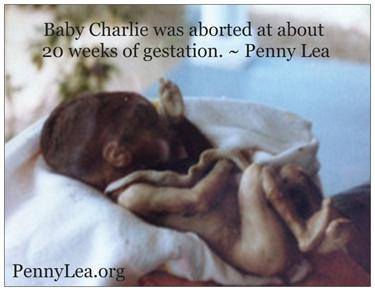
Baby Charlie, aborted at 20 weeks

911 Babies recently shared a picture of Baby Charlie, a twenty week old (allegedly) aborted baby.

baby charlie 20 weeks

Here is the story that was shared:

“Baby Charlie was aborted at about 20 weeks of gestation. All his organs were functioning; he just needed time to grow. A pathologist gave him to pastors Norn Stone and Jerry Horn in 1986. They gave the baby to me at the Pensacola march that year. I carried him across America and brought him into churches. The reaction was horror. Many wept, and many cursed me. We buried him in Milton, FL several months later. I couldn’t take any more. He needed the dignity of a burial. I will never forget this little boy. He had one finger that pointed out as if to ask, “Where were you when I was led away to slaughter?” I’ll see you in heaven, baby Charlie”

 Penny Lea

Because of the condition of the body, I would estimate that he was aborted by the prostaglandin method, in which the prostaglandin is given by IV or vaginal suppository and forces a woman’s body to go into labor. he may have been injected with poison to prevent a live birth. This method was often used in the mid 1980s. Bruises on the baby’s body imply that labor was traumatic, possibly indicating this type of abortion, which caused what doctors referred to as “tetanic” contractions, which were very strong contractions that are continuous and could damage the baby severely (as well as being very painful for the mother) Another possibility is saline, a salt solution injected into the womb that burns the outer layer of skin. Because there are no visible burns, this was may not have been the method used.  Urea, which is another poison, is also a possible cause of death.

Formalin solution is commonly used in abortion clinics to prevent the baby’s from rotting and causing odors in the clinic. This or formaldehyde may have preserved the body. The gray skin is compatible with such preservatives.

I cannot verify from the picture that this is not a stillbirth. Nor have I personally interviewed the writer of the story. Therefore, I cannot state with total certainty that her story is true. But in a stillbirth, the cord is usually cut close to the body. The bruising on the skin is also inconsistent with a stillbirth.

Take from it what you will.

See more pictures of baby’s aborted at 20 weeks

Share on Facebook

Doctor: it’s “unethical”not to experiment on aborted babies

Today, it is illegal to perform experiments on living aborted babies in the US. The issue of fetal experimentation has faded into the background. But it wasn’t always that way. There was a time, shortly after Roe V Wade, when babies who survived abortion not only were allowed to die, they were sometimes experimented on until they died. And experimentation on living aborted babies is legal in some countries.

Dr. Jerald Gaull, then chief of pediatric research at New York State Institute for Basic Research in Mental Retardation on Staten Island, was quoted defending this practice:

“Rather than it being immoral to do what we are trying to do, it is immoral it is a terrible perversion of ethics to throw these fetuses in the incinerator as is usually done, rather than to get some useful information.”

“Operations on Live Fetuses.”San Francisco Chronicle, April 19, 1973, page 20.

The book the article was cited in gives the following information:

Dr.  Jerald Gaull, …was making  periodic trips  to Finland “to experiment on aborted but  still-living  fetuses.”   He severed the nerve connections between brain and body, then surgically removed   the  brain,  lungs,  liver  and  kidneys  for   study   and dissection.

Beyond Abortion, A Chronicle of Fetal Experimentation* by Suzanne M.  Rini, (Avon, NJ: Magnificat Press, 1988) pp.32

22 to 24 weeks – a baby capable of being born alive and experimented on

I encourage anyone who wants more information on this to read Rini’s book.


Share on Facebook

Women give reasons to abort down syndrome babies

Rayna Rapp, a former abortion clinic worker, interviewed women getting genetic testing to find out if their babies would be disabled or have a genetic problem. Here are some things that people said about why they would abort a down syndrome baby:

“The bottom line is when my neighbor said to me: “Having a “tard,” that’s a bummer for life.”

“I have a cousin, my mother’s sister’s son, he’s retarded and 38. Oh, it isn’t Down’s, it’s something else. He’s done fine, he’s likely to live a normal life, to die at 80. But it’s really messed up the rest of the family. My aunt give up a lot of her life… I’m not that selfless, I don’t want to live like that.”

“I would have a very hard time dealing with a retarded child. Retardation is relative, it could be so negligible that the child is normal, or so severe that the child has nothing… All of the sharing things you want to do, the things you want to share with a child – that, to me, is the essence of being a father. There would be a big void that I would feel. I would feel grief, not having what I consider a normal family.”

“I have an image of how I want to interact with my child, and that’s not the kind of interaction I want, not the kind I could maintain.”

…..

“I just couldn’t do it, couldn’t be that kind of mother who accepts everything, loves her kid no matter what. What about me? Maybe it’s selfish, I don’t know. But I just didn’t want all those problems in my life.”

Rayna Rapp Testing Women, Testing the Fetus: the Social Impact of Amniocentesis in America (New York: Routledge, 1999)

To some, they may seem like good reasons. But keep in mind that abortions of down syndrome babies are usually late-term abortions, performed after 16 to 20 weeks. Below is a picture of a 16-week-old unborn baby. A baby like this would be completely torn apart in an abortion procedure

16 weeks

Share on Facebook

Clinic administrator: I had no conception that “life was sacred”

A "potential life" at eight weeks after conception
A “potential life” at eight weeks after conception

From clinic owner an administrator Merle Hoffman, on counseling women for their abortions:

“Choice” is sometimes not a choice at all. It is an outcome determined by the economic, physical, sociological, and political factors that surround women… At times this reality would move me profoundly as I sat opposite the women I counseled prior to their abortions, acutely aware of the potential lives growing inside them that would soon cease to exist. I began to think critically, to come to terms with what was going on. Each time I did that, I came out of that process more committed than before. I had no conception, either religious or philosophical, that “life was sacred.”

Merle Hoffman Intimate Wars: the Life and Times of the Woman Who Brought Abortion from the Back Alley to the Board Room (New York: Feminist Press, 2012) 108 – 109

She uses the term “potential life” to describe the unborn babies, but readily admits that she has no belief that life is sacred. Perhaps deep down she realizes that what happens in her clinic dozens of times a day is the taking of actual, not potential, human life. However, by thinking “critically” she can come to terms with this fact, or at least repress it.

Share on Facebook