“Good and moral women have abortions every day, but when patients come in and are very conflicted, I try to address it. I say there are good people who are serious about religion who understand the sacredness of a woman’s right to choose about whether or not to continue a pregnancy. You can respect that other people disagree with you, but you have to listen to your own heart, and there are people who understand.”
Only 1% of women with an unplanned pregnancy go forward with adoption in the US — very, very small. And I hear it from my patients for all different reasons: they never could do it, the interesting thing they say is that they don’t trust anybody else to raise their child. Will the child be loved? Will the child be well cared for? Again, it gets to the idea that they understand how important motherhood is …
During the partial birth abortion trials, there was a much discussion about late term abortions and how often they were done. The pro-choice side claimed that late term abortions by partial birth (see here) were extremely rare and only done for the most extreme of reasons.
Illinois physicians M. LeRoy Sprang and Mark G. Neerhoff :
“The vast majority [are] done not in response to extreme medical conditions but on healthy mothers and healthy fetuses.” They point out that 56 percent of partial-birth abortions are done as a result of “fetal flaws . . . some as minor as a cleft lip,” while 9 percent involve maternal health problems, “of which the most common [is] depression.”
Mary E. Williams. ed. Abortion: Opposing Viewpoints (San Diego, California: Greenhaven Press, 2002) 13
Even though partial-birth abortions aren’t done anymore, the same is true for other late-term abortions done differently today
Virginia Griffin, nurse, midwife, fertility counsellor and natural family planning teacher:
I’m pro-choice – but I believe very strongly in women’s right to decide NOT to have an abortion.
I think society puts too much pressure on women to have abortions for the slightest of reasons. …
I also believe it is too easy for women to say they’ll have an abortion because they won’t be able to cope financially. Here again, this is society putting on the pressure.
But women can get support through social services, and from centres such as ours which offer immediate support and continue it after the baby’s birth.
We’re still helping people whose mothers came to us 25 years ago…
The long-term damage can be devastating.
I see women who are still suffering from a termination they had decades earlier.
Having to help them pick up the pieces just makes me more and more convinced that abortion is wrong – not only because of the loss of a potential life but also because of the destruction of the mother’s life.
I once had a young girl who’d had four abortions and she said it was cheaper for her to have abortions than use any form of contraception because her boyfriend paid for the abortions. She complained about our menu, saying it wasn’t as good as the last time.
Whether or not to show graphic images is something pro-lifers disagree on. I do show them, but some equally dedicated prolifers do not. Many worry about women who have had abortions and how they would cope with seeing them. In this passage Theresa Burke, a therapist who works with post-abortion women, addresses this. This is taken from Priests for Life :
“Facing the truth and freeing oneself from deception is, in fact, integral to what healing is all about. That is why Dr. Theresa Burke, a psychologist who founded Rachel’s Vineyard, the world’s largest ministry for healing after abortion, and a ministry of Priests for Life, wrote that the use of graphic images, which impelled her into the fight against abortion, has an important place in the pro-life fight.
Through her extensive experience, Burke has seen the range of reaction such images can provoke. These images disturb not just the mothers and fathers of an aborted child, but the aunts and uncles and especially the grandparents. Yes, these images can wound those who have an abortion in their family, but so do more benign images, like the sight of a pregnant woman or an ultrasound or the cry of a newborn.
Burke acknowledges that some find it easier to attack the pro-lifer who shows the image than to look within at the grief and shame those involved in an abortion bury deep within their hearts. “Those that zealously defend abortion rights often respond to graphic images like a culture of eating disordered bulimics,” wrote Burke. “They simply throw up and out what they refuse to digest.” That much said, Burke reminds us, “The vivid truth spoken through a photograph that can resurrect trauma can also break denial.”
Theresa Burke and J Kevin Burke “Let’s Talk about Graphic Pictures” on the Priests for Life Page Looking Abortion in the Eye, Accessed September 11, 2014
Quoted in Rev. Frank Pavone Abolishing Abortion: How You Can Play a Part in Ending the Greatest Evil of Our Day (Nashville, Tennessee: Nelson Books, 2015) 170
“If it hadn’t been legal, I probably would have had the baby then because I wouldn’t have wanted to risk putting my health in any risk… If it wouldn’t have been legal I probably just would just gone ahead and made the decision to have the baby.”
Sumi Hoshiko Our Choices: Women’s Personal Decisionsabout Abortion (New York: Harrington Park Press, 1993) 90
Many women would not have illegal abortions if legal abortions weren’t available. This is only one example.
“I had established quite a connection with the baby. I thought it was a girl, I had named her, and I had my little relationship going with her. I talked to her all the time. The night before I kind of started this process of talking to her and telling her what was going on. And telling her, asking her how she felt about it. This may sound a little strange. And she understood, and she’s at peace with it, she wasn’t angry. She said to me that we would meet again, that she will come back in my life someday.…
And so [the abortionist] came and gave me a shot. It was a great drug. It was just so perfect. As soon as he gave me the shot, I just wanted to stay with… Like I stayed with her and made sure we were doing it together. So he gave me the shot and I took a deep breath and at the top of my lungs, screamed! [she laughs.] Freaked everyone out! But it felt great.
I said goodbye to her as she was leaving, and our goodbye was beautiful, and we both totally understood and were at peace with it. And that was the most important thing for me. I felt like I had… Like I was with her to the very end. Then I just started sobbing. I just let myself really let go. It wasn’t from fear or anger. Grief, and be in as much pain as I wanted to be in. And when I cried, I’ve never cried as deep before.…. And it felt really good to be screaming, to cry, and just be there with all the pain…
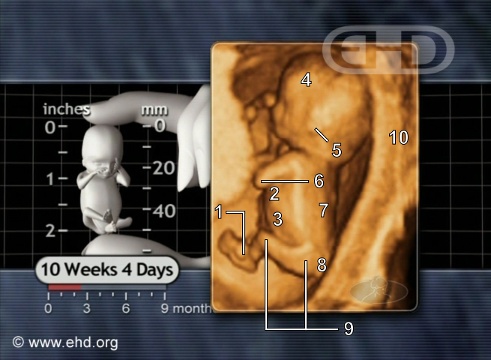
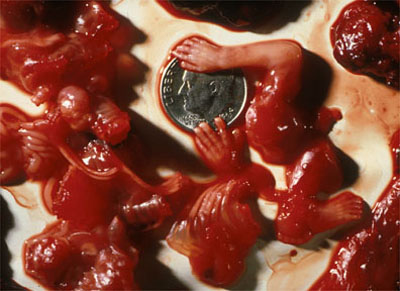
Abortion at 10 weeks. This is what happened to her baby.
I hear Jim crying, so I started opening my eyes. And there he was sobbing. Not crying, he was sobbing. I’ve seen him cry before, but he was choking and gasping and sobbing. And it made me feel so good, that he was feeling some pain over it. So we were there crying together for a little while… I was just really glad he was crying like that; then I felt like I wasn’t alone with it.…
I’ve been continuing to grieve when I need to, and allow myself to do that. There’s a part of the [religious] services, that if you want to mourn, you get up and say it. And I’ve been getting up to do that. At that time I picture her in my head, and it’s an opportunity to say hello to her, and so I feel like I’m continuously in contact with her…
Every time like I’m up in an airplane, in a cloud, I kind of see her. It’s a little strange, but I see her, clear as a bell, looking, little blonde Sarah. Sitting up there, happy as can be. She is like my little angel. I talk to her. So I allow myself… By being sad about it once in a while, as I’m continuing to talk with her and keep her a part of my life, it’s kind of evened out the whole grieving, the whole sadness about it. And I know she will come back into my life.”
Sumi Hoshiko Our Choices: Women’s Personal Decisionsabout Abortion (New York: Harrington Park Press, 1993) 108 – 109, 111
“True, women are amazing and have tremendous capacity for love, overcoming overwhelming obstacles and, when forced to, changing their lives to provide for children. But when an alternative exists, why not take? It seems logical that when the pregnancy is unwanted or will be an emotional or economic burden on the woman, abortion is clearly a more ethical choice than placing both herself and the child in a desperate or unhappy situation.”
Sumi Hoshiko Our Choices: Women’s Personal Decisionsabout Abortion (New York: Harrington Park Press, 1993) 3
Is this (abortions at 9 weeks) really more ethical than allowing a child to be unhappy?
An abortionist talks about the dangers of abortion and why nonmedical personnel shouldn’t do them.
Abortion, particularly early suction curettage, gives the impression of not being a very difficult procedure. …However, impressions can be misleading. Ninety-nine times out of one hundred, everything goes very smoothly. But it’s that one time that can be associated with complications, some of which are very serious, even deadly. Surgical abortion in and of itself is not that difficult to do, although there’s a bit of an art to it and is more challenging in the second trimester, particularly since it is essentially a “blind” procedure when ultrasound is not used, which is how it’s generally done. The real skill comes in with regard to preventing, recognizing and managing those infrequent complications. I used to tell residents that anyone can teach a monkey how to operate; the real skill in surgery involves clinical judgment. The same is true of surgical abortion—it is feasible for nonclinicians to do it, but without question the risks are greater in terms of infection, incomplete abortion and uterine perforation, and even more importantly, it’s not clear to me how effectively those complications would be recognized and managed. ..
all of us who are well-trained to provide abortions and who have considerable clinical experience still have complications. About once a year, the average experienced abortion provider may perforate a uterus. Indeed, a pregnant uterus is much more easily perforated than a nonpregnant one….… if the best abortion providers still have occasional complications, nonclinicians who may provide such procedures on an infrequent basis will undoubtedly have a higher incidence of complications. …
Estimation of gestational age is critical. In trained hands, this doesn’t require ultrasound, but even some skilled gynecologists have blown it, thinking they were dealing with an 8-week pregnancy when they really had a midtrimester pregnancy on their hands…