Clinic Workers Display “Cultural and Religious Ambivalence”

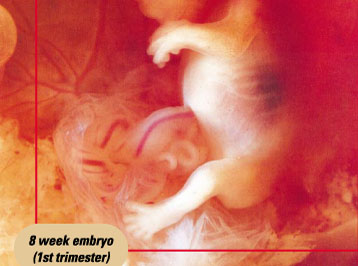
eight week-old unborn baby – most abortions are done at this stage or later

From one clinic worker:

“… workers in abortion clinics are often not pro-choice activists or “radicals.” Although most workers in these settings are committed to women’s access to legal and safe abortions, the cultural and religious ambivalence that surrounds abortion is also reflected in our daily struggles with the nature of our jobs.”

Sarah Todd “Abortion Providers Should Not Have To Work with Fear, Threats, and Violence” Lucinda Almond The Abortion Controversy (New York: Greenhaven Press, 2007) 137


Share on Facebook

Clinic Worker: 20 Week Abortion “Turns My Stomach”

The Director of nursing at one abortion clinic said the following:

20 weeks

“I feel that up to 20 weeks you really push an abortion. Personally. And if they had modified that law I would be all for it. Because after that stage they’re getting pretty big. I mean, have you seen the 20 week ones? And I must say, it turns my stomach, and I agree with the staff in one way that they feel little repulsed when you get a big fetus. It’s very traumatic for the staff to pick this up and put it in a container and say, “Okay, that’s going to the incinerator.”

18 weeks

Magda Denes, PhD. In Necessity and Sorrow: Life and Death in an Abortion Hospital (New York: Basic Books inc 1976) 153 – 154

Share on Facebook

Teenager Who Had Illegal Abortion Shows Grief And Remorse

Jane was the name of the underground abortion network that was in place before Roe versus Wade. The feminists who ran the organization employed an abortionist who had no medical license, and later did the abortions themselves despite having no official medical training. While they claimed that their abortions were safe, they did not follow the women after they return to their homes, often many states away.

A teenager who had an abortion said the following to a woman who assisted it and was pregnant:

“The other was a high school student who had had a difficult time during her abortion. Afterword, as Deborah sat with her on the couch in the living room, she collapsed in Deborah’s arms, sobbing , “I killed my baby, but you’ll be a very good mother because you’re taking care of me.”

Deborah was horrified. The counseling session was the place to address these feelings. Hadn’t her counselor talk to her about this? Deborah asked, “If you felt that way, why did you do it?”

“My mother said if I have this baby, she’d see to it that the welfare people take it away from me, so what’s the point.” She hugged Deborah’s belly, “I killed my baby and here’s your baby. I’m glad you helped me, but I wish I could have a baby like you.”

Laura Kaplan The Story of Jane: The Legendary Underground Feminist Abortion Service (New York: Pantheon Books, 1995)  133

Share on Facebook

German Company that Manufactured Poison Gas in Holocaust Obtains Patent

The National Catholic Reporter said the following about RU-486:

“[RU-486] reminds politicians and the chemical industry in Germany of their special historical and moral responsibility to such a topic. Among other things is certainly resurrected shadow of the German past when the Hoechst Company, a successor enterprise IG Farben [the German company that patented the poison gas Zyklon B used in the gas chambers during World War II] obtained the patent RU-486.”

Cardinal Joachim Meisner of Cologne

Quoted in Mark Y Herring. The Pro-Life/Choice Debate (Westport, Connecticut: Greenwood Press, 2003) 143

Share on Facebook

The Silent Scream: Video

On the silent scream – Ron Fitzsimmons, lobbyist for NARAL pro-choice America:

“It’s really quite moving. I can see how it would affect people. It could possibly do some damage.”

Julia Malone, “Graphic Film Raises Intensity Level of US Abortion Controversy” the Christian Science Monitor (February 14, 1985)

Watch this film:

See what babies look like after being aborted at different stages

Share on Facebook

“Abortion Gets Abused” Says Abortion Provider

16 week twins – legal to abort in every state

From one abortion provider:

“… I think from a straight moral point of view I probably would object to abortion. Because I love kids. From that point of view every fetus is a potential child, and morally I just really don’t think that should be done. Socially there’s a great need for abortion, purely because there’s a large group of women who for various reasons will get pregnant and they don’t want a child.… Of course, there’s abortion that gets abused. Women who come back three, four, and five times. This is another one of the boundaries a place in my own personal feelings. I would just not do it, I would probably refuse to do the abortion after two.”

17 weeks

Magda Denes, PhD. In Necessity and Sorrow: Life and Death in an Abortion Hospital (New York: Basic Books inc 1976) 146

If abortion is simply the removal of some cells, the termination of a pregnancy, and is morally benign, why should having more than one disturb a doctor?

Share on Facebook

Doctor Changes His Mind “As a Result of All This Technology”

One abortion doctor discussed how the advent of technology showing the unborn baby led him to change his mind about doing abortions:

“As a result of all this technology – looking at this baby, examining it, investigating it, watching its metabolic functions, watching and urinate [and] swallow… I was a physician pledged to save my patients’ lives, not to destroy them.. So I changed my mind on the subject of abortion.”

David Kupelin and Mark Mastos “Pro-Choice 1991: Skeletons in the Closet” New Dimensions: the Psychology behind the News (September/October 1991): 40

Share on Facebook

Living Aborted Baby Holds on to Unwilling Mother

From an interview with an abortion clinic worker:

“There was one week when there were two live births in the same week. And just, you know, there’s this baby crying on the floor while all these women are in the process of trying to deal with their feelings about aborting their babies. One survived for a while.

[Interviewer] how did the mothers react who gave birth to the live babies?

Well. This one, she didn’t talk much. The mother delivered when there was no one there and there was some period when the mother was holding the baby. And it was grabbing onto her.… She was extremely upset by this whole thing.”

Magda Denes, PhD. In Necessity and Sorrow: Life and Death in an Abortion Hospital (New York: Basic Books inc 1976) 79

22 – 24 weeks
Share on Facebook

Dr. Susan Poppema on RU-486

Dr. Susan Poppema, NAF president, discusses one problem with RU-486.

“Having a group of women doing a lot of bleeding and cramping in your office, when they would rather be home, doesn’t do much for the [patient] flow in your clinic.”

She argues that women should be sent home to abort alone – despite the risk to a woman’s health and the lack of medical attention should something go wrong. This is because she is concerned about  “patient flow” efficiency in her clinic.

Wendy Wright “The Deceit behind RU-486: Who’s Really in Control?” Family Voice, November/December 2000

Share on Facebook

Clinic Workers Knew Pro-lifers Helped Women

In an interview with pro-life author Rachel M MacNair, PhD, former clinic worker Joy Davis was asked about what her clinic did when women told them they did not want abortions.

“We sent into the pro-lifers, we knew they were going to take care of them.”

Rachel M MacNair, PhD. Achieving Peace in the Abortion War (New York: iUniverse, 2009) 61

Read the testimony of Joy Davis here. 

Share on Facebook