“Pain is a factor in life; could an element of pain be a justification for no more abortions? I don’t think so.”
Anne-Marie Keary, head of Britain’s National Abortion Campaign, explaining why the fact that unborn babies feel pain should not be a reason to oppose abortion
Sue Brattle. “Can a Foetus Feel Pain?” London Daily Express, August 6, 1996, pages 25 and 26.
Late-term abortion. Did this baby feel pain while he was being dismembered? Anne-Marie Keary Doesn’t care
“Trauma from an abortion can also affect men. Guilt and hurt after an abortion can drive couples apart, especially if one partner was unsure about the decision. Often couples split up following an abortion.
You may want your relationship back to where it used to be, but this is impossible. Sometimes men react with a gut instinct that it is better to do something quickly and worry about the consequences later. A common reaction is “Get rid of it”. But this is not one of those situations, and an abortion will not put things back as they were. In short, both you and your partner have been permanently changed by the pregnancy.
Some men feel guilty about what they have done and then find it difficult to form close relationships in the future. Some disguise their feelings by remaining emotionally cold and distant. One man said “following the abortion I split up with my girlfriend and it was only years later I realized that I’d never settled down and got married because of the abortion.”
There is a deep instinct in man to protect women and children. An abortion can undermine a man’s confidence in himself and he can come to think of himself as a failure – a failure as a partner, a failure as a father, a failure as a man.”
Men and Abortion, Information from Lighthouse Family Trust
Quoted in Cara Acred The Abortion Debate (Independence Educational Publishers, 2012), Kindle edition
“I hate the thought that there will be fewer people with Down syndrome in the world as a result of advances in prenatal testing. As I’ve written before, it impoverishes us all when we selectively abort babies based upon particular characteristics (gender, for instance, in China and India … disabilities here in America). But I also hate the thought that mothers of children with Down syndrome think they are alone. Yes, some women choose abortion when they see a karyotype with three 21st chromosomes. But many other choose life.”
From a woman who had a medical (by pill) abortion:
“I had my medical abortion a few days ago at slightly less than 8 weeks. It was the most painful experience ever in my life. On top of emotional pain, when the second pill was taking effect, I had the most indescribable excruciating pain for more than 6 hours. It almost killed me… I wonder if child birth is even more painful than this… There was just so much pain that I could’t even cry… Maybe I should have chosen surgical.”
I feel very empty now, the presence of my baby is gone… It just feels so “different” I’m not sure if it’s a good or a bad thing… I’m calm but something is missing…. One thing I know for sure is that this will forever be a part of my life and I will always be tied to the father of my baby emotionally.
If she already feels this type of grief and loss so soon after her abortion, one wonders how she will feel as the years go by and she begins to process the loss of her child. Many women only begin to grieve for their babies long after they had their abortions. Hopefully, she found healing.
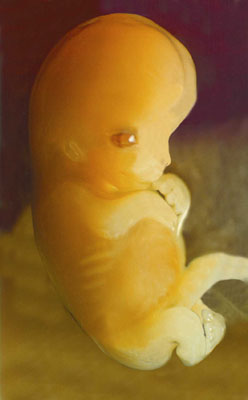
Seven-week-old unborn baby –Similar to the one this young woman lost in her abortionShare on Facebook
A report presented at the 1977 annual meeting of the Association of Planned Parenthood physicians describes the negative psychological reactions doctors may have after performing D&E abortions [which were then new]:
“When performing a D&E abortion, the gynecologist is aware of being the active agent in the procedure. On the one hand, the doctor is sparing the patient the pain and emotional distress of the amnio abortion. On the other hand, he or she is the one who is crushing and dismembering the fetus in a D&E procedure, which can be emotionally disturbing… As the doctor tends to take responsibility and assume guilt for the procedure, she or he may have disturbing and recurrent ruminations or dreams. Doctors have found that these negative reactions decrease as they get used to the procedure, decrease if fewer D&E’s are done per session, and may depend on their feelings about the women’s reason for needing a late abortion… Because of these problems, it is important that participation in D&E abortions be entirely voluntary, and that doctors have a chance to talk over their feelings with understanding colleagues or counselors.”
“2nd Trimester Abortion by Dilation and Extraction (D&E): Surgical Techniques and Psychological Reactions.”, Paper presented at the annual meeting of the Association of Planned Parenthood Physicians in Atlanta, Georgia, 13 – 14. October 1977 by Drs. Sadja Goldsmith, Nancy B. Kaltrevider, and Alan J. Margolis
The paper goes on to explain a little more detail what the procedure is so traumatizing:
“When the amniotic fluid had drained, the placenta and fetus were removed: the fetus was extracted in small pieces to minimize cervical trauma. The fetal head was often the most difficult object to crush and remove because of its size and contour. The operator kept track of each portion of the fetal skeleton in order to be sure of complete evacuation. Finally, a blunt or sharp curette, and a 12 mm vacuum aspirator were used, which often yielded additional tissue fragments. The patient was then transferred to the recovery room, watched for about 2 hours, and sent home with a friend.”
The National Institute of Health meeting held a meeting that discussed the ethics of experimenting on human embryos.
Panel consultant Charles McCarthy said that perhaps experimenting on these developing human lives is respecting them – somehow. In his own words:
“using or involving an embryo in research may, in and of itself be a mark of respect” even if involves destroying and discarding the embryo.
Panelist Brigid Hogan agreed:
“Perhaps the way you can show the most respect to an embryo is to do the very best possible research with it from a scientific point of view.”
Yes, poking and prodding and splicing and injecting chemicals into a developing human embryo is more respectful than allowing it to be implanted so it could grow into the baby it’s meant to become. Sometimes you just can’t explain this kind of twisted thinking.
Richard Doerflinger , “the Human Embryo Research Panel: Creating Life to Destroy It”
From the pamphlet “Fetal Experimentation: Violating Ethical Standards” Life Cycle, March 1996
“…if those 1.21 million abortions [performed every year] represent only the women who could access abortion financially, geographically or otherwise, then that number is too low. Yes, too low. If that’s the case, then what is an appropriate response? How do we best support women and their reproductive health? Do we dare admit that increasing the number of abortions might be not only good for women’s health, but also moral and just?…. We say we care about women and want them to have access to all the information, services and resources necessary to make the best decisions they can for themselves and their families. That is at the core of reproductive justice. Not reducing the number of abortions. Safe – yes. Legal– absolutely. Rare – not the point.”
Concerned about sex selection abortions in Canada, Dr. Rajendra Kale, who the article described as “interim editor-in-chief of the Canadian Medical Association Journal” has proposed that doctors not tell pregnant women the gender of their babies until 30 weeks, when it is too late to abort.
“Kale pointed to research in Canada and the United States indicating that immigrants in certain ethnic groups, including people from China, Korea and India, selectively abort female fetuses: couples who have two daughters are more likely to have a son as their third child than would be excepted if left to chance.”
An article in The Los Angeles Times profiles an abortionist and describes several of his patients. from the article:
The last patient of the day, a 32-year-old college student named Stephanie, has had four abortions in the last 12 years. She keeps forgetting to take her birth control pills. Abortion “is a bummer,” she says, “but no big stress.”
From a publication of the Religious Coalition for Abortion Rights, on pictures of aborted babies:
You’ve probably seen the garish brochures that anti-choice organizations hand out. The pictures in those brochures are designed to shock you and they do! They are designed to keep you from thinking seriously about the real issue. Sadly, they often do. THE REAL ISSUE IS FREEDOM!
‘Religious’ Coalition for Abortion Rights (RCAR) brochure entitled “RCAR has no pictures in this brochure. You can’t take a picture of freedom.”
The pro-choice group is attempting to dodge the issue. Pictures of aborted babies, like the one below, show the humanity of the unborn child.