Abortionist: seeing an arm pulled out was “shocking”

This doctor writes, after observing her first second trimester procedure at 21 weeks:

“Seeing an arm being pulled through the vaginal canal was shocking. One of the nurses in the room escorted me out when the colour left my face… Not only was it a visceral shock; this was something I had to think deeply about… Confronting a 21-week fetus is very different. It… cannot feel pain or think or have any sense of being, but the reality is, this cannot be called ‘tissue’. It was not something I could be comfortable with.”

“What about us? Staff reactions to D&E”. In:  Hern WM,  Corrigan B editor. Advances in Planned Parenthood. 15:1980;p. 3–8

She decided to do only earlier abortions.

The article was about the D&E procedure, which is what this abortionist witnessed. In this type of abortion, the baby is dismembered with forceps. See diagram below.

de

Actually see what a baby looks like after a D&E at 21 weeks

Share on Facebook

Abortionist: This will shake pro-choicers

“I thought there are folks who are pro-choice who do not want to know about what we are doing because it’s very scary to them. And if they start to know what really this is about for women and what we know, it’s going to shake their own simple way of being pro-choice.”  

Said by one abortionist at a meeting of abortion providers.

National Abortion Federation Meeting
Transcript tapes: 9415-18, p. 23

Collected by Life Dynamics

9 weeks
9 weeks

They worry that when the average pro-choice person learns more about abortion, and what it does to women and unborn babies, they will be horrified.

Because abortion is a horrifying thing.

Share on Facebook

Columnist: “poor, black, Indian” children are “marked for failure”

An American columnist said abortion is needed for the “at risk” population, “poor, black and Indian” whose children are “marked for failure.”

The quote appeared in Tony Bouza “A Mother’s Day Wish: Make Abortion Available to All Women,” Minneapolis Star Tribune, May 8, 1989 

 Melinda Tankard Reist Giving Sorrow Words: Women’s Stories of Grief after Abortion (Springfield, IL: Acorn Books, 2007) 193

Share on Facebook

“I am left alone without the father or the child”

Lena, from Queensland, became pregnant at 25 by a man she loved:

“He encouraged me to wait until we were married, wait until we had spent more time with each other, wait until we had more money, wait until we did all the things we wanted to do together, and wait until the time was right. I desperately needed some support and agreed out of trust. After all, as some consolation, I had all these other things he wanted with me to look forward to.…

Shortly afterwards, the relationship failed. She says:

“I have just come to the end of this relationship and I can’t help but feel tricked somewhere along the line. We never got to that stage again and at the end of it all I am left alone without the love of either the father or the child… I feel I have lost something I can never regain.”


 Melinda Tankard Reist Giving Sorrow Words: Women’s Stories of Grief after Abortion (Springfield, IL: Acorn Books, 2007) 26

Too often, husbands or boyfriends pressure women to have abortions, then break up with them after the abortion. They often promised many things, and put a lot of pressure on the woman. One study shows that 64% of women are pressured into abortions by the men in their lives.

Share on Facebook

Pro-choice researcher; Study shows that abortion is a “traumatic life event”

Melinda Tankard Reist, who compiled a book full of testimonies from women who regretted their abortions, said:

“… In early 2006, a group of researchers in New Zealand published a paper in the Journal of Child Psychology and Psychiatry, an international peer-reviewed journal, detailing the findings of an ongoing survey of some 500 women who had been tracked from birth to approximately 25 years of age. The data was drawn from one of the most long-running and valuable longitudinal studies in the world, and the research team had previously published other well-received papers about the findings from their survey.

This study from Australia’s next-door neighbor created an international stir. The researchers had found that the young women in the study who had undergone an abortion were significantly more likely than their peers to experience major depression (nearly double the rate of women who had never been pregnant and 35% higher than those who had carried to term), substance abuse, anxiety disorder, and suicidal behavior.”

The study was:

David M Ferguson, et.al., “Abortion in young women and subsequent mental health,” Journal of Child Psychology and Psychiatry 47 (1): 16 – 24, 2006.

Professor David M Ferguson, leader of the research team:

“I remain pro-choice. I am not religious. I am an atheist and a rationalist. The findings did surprise me, but the results appear to be very robust because they persist across a series of disorders and a series of ages.

Abortion is a traumatic life event; that is, it involves loss, it involves grief, it involves difficulties. And the trauma may, in fact, predispose people to having mental illness.”

Nick Grimm, “Higher Risk of Mental Health Problems after Abortion Report,” Australian Broadcasting Corporation, January 3, 2006

From

 Melinda Tankard Reist Giving Sorrow Words: Women’s Stories of Grief after Abortion (Springfield, IL: Acorn Books, 2007)  XI-XII

Share on Facebook

Abortion is a “good procedure”

“Women who have abortions are good women. Abortion, when desired by a woman, is a good procedure. Abortion itself holds no moral weigh except in the context of its usage. Therefore, in order to change to stories in our heads we must resist forces that tell us that abortion as a procedure is bad, shameful, or not to be supported…Each and every one of us needs to stop apologizing for abortion. ”

Katie Stack Eliminating Abortion Stigma: Playing Offense Starts With You” RH Reality Check June 14, 2012

Remains of a baby aborted at eight weeks. Most abortions in the US happen around this time or later
Share on Facebook

I’m an abortionist. So what?

“I’m an abortionist. So what? I could be a cardiologist or a dermatologist. It’s another subspecialty of medicine.”

Dr. LeRoy Carhart, who performs abortions up through the third trimester.

SANDY BANISKY “CIRCUIT-RIDING DOCTORS FILL ABORTION NEEDSAlbany Times Union September 5, 1993

Carhart aborts babies like the one below. He kills babies at this age by poisoning them in utero. Other children, he tears apart with forceps.

7 months. Legal to abort in some states.
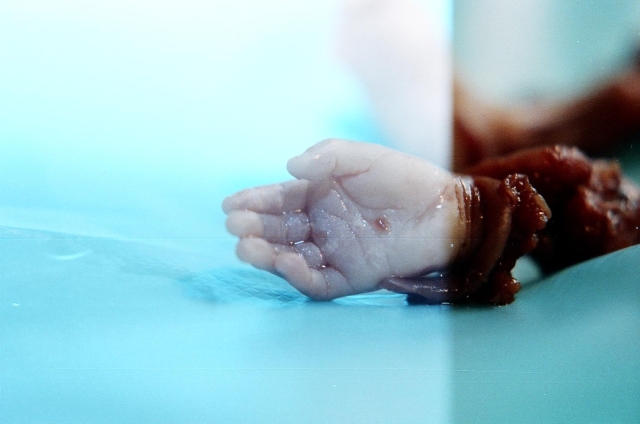
hand of baby aborted at seven months
hand of baby aborted at seven months.
Share on Facebook

Clinic director calls man involved in pregnancy “sperm donor” says abortions usually not for hard cases

Mary Ann Sorrentino, was was the director of Planned Parenthood of Rhode Island for ten years, admits that “the hard cases” of abortion- rape, incest, health risk to the mother or handicap in the child, are rare.

14 weeks. Legal to abort in every US state

“I have never chosen to base my defense of abortion rights on that tragic group often referred to as “victims (or survivors) of rape and incest.” Of course I believe they should have access to abortions, but the number of patients coming forward for these reasons has always been such a small percentage of the total number of terminations performed, that its statistical and logistical significance is not so much influential, as tragic and dramatic.

Women whose health and lives are threatened by a pregnancy are also a small number, fortunately. …. It is important to reinforce the notion that a woman’s right to have or not have a child is important, personal, and valid, however the pregnancy came to be.…

The sperm donor is in most cases a boyfriend, fiancé, or husband. Less often, there are cases where a married woman has conceived outside her marriage, or where single women have been taken advantage of by rapists or pimps. Older men out for a good time may impregnate minors, and teen pregnancies sometimes result from incest and rape. But none of these groups, taken individually, are of statistical significance.

The facts always have been and still are, that most often, women seeking abortions come from a less dramatic and more average group and is often described by well-meaning advocates trying to make a case for legalized pregnancy terminations….

In some ways, the pro-choice movement has caved into the pressure from its opponents by basing its defense of all women’s reproductive rights on the backs of those few in the most dramatic circumstance.”

Mary Ann Sorrentino. The A Word: Abortion: Real Women, Tough Choices, Personal Freedom (Great Barrington, MA: Gadd & Company Publishers, 2006) 4 – 6

The man involved is not a father. he is a “sperm donor.”

Just over  six weeks. The majority of abortions happen after this time.
Just over six weeks. The majority of abortions happen after this time.
Share on Facebook

Postabortion woman wonders what happened to her baby’s body

A postabortion woman named Cassie wrote:

“I often wonder what happened with my baby. Where did they put her? Sometimes I wish I could’ve seen her, although I know that it would have been not only painful but I think I would’ve got out of my mind! Still, most of the times I wish I knew what became of her; was she buried or just thrown away like some piece of rubbish. Sometimes I think of just ringing the clinic and ask them what they do with all the babies, but then, what am I expecting they’ll tell me!… All through the day I wonder how she would look, and how it would’ve been having her around with my two sons… Whenever I’m asked how many children I have, I refrain from saying three!”


 Melinda Tankard Reist Giving Sorrow Words: Women’s Stories of Grief after Abortion (Springfield, IL: Acorn Books, 2007) 40

Share on Facebook

Pro-choice groups reject women who were hurt by their abortions

From author Melinda Tankard Reist, who interviewed many postabortion women:

“Women often spoke of being unable to get satisfactory help for their grief from clinics or organizations connected with abortion. Karleen said that when she sought help at a women’s counseling clinic in Sydney she was told it was wrong of her to speak badly of her abortion experience. Kara, from Queensland, told of posting her personal abortion story on an Internet discussion of abortion. She was told to “get lost” – her story wasn’t welcome….If a woman is depressed after an abortion, she is made to feel it’s her own inability to deal with sadness which is the problem. The onus is all on the woman.”

 Melinda Tankard Reist Giving Sorrow Words: Women’s Stories of Grief after Abortion (Springfield, IL: Acorn Books, 2007) 24 – 25

Share on Facebook