NARAL Pro-Choice America, NOW and Planned Parenthood’s political position, their push for no restrictions at all on abortion up until the time of birth, has always been supported only by a minority of the population.
“Even in abortion’s prime, a Gallup poll, published in USA Today (1/22/1998), revealed only 23% of Americans were willing to endorse the idea that abortion should be legal under any circumstances.”
Randall K O’Bannon “Support for Pro-Life Policies and Legislation Growing” National Right to Life News, November 11, 1998, 6
An article in the New York Times tells of an abortion performed by Dr. Abu Hayat, which led to severe complications
“Ms. Olivo paid cash in advance. After a 30-minute wait, she said, the nurse took her into a room, put her on an examining table and injected her with what proved to be an ineffective anesthetic. Then, she said, Dr. Hayat appeared and, without a word, began the abortion.
“It lasted two minutes,” she said. “While he was doing it, I could feel everything.” After a few minutes in a small recovery room, she said, she was sent home and told to call if she felt ill. There was pain in her abdomen, and later it became worse. “I felt sick at my house,” she said. “I had a lot of cramps and pains.”
Four days later, the pain and cramps were still growing worse. She went to a hospital and was admitted with a 103-degree fever. A doctor examined her, found that she had endured an incomplete abortion and removed parts of the fetus that were still in her uterus. After five days, she went home.
Later, Ms. Olivo returned several times to Dr. Hayat’s office “to tell him how I felt,” but was told each time that he was not there. That, officials say, is also typical of abortion mills, which provide little if any follow-up care.
Now, two years later, Ms. Olivo is still weak from the experience. She said she was stunned by reports last week that the doctor had botched other abortions. She said she wanted to sue him, but knew now that she could never collect damages.
“I would never have imagined that a clinic wouldn’t have insurance,” she said. “I thought it was required by law that you have insurance.” But Mr. Slocum said doctors are not required to have medical malpractice insurance, and other officials said it was unlikely that abortion mills had such insurance.
The realm in which Dr. Hayat operated is a largely hidden one. The State Health Department, which licenses doctors and dozens of legitimate abortion clinics in the city and investigates complaints of malpractice and negligence against physicians, acknowledges that it does not know enough about illegal or incompetent abortion mills and says it needs more authority to regulate them.
Yet pro-abortion groups such as NARAL Pro-Choice America, NOW, and Planned Parenthood use all thier resources to fight legislation requiring abortion facilities to be inspected and live up to basic safety standards.
The New York Times ran an article about unlicensed abortion “mills” that injured women and operated under terrible conditions:
These are usually private doctors’ offices masquerading as clinics — that is, the doctors are licensed, but the clinics are not. Many of the mills, though not all, are situated in poorer neighborhoods, where immigrants, the uneducated and non-English-speaking residents form a core of clients.
The New York Times goes on to say:
Most mills, officials said, lack such proper equipment as sonogram or ultrasound machines that help determine the age, size, position and other vital data on a fetus. Sonograms are normally required after the 12th week of pregnancy.
…. officials say some abortion mills make no effort to determine the age of the fetus and illegally abort pregnancies in the third trimester. After the 24th week, a pregnancy may be ended only in a hospital and only if the mother’s life is in danger.
From one health official:
“We don’t know as much as we’d like to,” Mr. Slocum said. “They’re underground, unfortunately, and we learn about them only when someone files a complaint or ends up in an emergency room. All we can see is the surface, but that is troubling to us. We suspect there is a lot more we don’t see.”
Lauren Mitchell is an abortion doula who was training other abortion doulas. She gave a series of scenarios that she says she encountered in her abortion work. The writer of the article was another abortion doula who is going through the training:
“A woman who says she’d like to do another ultrasound to see if it’s definitely a girl, because she’ll only keep it if it isn’t….“What do you assume?” Mitchell asked of each case. “How can you be supportive?” We talked about what would be hard for us to overcome, things we might say or do and how we might feel. I felt embarrassed by my assumptions, and the limits of my compassion. I judged these women on the worthiness of their reasons (“Would she really only keep a boy?” I wondered) and found myself questioning why those who come in for late-term abortions had waited so long to decide.
Editor Gilbert Millstein said that NBC news considers the phrase “pro-life” to “loaded” for inclusion in new stories, but added:
“If someone wanted to use “pro-choice,” I’d say that was fine.”
Robert Levy “The Code Words in the Battle over Abortion” Boston Globe November 21, 1980, P. 13
The vast majority of news outlets do not use the term “pro-life” and substitute “anti-abortion,” but call those in favor of abortion by the term they prefer- “pro-choice.”
Pro-choice writer Cara J. Marianna gives reasons why women had abortions. Read these reasons why women had abortions and look at the pictures of aborted babies. Do these reasons justify what you see?
“In addition to relationship issues, financial concerns, youth, and general fear of parental/familial response, many women simply reported that it was not the right time to have a child. A number of women had other things they wanted to do and did not want to disrupt their plans.
Pregnancy and motherhood are physically, psychologically, and emotionally demanding, and the women I interviewed had a clear sense of their capabilities and limitations. Five of the younger women did not feel ready for the responsibilities of motherhood, while two of the older women I spoke with had reached a point in their lives when they looked forward to having the duties of motherhood behind them. It was common for women to feel that they had (and continue to have) their own lives, identities, goals, and dreams, quite independent of boyfriends, partners, husbands, and children. Some women are not interested in being mothers while other women have things “they want to do before taking on the responsibilities of parenting.
From babies aborted at 9-10 weeks
Women who do have children may not want all their years consumed by the demands of motherhood. No matter how rewarding women find motherhood to be, many look forward to a time when we can focus on ourselves….. The desire for some type of freedom was a persistent narrative theme in these stories. Several women I spoke with were not willing to have a baby because it would result in a significant curtailment of personal liberty and a loss of control over their lives.”
14 weeks
“I wanted more woman-time to grow and discover. Something in me knew that that would clearly cease in the way that I was looking for it at that time. Of course, you would still become a woman if you had a child at that age, but I wanted to travel, I wanted to go to graduate school, I wanted to read more, I wanted to go to concerts. A lot of the reasons for the first one were issues of freedom.”
10 weeks
“I had a lot of plans for the fall, and I knew that if I was pregnant, I couldn’t do it. I was gonna travel with the fairs for the summer and knew there was going to be camping. It was just a great way to make a lot of money. I didn’t want anything to mess it up.”
Dismembered body of baby aborted at 20 weeks
“as many women know, children can and do impinge upon our personal freedom in significant ways. Jane would not have been able to pursue her educational and career goals with a new baby to care for. At the very least, she would have had to postpone her career development for several more years, by which time she would have been in her forties.”
8 weeks
“Two of the older women I interviewed (Paula and Jane), both of whom were in their thirties when they had their abortions, were ready to have childbearing behind them so that they could focus on their own lives and interests.”
Cara J. Marianna Abortion: A Collective Story (Westport, CT: Praeger, 2002) 93-94, 96. 97, 98
Late term
Do these reasons why women had abortions justify them?
Two doulas wanted to become abortion doulas, giving support to women as they killed their babies. They encountered resistance from the pro-choice movement. According to an article by Alex Ronan:
“…birth doulas Lauren Mitchell and Mary Mahoney sought to bring those support practices into abortion clinics, they met immediate resistance. “To imply that women getting abortions would need something as touchy-feely as support was not accepted,” Mitchell explains. …many pro-choice doulas, doctors, and nonprofits were unwilling to acknowledge how difficult and painful many women find abortion. To some on the left, drawing any more attention to the messiness of the procedure and the decisions surrounding it would mean potentially undermining the work of the political movement.”
Professor Robert White, Director of Neurosurgery and Brain Research Case Western Reserve University School of Medicine says:
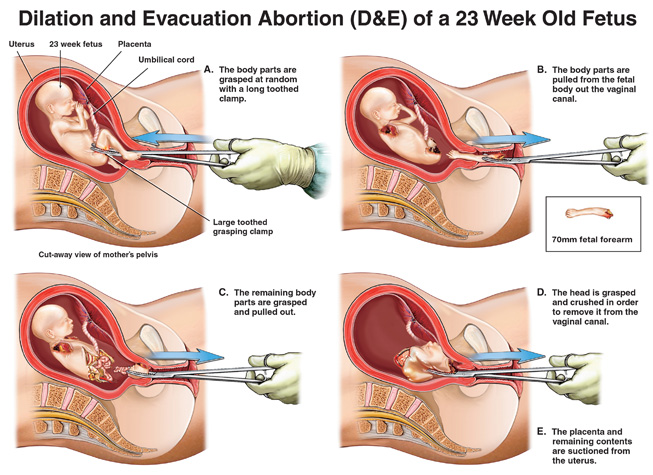
“The fetus within this timeframe of gestation, 20 weeks and beyond, is fully capable of experiencing pain….without question, all of this is a dreadfully painful experience for any infant subjected to such a surgical procedure.”
Professor Robert White, Senate judiciary committee hearing no. 31, June 15, 1995, 70
Quoted in Troy Clark, Ph.D. Abortion Every 90 Seconds: The Whole Story (Kindle, 2015)
20 weeks
This is a medical diagram of a D&E, the procedure Professor Robert White is talking about:
In an article about men and abortion, “Dan” tells his story:
“I really fucked this one up. At 51, I was having an affair with a 25-year-old and got her pregnant. When she told me at a coffee shop, I felt like the floor gave way.
I asked her what she wanted to do, and she was adamant that she wanted to get an abortion. She’d just graduated from college and was focused on her career. She also knew I had two children and a wife I wasn’t going to divorce….
I drove her to the clinic, paid for the appointment and booked a nice hotel suite with flowers for her to recover in. But she ended up in the hospital because they’d made a couple of mistakes during the procedure…. The doctors thought she was going to die. She had a really bad fever. Her parents, who are younger than me, didn’t want me at the hospital. But she did, so I took time off work to visit.
In the end, the doctors were able to fight off the infection, but I’m pretty sure she got a hysterectomy.”
Pro-Choice author Cara J. Marianna interviewed women who had abortions. She tells the story of Nancy. In Nancy’s words:
“I was thinking about being pro-choice. Before the abortion, I was never actively outspoken pro-choice, but I think I felt more and more pro-choice afterward. I remember a year later, in June, I went back home. I’d graduated in December and my mom sold me her old car and I drove it out. I remember I had found this cool pro-choice bumper sticker and I put it on the car. I was so proud of it. It was the message, ‘A world of wanted children would make a world of difference.’ So it wasn’t like ‘I’m pro-choice and proud of it.'”
Nancy later became pro-life and regretted her abortion
“In looking back on her experience, Nancy said, ‘It was pretty bad, the lack of counseling and the doctor. They were just ready to do it. Well, that’s to be expected, though.”
Cara J. Marianna Abortion: A Collective Story (Westport, CT: Praeger, 2002) 129
Even though Nancy had a bad experience, she became pro-choice to justify her abortion. How many pro-choice women are using similar reasoning?