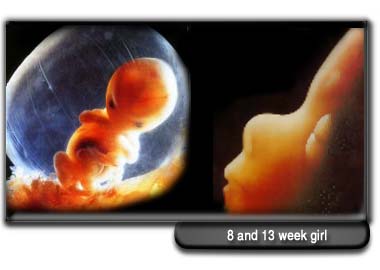
Dr. Liley,a scientist who is known as the “Father of Fetology”:
“We know that he [the unborn baby] moves with the delightful easy grace in his buoyant world, that fetal comfort determines fetal position. He is responsive to pain and touch and cold and sound and light. He drinks his amniotic fluid, more if it is artificially sweetened, less if it is given an unpleasant taste. He gets hiccups and sucks his thumb. He wakes and sleeps. He gets bored with repetitive signals but he can be taught to be alerted by a first signal for a second different one. And, finally, he determines his birthday, for unquestionably, the onset of labor is unilateral decision of the fetus.”
11 weeks
A.Liley “A Case against Abortion” Liberal studies,Whitcombe & Tombs, Ltd., 1971
“In adults, when we contemplate a physical move or action from a resting state, heart rate accelerates several seconds before the motion. The fetal heart does the same thing. [It} speeds up 6-10 seconds prior to fetal movement.”
N. Lauerson & Hochberg, “Does the Fetus Think?” JAMA, volume 247, number 23, July 18, 1982
“In its seventh week [the unborn baby] bears the familiar external features and all the internal organs of the adult….The brain in configuration is already like the adult brain and sends out impulses that coordinate the functions of other organs….The heart beats sturdily. The stomach produces digestive juices. The liver manufactures blood cells and the kidneys begin to function by extracting uric acid from the child’s blood….The muscles of the arms and body can already be set in motion. After the eighth week….everything is already present that will be found in the full-term baby.”
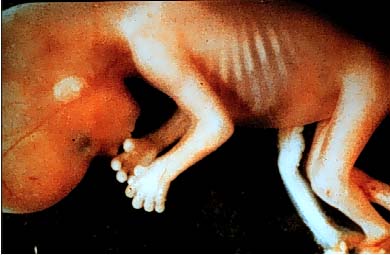
feet of an unborn baby at eight weeks
From an amicus curiae brief submitted by physicians (95:13-14)
John Ankerberg and John Weldon “When Does Life Begin? And 39 Other Tough Questions About Abortion” (Brentwood TN: Wolgemuth and Hyatt Publishers, 1989) 6
“The practice of separating embryonic development from fetal periods is clearly somewhat arbitrary, as most biologic events are not timed precisely…Indeed, many of these processes are not confined to fetal life but extend well into the postnatal period [infancy] Examples include glomerulopoieses in the kidney, alveolar, multiplication in the lung, and myelination of the nervous system.”
Gynecology & Obstetrics: A Longitudinal Approach. Thomas R. Moore, Robert C. Reiter, Robert W., M.D. Rebar, and Vicki V. Baker New York W.B. Saunders Company (October 1993) p 37
“It should always be remembered that many organs are still not completely developed by full term and birth should be regarded only as an incident in the whole developmental process.”
Human Embryology and Genetics. F. Beck Blackwell Scientific Publications
“After 28 weeks in utero, the fetus can hear… by four months in a female fetus, all 5 million ova are formed. At 4 1/2 months the fetus response to a brush it’s lips by sucking. By six weeks the brain is visible and electrically active; by eight, it has convoluted folds and the shape of an adult brain.”
“Do you Hear What I Hear?” Newsweek special issue summer 1991
“Eleven years ago while giving an anesthetic for a ruptured ectopic pregnancy (at 8 weeks gestation), I was handed what I believe was the smallest living human ever seen. The embryonic sac was intact and transparent. Within the sac was a tiny human male swimming extremely vigorously in the amniotic fluid, while attached to the wall by the umbilical cord. This tiny human was perfectly developed, with long, tapering fingers, feet and toes. It was almost transparent, as regards the skin, and the delicate arteries and veins were prominent to the ends of the fingers.”
Dr. Rockwell continues, “The baby was extremely alive and swam about the sac approximately one time per second, with a natural swimmer’s stroke. This tiny human did not look at all like the photos and drawings and models of ’embryos’ which I had seen, nor did it look like a few embryos I have been able to observe since then, obviously because this one was alive! When the sac was opened, the tiny human immediately lost his life and took on the appearance of what is accepted as the appearance of an embryo at this stage of life (with blunt extremities etc.).”
The statement by Paul E. Rockwell, M.D., an anesthesiologist, was quoted by Dr. and Mrs. J.C. Willke in their Handbook on Abortion
“In the sixth to seventh weeks…If the area of the lips is generally stroked, the child responds by bending the upper body to one side and making quick backward motion with his arms. This is called total pattern response because it involves most of the body rather than a local part.”
LB Arey Developmental Anatomy sixth edition, Philadelphia: WB Sanders and Company 1954