In December 1999, the Nebraska University Regents board met to discuss partial-birth abortions, which were being performed by Dr. Leroy Carhart at the University of Nebraska medical center.. A reading of the testimony was taped and played a local radio program the following Monday, introducing it into the public arena. Dr. Carhart was under oath.
“Are there times when you don’t remove the fetus intact?
Carhart: yes, Sir.
Can you tell me about that – when that occurs?
Carhart: That occurs when the tissue fragments, or frequently when you rupture the membranes. An arm will spontaneously prolapse through the os… We talk about the forehead and the skull being first. We talked about the feet being first, but I think in probably the great majority of terminations, it’s what they would call a transverse lie; so really you’re looking at a side profile of a curved fetus when the patient’s uterus is already starting to contract, and they are starting to miscarry, when you rupture the waters, usually something prolapses through the uterine, through the cervical os, not always but very often an extremity will.
What do you do then?
Carhart: My normal course would be to dismember that extremity and then go back and try to take the fetus out either foot or skull first, whatever end I can get to first.
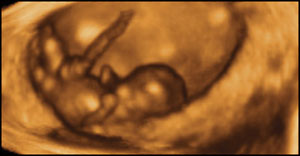
Unborn baby 22-24 weeks
How do you go about dismembering that extremity?
Carhart: Just traction and rotation, grasping the portion that you can get a hold of which would be usually somewhere up the shaft of the exposed portion of the fetus, pulling down on it through the os, using the internal os as your counter traction and rotating to dismember the shoulder or the hip or whatever it would be. Sometimes you will get one leg and you can’t get the other leg out.
In that situation… Are you… When you pull on the arm and remove it, is the fetus still alive?
Carhart: Yes.
Do you consider an arm, for example, to be substantial portion of the fetus?
Carhart: In the way I read it, I think if I lost my arm, that would be a substantial loss to me. I think I would have to interpret it that way.
And then what happens if you remove the arm? You then try to remove the rest of the fetus?
Carhart: Then I would go back and attempt to either bring the feet down or bring the skull down, or even sometimes you bring the other arm down and remove that also and then get the feet down.
At what point is the fetus… Does the fetus die during that process?
Carhart: I don’t really know. I know that the fetus is alive during the process most of the time because I can see the fetal heartbeat on the ultrasound.
The Court: counsel, for what it’s worth, it still is unclear to me with regard to the intact D&E when fetal demise occurs.
Okay, I will try to clarify that. In the procedure of an intact D&E where you would start foot first, with the situation where the fetus is presented feet first, tell me how you’re able to get the feet out first
Carhart: Under ultrasound, you can see the extremities. You know what is what. You know what the foot is, you know what the arm is, you know what the skull is. By grabbing the feet and pulling down on it, or by grabbing a knee and pulling down on it, usually you can get one leg out, get the other leg out, and bring the fetus out. I don’t know where this… All the controversy about rotating the fetus comes from. I don’t attempt to do that – just attempt to bring out whatever is the proximal portion of the fetus.
At the time you bring out the feet, in this example, is the fetus still alive?
Carhart: Yes.
Then what’s the next step you do?
Carhart: I didn’t mention it. I should. I usually attempt to grasp the cord first and divide the cord, if I can do that.
What is the cord?
Carhart: The cord is the structure that transports the blood, both arterial and venous, from the fetus to the back of the fetus, and it gives the fetus it’s only source of oxygen, so that if you can divide the cord, the fetus will eventually die, but whether this takes 5 min. or 15 min. and when that occurs, I don’t think anyone really knows.
Are there situations where you don’t divide the cord?
Carhart: There situations when I can’t.
What are those?
Carhart: I just can’t get to the cord. It’s either high above the fetus and structures where you can’t reach up that far. The instruments are only 11 inches long
Let’s take the situation where you haven’t divided the cord because you couldn’t, and you have begun to remove a living fetus feetfirst. What happens next after you have gotten the feet removed?
Carhart: We remove the feet and continue with traction on the feet until the abdomen and the thorax come through the cavity. At that point, I would try… You have to bring the shoulders down, but you can get enough of them outside, you can do this with your finger outside the uterus, and then at that point the fetal… The base of the fetal skull is usually in the cervical canal.
What do you do next?
Carhart: And you can reach that, and that’s where you would rupture the fetal skull to some extent and aspirate the contents out.
At what point in that process does fetal demise occur between initial remove… Removal of the feet or legs and the crushing of the skull or – I’m sorry – the decompressing of the skull?
Carhart: Well, you know, again, this is where I’m not sure what fetal demise is. I mean, I honestly have to share your concern, your honor. You can remove the cranial contents and the fetus will still have a heartbeat for several seconds or several minutes; so is the fetus alive? I would have to say probably, although I don’t think it has any brain function, so it’s brain-dead at that point.
So the brain death might occur when you begin suctioning out of the cranium?
Carhart: I think brain death would occur because the suctioning to remove contents is only two or 3 seconds, so somewhere in that period of time, obviously not when you penetrate the skull, because people get shot in the head and they don’t die immediately from that, if they’re going to die at all, so that probably is not sufficient to kill the fetus, but I think removing the brain contents eventually will.”
Testimony of Leroy Carhart, M.D. Quoted in Randy Alcorn “Pro-life Answers to Pro-Choice Arguments” (Sisters, Oregon: Multnomah Publishers, 2000) page 207-208
A pro-choice feminist who observed at an abortion clinic told the following story of a woman who came in for an abortion:
“The second woman was Japanese and spoke very little English, and she had not brought anyone to translate.… This woman actively resisted… She was very drugged up – Demerol and Valium on top of the Sublimaze. She wouldn’t keep her legs open and kept sliding up on the table. From the second Roger first touched her, she looked like she was in agony.
What happened was that three people held her down, basically. Julia and Toby held her legs apart, and Ilene, who was assisting, held her at the waist to keep her from sliding up. I stood at her side and tried to get her to do deep breathing, pretty ineffectually. It was horrible to watch… Roger looked very annoyed during the whole thing. Toby told me later that when Julia was first encouraging the woman to take deep breaths, Roger said, “This will make or breathe!” And slid in the speculum roughly. I had thought of him as very compassionate but apparently not when things don’t go well. I wonder what that woman was thinking during the whole thing.”
Wendy Simonds. Abortion at Work: Ideology and Practice in a Feminist Clinic (New Brunswick, New Jersey: Rutgers University Press, 1996) 75
On November 2nd, 2012 the organization 40 Days for Life, which arranges prayer campaigns and protests outside abortion clinics, told the following stories:
In Michigan:
A woman visited the pregnancy help center just down the street from the 40 Days for Life vigil – after “a nice man” praying at the abortion center gave her a coupon for a free ultrasound.
She said she had gone into the abortion facility and planned to have an abortion. They did an ultrasound first – and she asked to see the screen. “Is that my baby’s head?” she asked. She was told, “Yes, but it’s just a blob.”
They started the procedure, but it was painful for her and she made them stop. They let her off the table so she could calm down a bit before trying again. But once off the table, she had made up her mind not to go through with it.
A few days later, she showed up at the pregnancy center. She and the ultrasound tech watched as the baby seemed to wave, jump and turn. They listened to the baby’s heartbeat … and tears of joy fell from her eyes. She was so happy to have this precious child safe and secure.
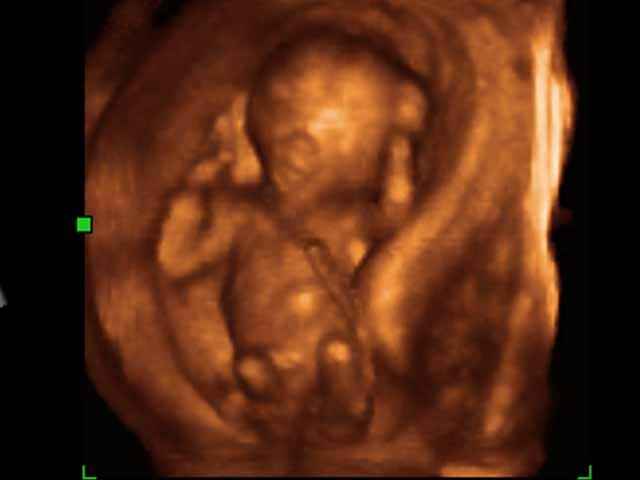
Here is a picture of her unborn baby, the picture that changed her mind:
Another story came from Bakersfield California:
A woman had made the long drive from another county for an abortion appointment. She was one of the first to arrive that day, walking past the vigil participants and into the building.
As she was leaving, the volunteers noted that she might have been inside long enough for the abortion. They also noted that she was crying, so one of them asked her, “Is there anything I can do to help?”
“I couldn’t do it,” the woman said. “They were doing an ultrasound, so I asked if I could see it. At first they refused, telling me ‘you don’t really want to see it.’ But I insisted ‘yeah, I do want to see it, because if I can see it … maybe I won’t do it.’”
She was right. Once she saw her nine week baby on the ultrasound screen, she knew that she couldn’t go through with the abortion.
Do women ever get abortions because the baby is the wrong gender? one abortionist recounts a story:
“In one case, a woman who was in her late thirties, well educated, and a professional person with healthy children requested an abortion for the reason that the fetus was male…The fetus was normal but it was male…
Even though I had begun by being totally opposed to an abortion for this reason, she persuaded me that, in her mind, abortion was the only choice she could accept for this pregnancy for her own mental health as well as the welfare of her family.
The lesson from this anecdote is that we, as abortion-service providers, cannot place moral judgments on the motives or actions of out patients.”
Jenny Jerrome has a page where she rates abortion clinics for women, advertising those that she feels best serve them. Here is some of the advice she gives pregnant women considering abortion:
“Don’t get sucked into one of those abortion options counseling centers. They will hound you and heap guilt on you and pound on you until they break down your spirit and force you to wait until it is too late. Then, they will abandon you and look down their noses at you.…
Don’t wait. Make your decision quickly it’s a hard thing to do, but the longer you wait, the fewer options you have. Take a day, (no more than one day) and make your decision. A favorite tactic of those who don’t want you to have a choice is to delay, find excuses for you to delay a little longer, and finally tell you, “tough luck honey, it’s too late!”
Crisis pregnancy centers have helped tens of thousands of pregnant women and new mothers, offering both emotional support and material help, including referrals for medical care and social services. Some crisis pregnancy centers follow the women for years, providing daycare assistance and parenting classes, and job training, whereas an abortion clinic will do her abortion and sent her home. Putting pressure on a pregnant woman to decide what to do about her pregnancy quickly is a common technique that abortion clinics use in order to convince women to have abortions. Studies show that the longer a woman waits to have an abortion, the more likely she is to change her mind and have her child. Abortion clinics know this.. They will often say that it will become too late to have an abortion if the woman does not abort immediately. In reality, abortion is legal for all nine months of pregnancy and over half of all abortion clinics perform abortions after 12 weeks.
Jerrome continues with her “good advice”:
Under “Who Will Know I Had an Abortion?”
“First, don’t tell anyone. If you told someone you were going to have an abortion, lie! Yes, lie! Tell them you started bleeding and it was suddenly all gone. Cry a little, if you can, and say you feel better and don’t want to talk about it… Remember, you can’t trust anyone with this. If you really don’t want anyone else to know, you have to keep it from your closest friends and family. You might be able to trust them now, but over time, things will change. Your relationship with them might change… Don’t tell and no one will know!”
Isolating the pregnant woman from her support system is one of the cruelest things that can be done to her. A woman should not be forced to go through an abortion decision on her own. Friends and loved ones can help a woman talk things out. Fear and and a sense of being alone often drive a person to choose something in a moment of crisis that they will regret for the rest of their lives. A woman should find out what support is available for her and her child if she chooses to carry the baby to term. Making a decision in isolation, without reaching out to anyone for help, can lead to devastating guilt and grief as well as undue pressure to have an abortion.
Not content with simply isolating a woman from her support system during her pregnancy, Jerrome takes it further and encourages her to lie about her abortion. This can set the course for a lifetime of denial and shame as the woman feels that she needs to hide this terrible secret from everyone she knows. It can be a major block to healing which needs to take place after an incident as traumatic as an abortion.
In an article in the Weekly Standard, the author says:
Two pro-choice leaders, Kate Michelman and Frances Kissling, acknowledged three years ago that “antiabortionists” had gained a significant advantage. Supporters of abortion, they wrote in the Los Angeles Times, “have had a hard time dealing with the increased visibility of the fetus.” To “regain the moral high ground,” they must deal with “a world that is radically changed from 1973,” when the Roe v. Wadedecision legalized abortion nationwide.
They are referring to pictures like the one below, which shows an unborn baby in the first trimester, the time when most abortions are performed
It is obvious that these images change hearts and minds, and pro-choice activists can no longer get away with arguing that the unborn baby is a clump of cells or blob of tissue. People can see the evidence with their own eyes. In fact, according to the article, 80 to 90 percent of the women who have sonograms at pregnancy centers choose to have their baby.
Perhaps this is why there is such a campaign against crisis pregnancy centers by pro-choicers who want to shut them down or at least deny them access to ultrasound machines. Pro-choice organizations bitterly fight laws that would require a woman to be offered the chance to view an ultrasound before her abortion.
Fred Barnes “Hidden Persuaders:The unheralded gains of the pro-life movement” The Weekly StandardNOV 7, 2011
Mother of a five-year-old girl with a cleft lip and palate wrote this letter to the editor:
“I was horrified to read that many couples now opt for abortion rather than risk having a baby with such a minor physical imperfection. My daughter is not some abnormal freak… She can, and does, lead a happy, fulfilled life… What sort of society do we live in when a minor facial deformity, correctable by surgery, is viewed as so abnormal as to merit abortion?”
Susan Kitching, London Sunday Times, February 11, 1990
Jean Wright, M.D., of Emory University School of Medicine, testified before a committee of the Virginia State Senate:
“Aspects of pain architecture begin as early as six to seven weeks, mature and are identified by their anatomy, their physiology, and the coordination of responses so that by 20-22 weeks of gestation, the evidence reveals a developed system of pain perception and response. … The ability to modulate or blunt the pain response does not develop until the last weeks of pregnancy and the first few weeks of infancy, leading us to believe that the pain perceived in the fetus is greater than that in the full-term infant.”
Paul Weyrich “Unborn Pain” Newsmax.com June 28, 2004
Associate Editor Meredith Oakley’s column entitled: Abortion business is profitable states,
“Abortion, you see, is something of a cash cow at the University of Arkansas for Medical Sciences, the facility against which abortion opponents filed a lawsuit in 1991 on the ground that UAMS was violating the amended Arkansas Constitution by performing abortions for reasons other than to save mothers’ lives. According to testimony by Dr. Harry Ward, the UAMS chancellor, the abortion program is self-supporting. Indeed, thanks to the exorbitant rates imposed on the paying customers, the UAMS abortion program generates enough profit to cover the debts of the non-paying customers. Consider last week’s (State Court opinion, on funding of abortion with tax dollars) : “It appears that the charges billed by UAMS far exceed costs, since full-pay patients cover the costs of those patients who do not pay.” The opinion noted that UAMS charged $ 2,500 for an abortion through June 1, 1992, but later raised the charge to $ 4,000. Not only is the state still in the abortion business, it’s doing very, very well.”
Arkansas Democrat-Gazette ,Abortion business is profitable: 5-11-1997
Retired New Jersey abortion provider Robert Livingston was a champion for abortion rights in the ’60s and ’70s — once, in 1972, he even held a press conference outing himself as an illegal abortion doctor. But now, almost half a century later, Livingston avoids talking about reproductive rights because he believes the issue has become more “emotionally charged” than it was back in the day.
…
Livingston said he thought the stigma of being an abortion doctor is greater now than it was in the 1960s and that public opposition is stronger than he’s ever seen “
Note: Dr. Livingston has no medical license – it was suspended in 2007 after he neglected to attend a treatment program after abusing prescription painkillers. Unsurprisingly, the Jezebel article did not mention this fact