“I have been in the same unfortunate position as the nurses in the story…doing everything medically possible to save a one baby while monitoring 2-3 aborted babies that are only 2 weeks younger, waiting up to 8 hours for them to die. It is heart-breaking and you keep asking yourself why.”
Sarah Terzo “Babies born alive after abortions, part 3: nurses tell their stories”Live Action April 12, 2013
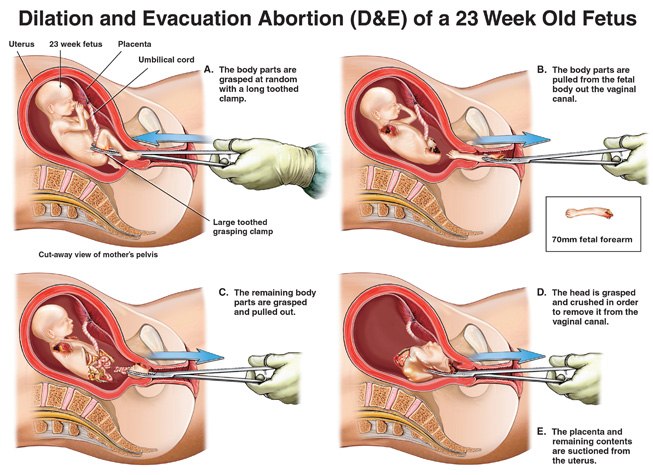
Many people are not aware that abortions in the late second and third trimester are legal, much less that they occur often. Read more about late term abortion in this section. Most late term abortions are done for elective, not medical, reasons.
Pro-choice feminist Wendy Simonds interviewed clinic workers who talked about how they felt when their clinic started performing abortions up to 26 weeks.
From one clinic worker:
“… We were so excited that women who were 26 weeks could get an abortion at our clinic and not have to go to Pavilion for a saline induction… But we were also extremely sensitive to what the increasing gestation was going to do to us as human beings… We’re just not hardened to the fact that abortion is hard. The women… are going to be in more pain… The abortions are going to be longer. The assistant is going to have to watch a much, you know, further abortion. And there’s a marked difference between 26 weeks and 21 weeks in terms of fetal development… We had [meetings] where we talked about our feelings… We talked about the ambivalence about wanting to provide this service and being really excited about it and being really nervous about handling the tissue.”
26 weeks
From another:
“so I felt like the women were getting a good procedure. And then I also felt… Thank God that were doing this!… I’m glad we’re doing it.”
Picture of an abortion around 26 weeks
A third clinic worker:
“I like that we go up to 26 weeks. For a while it kind of gave me some things to learn… Plus it gives a whole new dimension to working with those women who come in for later abortions. It’s, like, great because they almost can’t have an abortion. They’re almost about to have a baby, and they don’t want to. And they’re really appreciative.”
Wendy Simonds. Abortion at Work: Ideology and Practice in a Feminist Clinic (New Brunswick, New Jersey: Rutgers University Press, 1996) 62, 63
24 week abortion- two weeks before the cut off of when this clinic performs them
From an article that described questions and uncertainties abortion providers had about their jobs:
13 weeks
“Patients also sometimes ask to view the fetal remains. A Toronto physician said she didn’t know “how and whether we [should] protect the patient from the reality of the procedure.” She said she regularly hid the ultrasound screen and “whisked away” the “fetal products.” “She’s probably not prepared for what she is going to see,” she said of the patient.”
Diane M. Gianelli “Abortion Providers Share Inner Conflicts” American Medical News, 12 July 1999
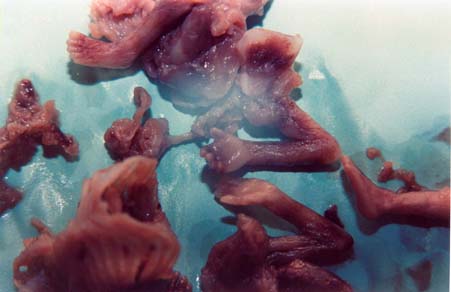
see pictures of what the remains of abortions look like
Shane Krouse, MSU sophomore and State News columnist:
“If anything, a fetus is merely a parasitical creature that uses the mother as its host. Tapeworms are parasites that house themselves in the intestinal tracts of humans, feeding off the food the host consumes. Comparatively, a fetus is little more than a tapeworm. It is quite common for humans to annihilate parasites with medications or toxins, so why not allow for fetuses to suffer the same fate?”
MSU State News:Wad of cells does not equate to human life, abortion isn’t murder:7-26-2006
“For many women nowadays, they’re angry that they had a choice. It’s too bizarre, but it’s like, if you weren’t here, I wouldn’t have to make this choice…
We’re working really hard at this clinic to assist women in moving from a place of experiencing themselves as victim of their decision, or their boyfriend, to moving to a place where they see this differently. I think that the same needs to happen with the physician. If the physician is a victim of the antiabortion movement, or a victim of other antiabortion doctors or a victim of Operation Rescue – no change is going to come from that. Plus, victims are annoying, you know. They don’t invite your participation.”
From an interview with Rachel McNair on page 123 of Rachel M MacNair, PhD. Achieving Peace in the Abortion War (New York: iUniverse, 2009)
9 weeks
Perhaps this baby and others like him are more the “victims” of abortion.
Dr. Richard Hausknecht, a New York City gynecologist who used to perform late abortions but no longer does so describes the partial birth abortion method:
the type of abortion he describes
”You go in and fish out a foot and pull the fetus into a breech position. You turn it so that the backside is up, pull down on its hips and rotate. When you get to the shoulder blade, it’s easy to sweep the arms down. Then, most of the time you have to crush or fenestrate the skull so that it can come out.”
”This is not something I rely on, but I find it absolutely bizarre that Congress wants to ban it….In my view, it’s as if they were to forbid me to use a certain kind of suture.”
Deborah Sontag “Doctors Say It’s Just One Way”The New York Times, March 21, 1997
Here is a picture of a 22-24 week old baby, of the age when most abortions of this type were done.
Here is a quote from a pro-choice author who interviewed workers and observed at an abortion clinic where abortions were done up to 26 weeks.
“Denying women access to safe abortion (whether we have been raped or not) is itself a form of figurative, if not literal, violation …. Rape denies us bodily integrity; so does restricting abortion. Both are strategies designed to subjugate women.”
Wendy Simonds. Abortion at Work: Ideology and Practice in a Feminist Clinic (New Brunswick, New Jersey: Rutgers University Press, 1996)229
“Most of the counselors didn’t like dealing with women who had had several abortions, they saw them as irresponsible at best, or, at worst, stupid. But I liked “repeat aborters” because they already knew what to expect and weren’t afraid of the abortion. They offered less emotion for me to soak up; they were easy process in 10 minutes.”
Wendy Simonds. Abortion at Work: Ideology and Practice in a Feminist Clinic (New Brunswick, New Jersey: Rutgers University Press, 1996)page 7
Abortion clinic worker “Toby” who was adopted talks about handling the bodies of aborted babies:
“… I think also just that the more you think about what it looks like… It looks like a baby. And you know that sometimes… We go farther than we intend to, then that’s really, really hard too because I was premature, and looking at this thing that could’ve been me, you know? And I try not to personalize it that much because it could’ve been me, and I would never know because I wouldn’t be here, but it’s still hard to do…I think I probably cope with it better than some other people who work here who talk about having nightmares and stuff…In the first couple of months [when] I started working here, I’d have images of, like, the face, you know , when it comes into sterile room. And I always turn it over. But I don’t dream about it. I dont’ know if that makes me more repressed or better able to cope. [Laughing].”
abortion at 20 weeks
Wendy Simonds. Abortion at Work: Ideology and Practice in a Feminist Clinic (New Brunswick, New Jersey: Rutgers University Press, 1996)84
The clinic this person works at does abortions up to 26 weeks.