Parents of disabled baby want to “hurry” his death, refuse operation

From a writer and researcher who spent time in a pediatric hospital, where they took care of disabled babies and did “genetic counseling,” where they sometimes advised women to abort their disabled children, this passage describes a family that chose not to treat their disabled baby and instead to allow him to die:

“She [the woman who counseled the parents] reported that the parents had decided not only that they did not want to repair the child’s oomphalecele, but they wanted the child to die, and they were willing to do what they could to hurry that event along. The parents had left orders that the child not be fed. She reported that Berger was very upset with this turn of events… Berger claimed that it was one thing for the physicians and the parents to handle this, and quite another for the nurses who had to deal with the infant every day and would be the ones to watch it starve.”

“Bill [a doctor] reported that the mother was discouraged because today the baby looks good. She was hoping that it would die soon, so seeing it looked healthy really discouraged her.”

Charles L Bosk All God’s Mistakes: Genetic Counseling in a Pediatric Hospital (Chicago: The University of Chicago Press, 1992) 77, 80


Share on Facebook
Prochoicer: it should be mandatory to abort babies with down syndrome

Detroit News survey asking women if they would have an abortion in the first trimester if the baby had down syndrome. One answer:

“it should be a mandatory abortion–at a minimum of $4million per child society cannot continue to pay for every unhealthy baby that a parent wants but wont take financial responsibility for–let parent birth them if they agree to sign over their tax returns, and 100% of assets to the people or abort them”

Quoted from here

Share on Facebook

Genetic counselors overstate health risks of babies by fudging numbers

A researcher who sat in on sessions where “genetic counselors” spoke to pregnant women, describes how the counselors explained the risks of genetic abnormalities:

“… the very fact that risks can be expressed in numeric form allows counselors, if they choose, to merely pass information on to clients in an objective fashion; for example, “The normal population risk is 3%. Your risk is 6%.”… Such risk statements without elaboration are rare… For example, consider the difference between the following statements, each of which is correct: “Your risk is 3% greater than that of the general population” and “Your risk is double that of the general population.” Risk statements of the latter form are more common than bare, unelaborated numbers, despite the counselors’ commitment to not intruding on the privacy of patient decision-making.”

Charles L Bosk All God’s Mistakes: Genetic Counseling in a Pediatric Hospital (Chicago: The University of Chicago Press, 1992) 28 – 29

So we see how hospitals, perhaps because of fear of malpractice, sometimes use subtle ways to overstate the risks of a child developing a genetic problem. This may lead to more abortions as parents overestimate the risks and abort healthy children.

Share on Facebook

Betty Friedan Calls Disabled Babies “Monsters”

CNBC’s “Hardball” debate on partial birth abortion between Helen Alvare of the National Council of Catholic Bishops and Betty Friedan, well known pro-choice feminist:

Friedan: “How lacking in compassion you are for women’s right to control their bodies! You want to force women to give birth to monsters! How terrible you are.

Alvare: “Calling disabled people “monsters” is hardly a start for a dialogue.”

Keep in mind that many of the babies aborted in the late 2nd and 3rd trimester, when partial-birth abortions were performed, are down syndrome children. Classifying these handicapped children (or any handicapped children) as monsters should be deeply offensive to everyone who cares about the disabled.

“News Briefs ”The American Feminist volume 4 number 3, Fall 1997

24 weeks, average age for partial birth abortion
Share on Facebook

Response to survey on down syndrome children shows contempt and selfishness

Detroit News survey asking women if they would have an abortion if the baby had down syndrome. One respondent said yes:

“Let’s be practical. I am not giving up 80% or more of my life to care for a Down Syndrome baby that will be depend on me through his/her adult life. “Corkey” was lucky and probably the only cast to get ratings to play on the hearts of others. Let me be as upfront as possible……This is the ‘Me’ generation, and with health costs increasing endlessly, who has the money?”

Quoted in the blog JivinJehosephat

Over 95% of all children with down syndrome report being happy, and many parents,  find raising these children very rewarding. There is even a waiting list for adopting down syndrome babies

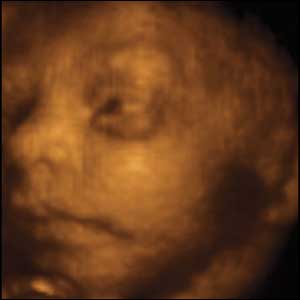
14-week-old baby – down syndrome is not detectable in a baby like this until he or she is at least 4 weeks older
Share on Facebook

Woman aborts disabled baby

From a woman who had a down syndrome pregnancy:

“Unless the child was institutionalized, I would have to give up my teaching to be a full-time nurse, putting the entire financial burden on [my husband] Bud. We would have to begin saving immediately for that day, in our old age, when we could no longer care for the child at home. While we may have somehow coped had we never had the tests, Bud couldn’t fathom knowingly bringing these burdens upon us… I decided I must go through with the abortion to preserve my family.”

Maria Vida Hunt, McCall’s, July 1985

quoted in Bonnie Szumski , Abortion: Opposing Viewpoints (St. Paul, Minnesota: Greenhaven Press, 1986)

Tests for Down Syndrome are not accurate until 16 weeks, when the baby is fully formed. (see below)

16 weeks

Abortions at this stage are done by dismemberment- a doctor tears apart the baby with forceps, taking it out piece by piece.

Remains of baby at 16 weeks

Was the suffering of the baby justified by the family’s right not to be inconvenienced? There is a waiting list to adopt even down syndrome babies.

Share on Facebook

University of Washington geneticist on health insurance

16 weeks – amniocentesis is done around this time.

When health insurers do enter the field [of genetic counseling], some enterprising company may offer to pay for amniocentesis and abortion, if indicated, but not for subsequent medical care of the offspring, should abortion be refused.”

Dr. Gilbert S. Omenn, Medical Genetics Division, University of Washington. Quoted in “M.D. Predicts Forced Abortion.” National Right to Life News, July 1975, page 4

Cases of this have already happened. When health insurance will cover the abortion of a disabled child, but not that child’s care, parents are being coerced into aborting their handicapped children.


Share on Facebook

Disabled people shouldn’t have children, says abortion advocate

Abortion advocate Joseph Fletcher:

“People who carry genetic disease should be prevented from having children. We ought, in conscience, to have a humane minimum standard of reproduction, not blindly accepting the outcome of every conception. And we ought to act on our genetic information to prevent the birth of children below that minimum.”

Bioethicist Joseph Fletcher, during his address of the second national Symposium on Genetics and Law, held in May of 1979 in Boston and sponsored by the March of Dimes.

This is an old quote, but it shows that the eugenics movement has existed in our country for some time. Read more quotes about abortion in cases of disability.


Share on Facebook

Patricia E. Bauer on babies with disabilities

“In ancient Greece, babies with disabilities were left out in the elements to die. We in America rely on prenatal genetic testing to make our selections in private, but the effect on society is the same. Margaret’s [her daughter with down syndrome] old pediatrician tells me that years ago he used to have a steady stream of patients with down syndrome. Not anymore. Where did they go, I wonder. On the Westside of LA, they aren’t being born anymore.”

Patricia E Bauer “The Abortion Debate No One Wants to Have,” Washington Post, October 18, 2005 A 25

Share on Facebook

Woman Who Aborted Her Down Syndrome Baby: “Psychological Pain Is Enormous”

From a woman who aborted her down syndrome baby:

20 weeks

“The psychological pain is enormous. Deciding to end the life of a fetus you’ve wanted and carried for most of five months is no easy matter. The number of relatively late second trimester abortions performed for genetic reasons is very small. It seems an almost inconsequential number, unless you happen to be one of them.”

Tricia Andryszewski Abortion: Rights, Options, and Choices (Brookfield, Connecticut: The Millbrook Press, 1996) 53-54

Research shows that 99% of adults with down syndrome are happy with their lives. 


Share on Facebook