Nurse Marlene Costa worked in New York abortion clinic for short time before leaving in 1989. This is what she has to say:
“The women did receive counseling, if you could call it that..I was one of the so-called counselors. There was absolutely no factual information given on fetal development, not a word spoken about the risks, & the counseling was completely biased..They were told that the fetus was a ‘blob of tissue,’ not to feel guilty about it, not to beat themselves up about it and [were] comforted if they had apprehension about it.”
There was definite pressure to sell abortions…I was told ‘get the cash & get them out.’ in fact, my coworkers made fun of me for staying ‘too long’ with the patients, giving comfort..They prided themselves on how much money they raked in each Saturday morning.
Costa never witnessed abortion procedures or saw the remains of aborted babies. She worked strictly with the women. However, despite the fact that she was insulated from the worst aspects of the clinic’s work, she quickly became disillusioned with the clinic’s focus on making money at the expense of vulnerable women:
“I still believed in the right to abort at that time..I just began to get sick at the heartlessness & callous atmosphere. It was all about the money.”
Also:
“I assisted him during exams of women and was repulsed b/c I actually witnessed him ‘coming on’ to the attractive patients while examining them..it was disgusting.”
Like many clinic workers, Costa had an abortion before working at the clinic. There were protesters outside the clinic when Costa had her abortion. However, they did not reach out to her with compassion. Rather, in her own words, one woman “slammed me with a Bible while I tried to enter the clinic.” This behavior from pro-life protesters did not cause her to reconsider her decision. She says:
“I think non-biased education, with videos, pictures, etc. on human development, in addition to ultrasounds would be the most effective in preventing abortions.”
Former abortion clinic director Abby Johnson describes why abortion providers fight laws requiring women to be asked if they want to see an ultrasound of their baby before an abortion
“Planned Parenthood Federation of America and the National Abortion Federation both REQUIRE ultrasounds to be performed before an abortion takes place. During a first trimester procedure, a transvaginal ultrasound is required. An abdominal or transvaginal is allowed in the second and third trimesters.
There is one reason for this. They need to be able to see exactly how far along the woman is in her pregnancy so the abortion facility knows how much to charge for the abortion. There is one reason they don’t want women to see their ultrasound…it is too risky. Ultrasounds expose the lie of the abortion industry. They show that it is not just a “blob of tissue” or a “mass of cells.”
Ultrasounds show the humanity of the child. They don’t oppose ultrasounds because it is too time consuming. They are performing them anyway! They are required (by their own rules) to perform them. It is not traumatizing for the woman. They are about to perform an invasive and painful procedure on these women and they are seriously worried about how an ultrasound will feel? Of course not. They only oppose ultrasounds because of the risk…a woman may choose life and they may be out several hundred dollars. It is pretty plain and simple.”
In the book The Zero People, a nurse, writing under the name “Mary Roe,” wrote the following essay about her experiences with abortion:
“I was for abortion. I thought it was a woman’s right to terminate a pregnancy she did not want. Now I’m not so sure. I am a student nurse nearing the end of my OB/GYN rotation at a major Metropolitan hospital and teaching center. It wasn’t until I saw what abortion involves that I changed my mind. After the first week in the abortion clinic several people in my clinical group were shaky about their previously positive feelings about abortion. This new attitude resulted from our actually seeing a Prostaglandins abortion, one similar in nature to the widely used Saline abortion.
What the medical professionals proudly feel is an advancement in gynecological medicine – the prostaglandins induced abortion – is actually, I now believe, a biochemical murder. It is a natural body substance being used to produce what is an unnatural body action: an abortion. Prostaglandins is a fatty acid present in many body tissues and affects the contractability of smooth muscles, especially useful in stimulating the muscles of the uterus. It is now being used in some medical centers to bring on labor post 16 weeks of conception and up to 20 weeks.
The 2nd trimester abortions are induced by prostaglandins by IV, vaginal suppositories, or most often by intraamniotic deliverance of prostaglandins. Actual labor is induced and the average abortion time is anywhere from 6 to 20 hours but can be longer. The pains are strong rhythmic contractions (just like the labor pains a woman has prior to the birth of a child). The fundus, the firm height of the uterus during pregnancy, moves under the nurse’s hand. The fetus is moving too.
The placenta, the biological separation between maternal and fetal systems, is jarred by the passage of pain medications. The strong analgesics quickly pass through the maternal bloodstream and into the fetal system to be absorbed there at a many times greater potency. Further assault. Ironically, it is an obstetrician who carefully advises against the use of even aspirin during pregnancy, for the child’s sake, but who now orders the dose of Demerol or Valium for the woman in the pains of abortion.
The fetus continues to move, harshly pushed down the birth canal by the strong muscle contractions of the uterine myometrium caused by prostaglandins. The woman remains in bed, unattended much of the time. It is a long wait. Hours pass.
Vital signs and the progress of labor are checked by the nurse at intervals. This nurse is one who is generally used to dealing with the advent of life, not death. She has at one time reassured a tired woman in labor that the tedious process will bring on the birth of a child, not a “termination of unwanted pregnancy”; an unnamed fetus.
16 weeks
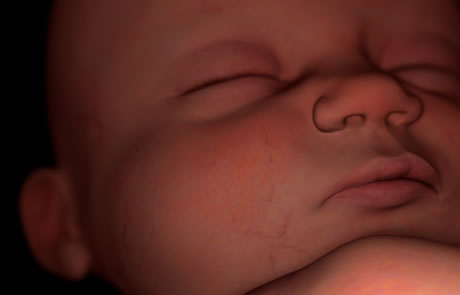
Finally the violent contractions of the prostaglandins have done their job. The fetus is expelled wet, red, mucus covered and warm. Limbs are flexed. The head and chin are bent into the chest. The slit like eyes are closed innocently. It is a miniature human being, being awakened from sleep too soon by a woman who was given the choice to interrupt her pregnancy.
The umbilical cord is cut. The fetus is taken away and the woman waits to expel the placenta. In an hour or 2 the entire process is over. She sleeps and then is discharged if there are no complications. She goes home. But I wonder if she realizes just how much he has left behind.
By that time in gestation chromosomes are laid out – distinctive markers of heredity. Crossing over of the genes assures that this fetus would have been unlike any human being: alone, special, and unique. Had it lived.
Although still in the experimental stage, this method is being used for terminations of pregnancies of 16 weeks and over. I used to find rationales. The fetus isn’t real. Abdomens aren’t really very swollen. It isn’t “alive.” No more excuses. At 16 weeks the fetus is well formed. By 20 weeks the face, eyelids, nose, and mouth are formed. Organs are well-defined. The heart and circulatory system have been laid down and I have heard a fetal heartbeat at 20 weeks (a pregnant friend of mine told me she heard her baby’s heartbeat at 10 weeks) with the Doppler machine – fast and bounding. Hair begins to appear on the head. The arms and limbs are formed. Sex of the fetus is evident. This is what is expelled from the uterus into a hospital bed or bedpan to be wrapped up quickly and carry to pathology and disposed of.
I am a member of the healthcare profession and members of my class are now ambivalent about abortion. Whereas before I was firm on my stand for abortion, I now know a great deal more about what is involved in this issue. Women should perceive fully what abortion is; how destructive an act it is both to themselves and to the unborn child. Whatever psychological coping mechanisms are employed during the process, the sight of a fetus in a hospital pan remains the final statement.
I’ve lost the steadiness in my voice when I discuss abortion. I find it difficult to say the word. That firm conviction, “a woman’s right,” is gone. There is a time to live in a time to die but I feel that there is a far greater authority to decide that time that a woman or her doctor.”
Jeff Lane Hensley The Zero People (Ann Arbor, Michigan: Servant Books, 1983) 221 – 222
Clinicquotes did an interview with former clinic worker Jewels Green. Her website, which has more information about her story as well as article she has written, can be found here.
1. What was the counseling like in your clinic? Did you give accurate information? Was it biased?
Women who came in to the clinic for an abortion were seen by a counselor one-on-one before paying for their abortion. This mandatory counseling session included making sure the abortion was her decision and that no one was coercing her, explaining the abortion procedure and aftercare, and asking her what kind of birth control she was intending to use when she resumed sexual activity after her abortion.
During my time working at the clinic a law was enacted requiring abortion clinics in Pennsylvania to offer each woman state- drafted information on fetal development that includes hand-drawn actual-size sketches of the detailed level of fetal development as well as size by weeks LMP of pregnancy. There was a script we had to follow, also drafted by the state, that went something like this—know that I’m paraphrasing from memory, “I am required by the Commonwealth of Pennsylvania to offer you detailed information on fetal development and information on WIC and public assistance available to pregnant women and families. The father of child is legally obligated to assist you financially in raising your child should you choose to continue the pregnancy. Would you like to see any of these materials?” Nine times out of ten, more like 19 times out of 20, the woman would decline.
Ultrasound of baby at 10 weeks
….When explaining the abortion, the word “baby” was never used, rather “contents of the uterus”, “the pregnancy”, or “products of conception” were the preferred terms to refer to the fetus.
2. Have you ever witnessed a second trimester abortion? Is there any way you may be able to describe it?
No, I have never witnessed a second trimester abortion. However, when the clinic where I worked gained approval to do abortions up to 16 weeks (from the original limit of 14 weeks) I had seen the aftermath of a few of those abortions in the autoclave room (where surgical instruments are washed and sterilized and where the doctor reassembles the body parts of the fetus to assure a complete abortion.)
14 weeks
3. Did you ever view the remains from abortions? If so, can you tell me what you saw? How did the clinic handle the remains? Were they buried, incinerated, sent to the lab, etc?
I saw the remains of hundreds, if not thousands, of first-trimester abortions in the more than five years I worked at the abortion clinic. The remains were bagged in red biohazard bags with anything else bloody, and put into a freezer until they were picked up by a medical waste management company. I assume they were then incinerated, but I do not know for certain.
4. Were parts ever visible?
9 weeks after conception
“Of course teeny-tiny body parts were visible. Well over half of the time body parts were easily discernible. Maybe more like 75% of the time. That was the only way the doctor could ascertain that the abortion was complete–to count limbs, make sure the spine and skull were present. The “blob of cells” argument is only spouted by people who have never seen the aftermath of an abortion. It is true that in a very, very early surgical abortion (about 8-9 weeks LMP) [Editor: this is about 6-7 weeks after conception] the fetal parts are too small to be seen, and in those cases the doctor looks for the gestational sac and chorionic villi to ensure a complete abortion.”
Marleen worked in a hospital that performed abortions. After 30 years, she’s come forward with her story.
“My husband was a resident at a hospital and I just got “the job of my dreams” at a nearby Oakland hospital. I was very much a believer in the abortion issue and now I felt I was going to be part of it.
24 weeks
I got hired as a charge nurse at this clinic that did late term abortions. I spent about 30 days on the day shift getting familiar with everything. I would witness and assist the doctor in the actual procedure, injection of drugs to the fetus, the seaweed, etc. On the day shift I really never saw the actual start of the contractions or the termination process. I was uncomfortable, but I really thought to myself, this was something new and I needed to get more experience.
26 weeks
One evening a young girl was having a very difficult time. I was there with the doctor. I knew even though the doctor wrote this patient was 15 weeks, she was close to 30 weeks. This happened quite a bit, but no one ever said anything.
When she delivered this tiny baby (it looked full term to me) she was actually alive and crying. The doctor said to me, “Put it in the room and close the door. Do not enter til the morning shift.” I immediately took the crying baby and wrapped it up and laid it in a room. I then immediately started calling hospitals around (against the doctor’s wishes) to find someone that would take it. None around would take it cause they said it was not viable. I spent many hours trying. I just wanted to leave this place, but I knew I could not walk out and leave other patients without a charge nurse. Til this day I hear this crying infant in my head.
28 weeks
I wish others that promote abortion, especially late term would experience what I did. The next day, I terminated my employment immediately and landed a job in a pediatric unit at another hospital.”
Joyce Craigg, director of a Brooklyn Planned Parenthood clinic, worked in surgery assisting in late abortions for two months, then quit.
“The doctors would remove the fetus while performing hysterotomies and then lay it on the table, where it would squirm until it died. One Catholic doctor would call for sterile water every time he performed a hysterotomy and baptize them then and there. They all had perfect forms and shapes. I couldn’t take it. No nurse could.”…
James Burtchaell, editor Rachel Weeping and Other Essays on Abortion ( Life Cycle Books 1982) 34
A hysterotomy abortion is similar to a C-section, were an incision is made into a woman’s uterus and the baby removed. It is done late in pregnancy, but before the point where a baby can survive on its own. These abortions were rarely done even in the 1980s, they are almost never done today because they result in a live birth of a baby that has to be disposed of. Also, they carry unnecessary medical risks for the mother. Today most late-term abortions are done by D&E, where the baby is dismembered in utero, or by injecting digoxin into the woman’s uterus or directly into the baby’s heart to stop it, then inducing labor.
Eidelman worked for a short time in an abortion clinic that provided second trimester abortions. She said:
“They always wanted to know the sex, but we lied and said it was too early to tell. It was better for the women to think of the fetus as an “it.” They would scoop up the fetuses and put them in a bucket of formaldehyde, just like Kentucky fried chicken. I couldn’t take it any longer, and I quit.”
James Burtchaell, editor Rachel Weeping and Other Essays on Abortion ( Life Cycle Books 1982) 34
Victim of a saline abortion. These abortions are seldom done today because they caused so many live births, and because they were dangerous to the mother. This was probably mostly the type of abortions Eidelman assisted inShare on Facebook
In a recent article, former Planned Parenthood clinic worker Marianne Anderson tells her story – here are some excerpts from the article:
When did you start having qualms or misgivings about working for Planned Parenthood?
A. “I started feeling uneasy working there when people came from [the] national [office] in New York City to teach us the conscious sedation process. It was disgusting. These two ladies had this chant they would do: ‘Abortion all the time!’ I thought, ‘I’ve got to get out of here.’ That was about six to eight months after I started.
“Those women from New York acted like an abortion was a rite of passage. They were like, ‘How can you not offer abortion to women? It’s their body. They should be able to do whatever they want. How can you force them to have a baby? Abortion should be free to anybody, anytime.’ ”
10-week-old unborn baby. Thousands of abortions are done at this stage every year.
Q. How many abortions are done at the Georgetown facility per day?
A. “In the upper 20s to low 30s, including medical abortion by pill. Abortions are done there every Tuesday and Friday, and then they alternate between Thursday and Saturday.”
Q. Were there ever any difficulties with the abortion procedures?
A. “Several times, there were difficulties with abortions while I worked there, where they had to call the hospital to come pick the woman up.
“One girl almost bled out. She was passing clots, her blood pressure was dropping.
“A lot of the cases we had were from excessive bleeding or reactions to the sedation.
“When we had to call 911 for an ambulance, we were told never to say the word ‘abortion’ because they don’t want that broadcast. They knew that the calls were recorded, and could be made public.” Q. What was it like working there?
A. “It was a money-grubbing, evil, very sad, sad place to work.
“We would get yelled at if we didn’t answer the phone by the third ring. They would tell us we’d be fired [if we didn’t] because they needed the money.
“They would remind us in our weekly staff meeting that we need to tell everyone [who called to schedule an appointment] to avoid ‘those people’ [the sidewalk counselors] because we need the money. We were to tell them, ‘Don’t make eye contact with them, and don’t stop in the driveway. If you make eye contact with them or if you stop and roll down your window, they’re going to try their darnedest to talk you out of it.’
Unborn baby at 8 weeks
“You have to have so many [abortions] a month to stay open. In our meetings they’d tell us, ‘If abortions are down, you could get sent home early and not get as many hours.’
“They would allow girls to have ultrasounds that were obviously way too far along [the legal limit for having an abortion in Indiana is 13 weeks and six days]. They said, ‘If they want to be seen, you just put them through, no problem,’ just taking advantage to make money.
“I was always getting in trouble for talking too long to the girls, asking if they were sure they wanted to do this.
“It was absolutely miserable going in there.”
Q. What experiences stick with you?
A. “One young girl came in with her mom. She was about 16. Her mom had made the appointment. That’s not supposed to be how it works. It’s supposed to only be the patient who makes the appointment. I checked her in, and she thought she was there for a prenatal checkup. The mom was pushing it. She blindsided her own daughter.
“This guy brought in a Korean girl. I had no doubt in my mind this girl was a sex slave. This guy would not leave her side. They could barely communicate. He wanted to make all the arrangements.
“During the ultrasound, she told one of the nurses that there were lots of girls in the house, and that the man hits them. She never came back for the abortion. I always wondered what happened to her. One of my co-workers said, ‘You’re better off to just let it go.’
“These girls would start crying on the table, and Dr. [Michael] King [the abortion doctor for whom Anderson worked] would say, ‘Now you chose to be here. Sit still. I don’t have time for this.’
8 weeks
“One doctor, when he was in the POC [products of conception] room, would talk to the aborted baby while looking for all the parts. ‘Come on, little arm, I know you’re here! Now you stop hiding from me!’ It just made me sick to my stomach.
“The sound the suction machine made when it turned on still haunts me.” Q. Did you ever interact with the sidewalk counselors?
A. “One day I was coming in, and I’d written out a note to one of the [sidewalk counselors] that said, ‘I’ve worked here for a little over two years. I’m actively looking for something else. Please pray for me. I don’t want to be here.’ All I could do was hand it to her. She tried to give me a pamphlet, but I told her no, I had to go because there are cameras that watch the drive.”
A former clinic worker identified as “Sandra” describes late-term abortions at the clinic where she worked. According to a mailing sent out by And Then There Were None, a ministry for former clinic workers:
Sandra” began her work in the abortion industry as a translator, but eventually, she was “there holding the instruments as the baby came out, alive.” Sandra continued, “The largest I saw done illegally was 28 weeks. They were supposed to go up to 25 weeks… the doctor would fudge the numbers on her chart.”
“One Saturday, another employee and I were working, we were closing up, and we went down the back hallway to get the garbage. Well, we smelled this awful smell – it wasn’t coming from the garbage. So we opened the door to a storage room. Inside the storage room was a bunch of fetuses, wrapped up in the blue paper in the gloves that had been sitting in there for, I would say, at least a week. There were maggots. It stunk like – I couldn’t even describe it. We gagged and closed the door. There were at least six or seven of these fetuses just sitting there, just rotting away.”
The employees said that the abortionist who worked there often left dead fetuses lying around the office
Interview with former employee of an abortionist by Rachel McNair, 3/10/92
Quoted in Mark Crutcher “Lime 5: Exploited by Choice ” (Denton, Texas: Life Dynamics Incorporated, 1996)