
First hand account of a forced abortion in China

In a hearing on forced abortion in China, a woman told this story:

Statement of Ms. Ji Yequig:

“In June 2003, I discovered that I was pregnant again after a checkup at the only gynecologist clinic nearby, the Jiading District Women and Children’s Clinic. Both my husband and I were very happy. However, the clinic was in close cooperation with the Family Planning Commission of Xiaomiao Village, Jiading District of Shanghai, and reported my pregnancy. The day after my checkup at the clinic Li Chunping of the Family Planning Commission and 3 other agents came to our home and told me that, according to China’s one child policy, we could not have a 2nd child. I was pregnant again. I had no choice but to undergo an abortion; otherwise, we would be sabotaging the family planning policy and breaking the law. Not only would we be fined 200,000 yuan, equivalent to $31,300, which was more than 3 times our combined annual income, but also, we would be fired from our jobs. We were very afraid at the time of losing our jobs. We could never acquire enough money to pay the exorbitant fines.

Li then brought me to the same clinic to force an abortion. After that operation, they made me promise that I would have the IUD put in. I told him I would do it after my body recovered. Only then did they release me.

But I never did get the IUD implemented because I was still very hesitant about the IUD procedure. I had heard it was very painful, and it could produce serious physical complications. So I continued taking contraceptive pills. My in-laws insisted that we try for another pregnancy. They also promised to give us money to pay for the fines. They wanted a grandson [her first child was a girl], even if it would cost 200,000 yuan.

My husband persuaded me to stop taking the pills in February 2006. I was pregnant again in September of the same year. We were determined to have another child and prepared for the fines. After my checkup at the hospital, like the previous time, the Family Planning Commission learned of it the very next day. We had known of the close cooperation between the clinic and the local birth planning agencies, so we expected this. But there was only one licensed hospital in the area, so we had no choice but to go there for checkups. Two days after my visit to the hospital, Li Chunping and five other agents came to our home to ask why I had not had the IUD inserted and why I had decided to get pregnant again. I told them that I wanted another child and we were prepared to pay the fines. Li stated that Chinese law decreed that the second child was forbidden. Even if it was born, the child could not be registered and would not be able to attend school. More than the fine, we would be fired from our jobs with a child that would never be registered by the census. We were willing to take the punishment of fines of losing our jobs. It wasn’t as important to us as our child.

Li then ordered the other agents to bring me to the hospital for an abortion. They surrounded us. Li and two others grabbed me by the arm and dragged me outside. Two others stopped my husband Liu Bin from rescuing me and beat him. I begged them to spare us. We only wanted another baby and never wanted to do anything evil. Why did they keep such close watch over us? I also said we were willing and prepared to pay the fines. I kept begging them in tears, but it was no use. Then I threatened to take legal action, but Li replied that my pregnancy with a second child was illegal, so reporting the case to court would be useless. I couldn’t free myself, although I struggled all the way. They dragged me down from the fourth floor into a waiting car, drove into the Jiading Women and Children’s Clinic, and pulled me directly into the operating room. They held me down and abetted sedated me. The abortion was performed while I was unconscious. When I came to, I was already in the recovery room outside the operating room. Doctors told me they had installed the IUD immediately after the abortion, and that I was responsible for the cost of the IUD procedure. So the intrauterine device was installed in me against my will while I was lying unconscious, completely unaware. After the abortion, I felt empty, as if something was scooped out of me. My husband and I had been so excited for a new baby. Now, suddenly, all that hope and joy and excitement had disappeared, all in an instant. I was very depressed and despondent for a long time. Whenever I thought about my lost child, I would cry.”

The abortion, and Ji Yeqing’s physical and emotional difficulties afterwards, lead to the breakup of her marriage in 2008. She now is remarried and lives in the United States, but doctors told her she would never have children because of the damage caused by her forced abortion.

Hearing before the Subcommittee on Africa, Global Health, and Human Rights of the Committee on Foreign Affairs, House of Representatives, 112th Congress, First Session. September 22, 2011

Share on Facebook
Chinese twins aborted at nine months due to one child policy

A report presented to a Congressional Committee told the following story about forced abortion in China. The babies in this case were  nine months along, twins, who were aborted against the  mother’s wishes:

“On December 13, 2007 Mrs. Dong (34 years old) from  Wutong Town, Yongtai County, Fuchou City was pregnant with unplanned twin babies for almost 9 months. She was working in Ganzhe Town, Minhou County, Fuchou Province together with her husband. Unfortunately, her pregnancy was discovered by the local Family-Planning Office. At about 2 o’clock in the afternoon she was taken to the local health center forcibly. Without the agreement or signature of Mrs. Dong or her family, she was held by more than 10 people and injected Ethacridine Lactate at about 5 o’clock. The family-planning officials declared that they would be responsible for any death. The twin babies struggled for a long time in their mother’s uterus and died in the end. Until 9:30 in the evening of December 14, she was still waiting to induce the dead babies. The local government blocked the event tightly and forbid anyone interviewing the victim. Until now her health condition is still unknown…”

“China’s One Child Policy: the Government’s Massive Crime against Women and Unborn Babies” Subcommittee on Africa, Global Health, and Human Rights, Committee of Foreign Affairs House Of Representatives 112th Congress, September 22, 2001

Share on Facebook

Average age of aborted baby was 11 weeks in 1991

legs of a baby at 11 weeks

In 1991, the average age of an aborted baby was 11 weeks.

“America Must Decide” The Life Chain People, 1991

I am looking for more current statistics. The Alan Guttmacher institute groups all abortions before ten weeks together in its statistics, so its impossible to extrapolate from their data.  Last time I looked, 42% of abortions took place at ten weeks or later.

In the early 90s, there were over 4,000 abortions a day, with some estimates as high as 4,500.

Share on Facebook

Sex ratios in China horribly skewed, 90 million women “missing”

Statement of Valerie Hudson, PhD, Prof. Department of Political Science, Brigham Young University, on sex ratios in China:

“Overall, there are at least 90 million missing women in Asia, and over 10% of young adult men in these nations will be hard-pressed to form traditional families of their own…

The 2010 Census in China provides the most recent comprehensive statistics for China’s population, but only preliminary results have been released thus far. According to the census the overall sex ratio in China was 105.2, far above the 98 – 99 that is normal. The birth sex ratio of China in 2010 was over 118. We have more detailed figures from the 2000 census. Of the 14 million births from November 1999 to November 2000, 7.6 million were male and only 6.5 million were female, resulting in a birth sex ratio of 116.9 China’s birth sex ratio has been increasing for the past 20 years: in 1981, shortly after the introduction of China’s one child policy designed to slow population growth, the sex ratio at birth was 108.5. Birth sex ratios vary from province to province, with only 2 provinces at or near the expected sex ratio of 105.0 (Tibet and Xinjiang) and some provinces exhibiting sex ratios as high as 128.2 (Hubei), 130.3, (Guangdong), and 135.6 (Hainan). We look forward to the release of these types of detailed figures from a 2010 census in the near future.

Childhood sex ratios are similarly high: sex ratios for children ages 1 – 4 have increased from 107.0 in 1982 to 120.8 in 2000. Early childhood sex ratios vary from China according to the 2000 census, with only one province (Tibet) exhibiting a sex ratio at or below ratio of 105.0 and 10 provinces exhibiting sex ratios above China’s average (with ratios as high as 135.7 in Hainan, 136.4 in Henan and 136.8 in Jiangxi). Whereas childhood sex ratios typically fall below that of the birth sex ratio due to higher male infant and early childhood mortality patterns, some of China’s childhood sex ratios are actually higher than birth sex ratios, indicating the presence of discriminatory practices against female infants and children.…

One of the few “laws” in sociology is that male criminal behavior drops significantly upon marriage or serious commitment… The foremost repercussions will be an increase in societal instability marked by increases in crime, violent crime, crimes against women, vice, substance abuse, and the formation of gangs involved in all of these antisocial behaviors.”

“China’s One Child Policy: the Government’s Massive Crime against Women and Unborn Babies” Subcommittee on Africa, Global Health, and Human Rights, Committee of Foreign Affairs House Of Representatives 112th Congress, September 22, 2001

Share on Facebook

Pre-Roe Planned Parenthood study: Anti-Abortion Laws Deter Abortions

Edward Pohlman, in a pre-Roe study financed by Planned Parenthood, noted:

“Induced abortion requires overt action and a decision that is somewhat daring. In cultures which provides sanctions against abortion, it is impossible to believe that all of the parents who want abortions have them. Others would seriously, consciously like to have them but do not, because of health, conscience, public opinion, and other barriers… there are psychological as well as legal and practical differences between… seriously considering abortion and actually going through with one, to be sure.”

Edward Pohlman “The Psychology of Birth Planning” Shenkman Publishing Company, Cambridge Massachusetts, 1967, 220

The conclusion of the study was that anti-abortion laws deter women from having abortions. Many women do not seek abortions when it is illegal. Making abortion legal leads to an increase in the number of abortions.

Share on Facebook

Indian midwife describes how unwanted female babies are suffocated

Author Gita Aravamudan interviewed an Indian midwife discussing female infanticide.

“They stifle them with a pillow or with a cloth. Oh! It is a horrible sight. The little one will struggle under the sari like this, like this… And then it will be still. Oh! how many I have seen.… I am only paid to do a job. It is my livelihood. It is their child and their wish. I have kept all my daughters. But if they want to send theirs away…”

“send them away” = euphemism for killing their baby.

Gita Aravamudan Disappearing Daughters: the Tragedy of Female Foeticide (New Delhi, India: Penguin Books India, 2007) 12

Aravamudan mentions that she believes this  midwife may have committed infanticide herself.

Share on Facebook

In parts of China, 70-80% of women have had abortions

Chinese author Sheng Keyi,  who wrote “Northern Girls” wrote about the lives of Chinese migrant women seeking jobs in cities like Shenzhen in the south:

“About 70 or 80 percent of migrant worker girls in Shenzhen have probably had abortions. I remember hearing that working in a gynecological hospital in Shenzhen was one of the best ways to make an income, because there was such a regular supply of abortions to be done. Millions and millions. It is very common.”

 DIDI KIRSTEN TATLOW Behind China’s High Abortion Rate: New Sexual Freedoms” The New York Times OCTOBER 19, 2012 

Share on Facebook

Women & Men Oppose Abortion in Almost Equal Numbers, Poll Says

Commenting on the “war on women” rhetoric of Planned Parenthood and other pro-abortion organizations:

“One of the central myths in American politics is that women are more pro-choice than men,” Karen Kaufman, an associate professor at the University of Maryland who has researched the gender gap, told Yahoo News.

In 2011, 59 percent of men and 56 percent of women said in a Gallup poll that abortion should be legal in no circumstances or only in a few.

Men and women are much more divided on the issue of war (women oppose military interventions) and the role of government (women are more wary of federal spending cuts) than on abortion.”

Liz Goodwin “Three myths about women voters that wouldn’t go away in 2012” Yahoo News November 6, 2012 


Share on Facebook

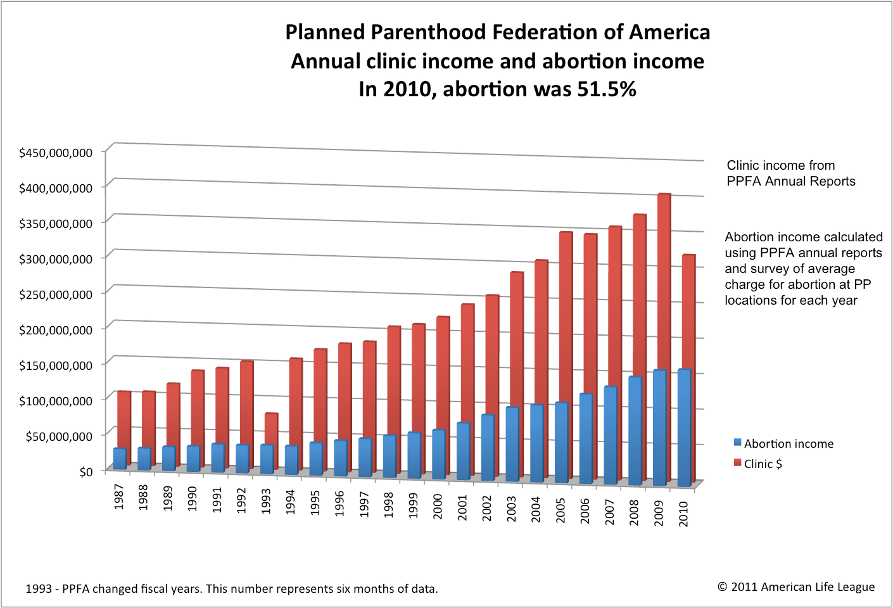
Half of Planned Parenthood’s Income Comes from Abortion

According to Planned Parenthood’s 2009-2010 Annual Report Abortion comprises 51.5% of PP’s clinic income. (click on chart to enlarge)

PP-clinic-income-and-abortion-income-1

Abortion is therefore very important to Planned Parenthood.

Jill Stanek Planned Parenthood Annual Report reveals organization in decline


Share on Facebook

Restricting Medicaid abortions result in 25% decrease in abortion rate among poor women

Stanley Kershaw, a senior fellow at the Guttmacher Institute and author of the 2009 study Restrictions on Medicaid Funding for Abortions: A Literature Review:

“The research literature clearly shows that restricting Medicaid funding for abortion forces many poor women – already at greatest risk of unintended pregnancy – to carry an unwanted pregnancy to term. Antiabortion advocates are using these restrictions in a misguided attempt to reduce the nation’s abortion rate.… In the end, approximately 25% of poor women seeking abortions are forced to give birth because funding for termination is unavailable.”

“How Can I Find All of the Money I Need?” National Network of Abortion Funds, Retrieved January 17, 2013 http://www.fundabortionnow.org/get–help/financial–counseling Quoted in Robin Marty, Jessica Mason Pieklo Crow After Roe (Brooklyn, New York: ig Publishing, 2013)

A 25% reduction in abortions among poor women – babies that will live instead of die. Pro-choicers consider this a bad thing, but what it means is that babies like the one below will not be torn to shreds by abortion instruments.

9 – 10 weeks
9 – 10 weeks
Share on Facebook