





They said it.
Opening Statement of Douglas Johnson, Legislative Director of the National Right to Life Committee, at the Joint Hearing before the Senate Judiciary committee And the Subcommittee on the Constitution of the House Judiciary Committee, March 11, 1997:
“We need to remember that “birth” and “full-term” are 2 very different things. My own youngest son Thomas, who is here with my wife Carolyn today, was born 13 weeks before full-term. He weighed only 1 pound, 12 ounces.
After his delivery – by emergency Cesarean section – as he lay fighting for his life in the intensive care neonatal nursery, he looked as small and hairless as “a skinned squirrel,” as my father, a Wisconsin outdoorsman, said later.
But that same “fetus,” born so terribly prematurely, now runs to hug me when I return home from work. He likes to engage in all manner of wordplay. He embraces every aspect of life with insatiable curiosity and relentless enthusiasm.
He is one-of-a-kind.
But so are they all.
Mei Ling Rein. Abortion: an Eternal Social and Moral Issue (Wylie, Texas: Information Plus Reference Series, 2000)

Pro-lifers spoke to abortionist Randall Whitney in his car. According to him, an aborted baby:
“Would not have been a full baby…It is not a being..It is not a baby. The baby is when its born, it is separate from its host…[when the pro-lifer mentioned God] I grew up in the church…It’s not a human being…
At this point the pro-lifer asked:
“what is it, a frog?”
Whitney laughed and said:
“it’s a frog…. I can kill a frog. “
See full conversation below:
Ok, quick lesson:
This is a frog:

This is a baby:

Share on Facebook
Former Pres. of Planned Parenthood Gloria Feldt on abortion and why women have them:
“I have spoken and read letters from hundreds of women about their experiences with abortion, and one thing I know is that abortion is almost always a profoundly moral choice. Women and men plan their families because they have respect and reverence for human life. Women who choose abortions do so because they love children…”
Gloria Feldt The War on Choice: the Right-Wing Attack on Women’s Rights and How to Fight Back (New York: Bantam Books, 2004) 103

Yes. They love children to death.
Share on Facebook
Analyn Megison was raped and conceived a baby. She chose to have her child, and is now a loving mother. And an article in LifeNews.com, she describes her frustration when people call her baby “the rapist child” or emphasize how the conception happened, while denying her child’s basic humanity:
“My basic human rights were violated when I was raped during his violent attack years ago as I plead for my dignity and humanity, but I think that one of the things I am still having to advocate for is the basic human rights of my child, and other innocent children like mine. Not only am I not an object for use by a rapist, but my child is also not to be reduced to a mere product of a violent criminal act simply because of how her conception took place.”
….
One of the first questions I am typically asked after I share with someone that I am raising my child who was conceived when I was raped is, “Does she know yet?” — often accompanied by a look of horror….
[T]he stigma that is associated with the precious child who you love so much needs to be overcome to make this world a better place for equal love and respect for your child, regardless of how he or she was conceived.
I hope that one day the first question I hear is something parents freely share with one another, such as: “What kinds of hobbies does she have?” and I could talk about how she has a great sense of humor and loves to do art projects and to sing. Or even, “Does she like being a big sister?,” and I could say, “Yes, she loves her little brothers very much and they love her lots too!””
Analyn Megison “People Look at Me in Horror When They Learn My Daughter Was Conceived in Rape” LifeNews 8/20/14
Analyn Megison is a co-founder / Board Member of Hope After Rape Conception – www.hopeafterrapeconception.org, and a blogger for Save The 1.
Share on FacebookOn this Thanksgiving, I would like to tell a story of pro-life victory, a story of life.
A young woman named Diana told the following story on the “Stories from the Sidewalk” series.
“I’ll never forget the day I found out I was pregnant. It was October 7, 2012. I had just returned from a retreat when I took a pregnancy test. I couldn’t believe it. I was active at Texas State’s Catholic Center and was a member of the Catholic sorority. I couldn’t let anyone find out I was pregnant – what would they say?
The baby’s father didn’t want a child and said he would pay for an abortion. Without his support, afraid of what others would say, and since I was expecting to graduate in just a few months, I scheduled an abortion.
I was the only person in the waiting room. I was really scared. The doctor had me sign some papers that he went through quickly. The examining room was dim and cold. There weren’t any pictures or posters like most doctor’s offices. He couldn’t confirm the pregnancy, so he asked me to reschedule. The next few days, I tried to live life as usual, but kept thinking of that little person inside me. Fortunately, one of my sorority sisters told me about [The John Paul II Life Center]. I didn’t want to go, but eventually, I did.
The JPII Life Center was very different from the abortion facility. It was warm… welcoming. Instead of doing the sonogram to determine how much they would charge me, they gave me one for free. I’ll never forget that sonogram. The doctor told me to lay very still. Then, he showed me the most breathtaking sight I had ever seen – a tiny pulse of red and blue. My baby’s heartbeat! I was only about 5 weeks pregnant, but my baby’s heart was already beating. I knew I couldn’t abort my child.
But later, reality hit. My mom made it very clear that she wanted nothing to do with me or my baby. If I didn’t have an abortion, I would lose my cell phone, my car, my tuition, my apartment. Without the help of my parents, there was no way I could finish school or support myself. How could I take care of a baby?
I choked back tears as I made an appointment at another abortion clinic. Thankfully, God placed the right person at exactly the right time in exactly the right place. As I drove up to [the abortion clinic], I saw a familiar face praying outside the clinic. Then, I heard my name.
“Diana, what are you doing here?” It was Judy [a Sidewalk Counselor and also a counselor] from The JPII Life Center. I ran up to her and was greeted with a warm embrace. I told her my situation and she welcomed me into her home. Within a few hours, she, her husband and The JPII Life Center found me a place to stay and help with tuition.
I didn’t know it at the time, but while this was going on, Drew Mariani and the listeners at Relevant Radio were also praying the Chaplet of Divine Mercy for me and my parents.
When I finally worked up the courage to tell my father, he reacted completely different from what I expected. He said he would stand behind my decision. And, he insisted that my mother do the same.
After that day, I knew everything would be ok. Since then, I have graduated from Texas State and gave birth to Enrique, who is loved by me and his grandparents. Without The JPII Life Center, [Relevant Radio and the Coalition for Life], I would not have my baby’s life – or even my own. You see, if I’d gone through with that abortion, not only would it have ended my son’s life, I would have taken my own life. [They] saved us both…
and I am forever grateful.”
Diana’s story shows how even a religious person can have an abortion when the stress of an unplanned pregnancy becomes overwhelming. Her story is a good reason why priests and pastors should talk about abortion and educate their congregations not just about abortion facts but also about places then can go if they become pregnant. Religious pregnant women often have the added stress of fearing what their congregation will think if they have a baby. This leads many frightened Christians to have abortions. With abortion such an easy option, always available, people panic. Always support mothers, whether or not they are married. They have made a brave choice.
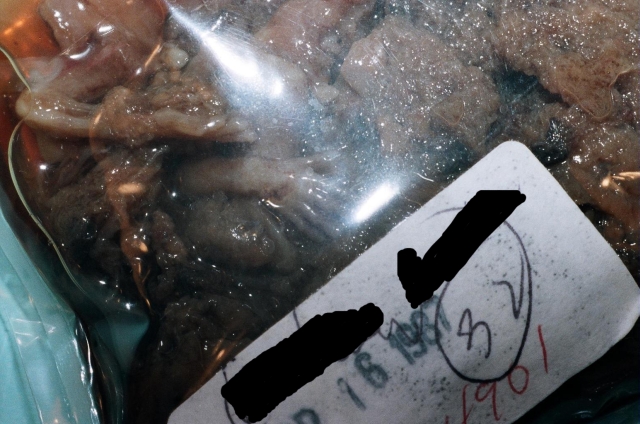
Share on FacebookThese babies were aborted in Chicago, at Michigan Avenue Medical Center, 30 South Michigan Avenue, Chicago, IL, February-April 1987 (Clinic now closed.) They were recovered from a dumpster there. Monica Miller took the pictures. They are buried in St. Mary’s Cemetery, Evergreen Park, IL, May 1987.
7 weeks


8 Weeks

 1
1


“Abortion is a sacred act.
Ginette Paris, The Sacrament of Abortion, trans. Joanna Mott (Dallas: spring publications, 1992) 8
12 weeks


“Women who have abortions are good women. Abortion, when desired by a woman, is a good procedure.”
Katie Stack “Eliminating Abortion Stigma: Playing Offense Starts With You” RH Reality Check June 14, 2012


“To choose not to give birth when there’s little foundation for that child’s well-being is a moral and caring act.”
Joyce Arthur “Know Your Enemy” Pro-Choice Action Network


`
Share on Facebook
This video, produced by Abort73, shows the remains of abortions. The majority of these babies, callously called fetuses by pro-choicers, were killed in the first trimester. Only the last baby in the video was aborted in the second trimester.
Abortions like the ones in this video are legal in every state in the US up until 20 weeks and in some states all the way up until birth. Even in states that prohibit late abortions, the Supreme Court Case Doe v Bolton set up a legal technicality that can allow later abortions to be performed.
Why are abortions done?
Here are the statistics:
from 1980 to 2000 –99.31% of abortions annually were for non-therapeutic reasons
5460 were for health of mother — that is .36%
3640 were for fetal defects — that is .24%
1,506,770 are for social cases- that is 99.31%
Although exact statistics on the numbers of more recent abortions are not available, the rate is most likely the same. 99.31% is a good ballpark figure.
Marybeth T. Hagan “Abortion: a Mother’s Plea for Maternity and the Unborn” (Liguori, Missouri: Triumph 2005)
Less than 1% of all abortions are done for rape or incest so….
98,31% of all abortions are done because the mother does not want the baby and does not want to put him or her up for adoption.
Do these statistics surprise you? Do you believe abortion should be legal? Express yourself in the comments section below.
At 4-5 weeks, abortion can be done either by pill or by suction aspiration. You can learn more about abortions by pill here. This page deals with abortions by surgery. Abortions by suction are the usual type of surgical procedure at this time in pregnancy. They are done by first dilating a woman’s cervix , then injecting anesthetic into a woman’s vagina with a needle, then inserting a suction cannula and sucking out the embryo and placenta. then the uterus is scraped to remove any leftover material. Abortion providers call these the “products of conception.” The suction cannula either pulls apart the developing embryo or sucks it out whole, and it dies in the bottle of blood from the abortion.
The risks of an abortion at 4-5 weeks are the same as the risks of an abortion done later in the first trimester.
— Infection
— Damage to the cervix which can lead to later miscarriage
___ Scar tissue in the womb which can prevent a future pregnancy from implanting
—- perforation (cutting) of the uterine wall or cervix which may be mild or severe
—- Depression or guilt stemming from the abortion
See info from studies on abortion’s physical risks and psychological risks here.
An ultrasound is recommended to check whether you have a potentially fatal condition called an ectopic pregnancy. In this type of pregnancy, the baby forms in the fallopian tubes. If you have this condition and you have an abortion, the embryo won’t be removed. Instead, the embryo will continue developing in the tube, which will eventually rupture. This can cause fatal hemorrhaging.
The only way to rule out an ectopic pregnancy is through an ultrasound. If the abortion clinic you call does not provide ultrasounds before their abortions, consider going elsewhere. One place we you can get a free ultrasound is a crisis pregnancy center. Remember, if the abortion clinic does do ultrasounds before abortion, the clinic will charge you, whereas an ultrasound at a crisis pregnancy center is free. You can locate a center here.
These centers are staffed by volunteers who deal with women who have difficult pregnancies and are considering abortion. Some centers, such as CareNet, (US) are religiously affiliated. Birthright centers (international) are not. Either type of center will give you information about abortion either by pill or by surgery, information you may not get in the abortion clinic. Keep in mind that abortion clinics are only in existence because they sell abortions. Even if the staff there is well-meaning, they can only stay in business if they make enough profit. At Planned Parenthood, abortion accounts for one third of their annual income. Freestanding abortion clinics depend on selling abortions in order to stay open. Their doctors and managers get a high salary from abortions. In a way, going to an abortion clinic for advice is like asking a Subaro dealer if you should buy a Subaro or a Ford. Most likely, they will present abortion in a positive light. Sometimes it’s best to get as many perspectives as you can, which is why go to a crisis pregnancy center can be a good option to consider. Crisis pregnancy centers are staffed by volunteers. All of their services are free. They are charities that depend on donations from supporters, not money from those who go there. Therefore, they have no financial interest in the decision you make. Some pro-choice activists have said that pregnancy centers are set up to dissuade women from having abortions. This is only partly true. The women at these clinics are volunteers and some of them do have an anti-abortion mindset. Yet they will respect your decision. Going to a pregnancy centers does not mean you can’t have an abortion later. No one can prevent you from having an abortion if you choose to do so.
The embryo
This is a picture of an embryo at 5 weeks

It is just beginning to take on a human form.
Below is a picture of an embryo at 4 weeks. You can see the developing spine.

Here is some information about how developed these embryos are. This fetal development timeline traces the growth of an embryo from conception onwards.
Day 20 (less than one month): Foundations of the brain, spinal cord, and nervous system are already established
Day 21: The heart begins to beat
Day 28 (4 weeks old) The back bone and muscles are forming. Arms, legs, eyes and ears have begun to show.
Day 30: At 1 month (4 weeks) old , the embryo is 10,000 times larger than the original fertilized egg – and developing rapidly. The heart is pumping increasing quantities of blood through the circulatory system. The placenta forms a unique barrier that keeps the mother’s blood separate while allowing food and oxygen to pass through to the embryo.
Day 35 (5 weeks):5 Fingers can be discerned on the hand. The eyes darken as pigment is produced.
Day 40 (end of 5th week): Brain waves can be detected and recorded

Just because the baby does not look fully human does not mean that it isn’t one. As a matter of fact, referring to the embryo as “it” is inaccurate- sex is determined at conception. Therefore an embryo is already male or female. he or she may not look like a full term baby, but neither does a full term baby look like an adult. As we go through life, our appearance changes.
The decision to have an abortion is ultimately up to you. But keep in mind that abortion destroys a life that has already begun. It stops a heart from beating. It destroys a developing body, the body of the baby. And it can be damaging to your life and health. Even though deaths from surgical abortions this early are extremely rare, an infection can still be serious. Abortions by pill have caused over 14 deaths in the US alone.
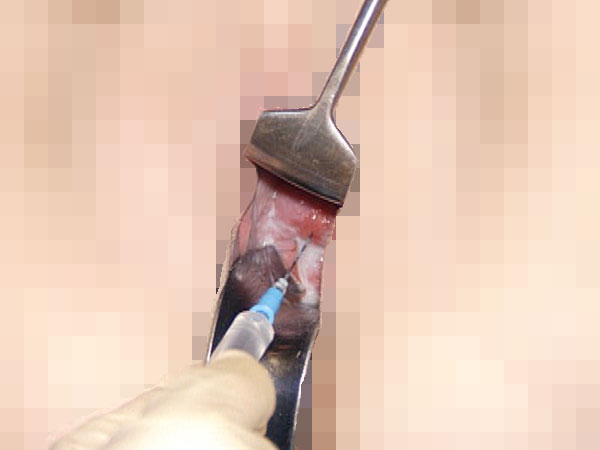
Below is a picture of anesthesia being injected after dilation of the cervix. The woman’s legs are blurred out.
if you are pregnant and would like to talk, email me here sarath5775@gmail.com
