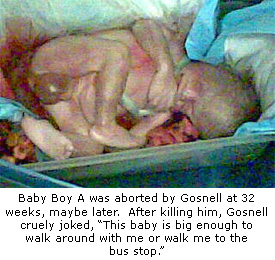
An Arizona abortionist who failed to estimate correctly the age of the unborn baby and instead of destroying her, delivered her alive, said the following. She was eight months in the womb.
“We can’t always be perfect.”
“Abortion Attempt Turns into Birth: Baby’s “Fine” Chicago Sun-Times March 23, 1981, 25. Quoted in James Tunstead Burtechaell “Rachel Weeping”
“The decision of a woman, or a couple, to have an abortion is not necessarily made because they dislike children, it is normally an expression of the fact that at this particular time in their life, they feel they cannot offer a child the love, security and physical support which would meet their ideals…Abortion is usually an altruistic decision.”
Malcolm Potts, Peter Diggory, and John Peel, Abortion (Cambridge: At the University Press, 1977) 227 – 228 Quoted in James Tunstead Burtechaell, C.S.C. Rachel Weeping: the Case against Abortion (San Francisco, CA: Harper & Row Publishers, 1982)
“The decision to have an abortion often reflects or is motivated by religious or spiritual beliefs that place priority on service and conduct of life as values even higher than procreation… Finally, if a woman cannot choose to terminate an unwanted pregnancy, she is denied the right to the “possession and control” of her own body.”
Lynn M Paltrow “To Return the Law to the Condition Before Roe Would Deny Women Their Fundamental Constitutional Rights” August 29, 1985 Amicus Cruiae prepared and filed by The National Abortion Rights Action League (Now Naral Pro-Choice America)
“For many young women, seeking an abortion is the first important health decisions they have had to make; recognition of their own abilities to take charge of their health can serve as a basis for other important health decisions, such as practicing contraception.”
Felicia H. Stewart and Philip D. Darney “Abortion: Teaching Why As Well As How” Perspectives on Sexual and Reproductive Health volume 35 January/February 2003
“What we are saying is that abortion becomes one of the choices, and the person has the right to choose whatever it is that is best that they need as necessary and best for them in that situation for which they find themselves, be it abortion, to keep, to adopt, to sell, to leave in a dumpster, to put on your porch, whatever: it’s the person’s right to choose.”
Esther Langston, professor of Social Work, University of Nevada, Las Vegas, Public debate on abortion at the campus of the University of Nevada, at the Hendrix Auditorium December 4, 1989. As recorded by Mark Wiegand (Quoted in Francis J. Beckwith “Politically Correct Death: Answering the Arguments for Abortion Rights” (Grand Rapids, Michigan: Baker Books, 1993) p 174)
“Why must so many defenders of abortion always present it in negative terms and never talk about how, for some women, the decision to have an abortion is a tremendously positive experience, even if an unplanned pregnancy is not a prospect to be welcomed in itself?”
Pro-choice author Janet Hadley “Abortion: between Freedom and Necessity” (Great Britain: Virago Press) 1996 p 164
“A woman may think of her fetus as a person or just cells depending on whether the pregnancy is wanted or not. This does not reflect moral confusion, but choice in action.”
Cited by John Leo in “the Moral Complexity of Choice” U.S. News & World Report, December 11, 1989, 64
“Unwantedness” may be regarded as a major complication of pregnancy, with surgical intervention in the form of abortion as the indicated treatment rather than medical management, as would be the case with a wanted pregnancy.”