Pro-Choice Feminist: Abortion Does “Violence” to Women

In the following article: Paige Comstock Cunningham, Esq. “The Supreme Court and the creation of the two-dimensional woman” in Erika Bachiochi. The Cost of “Choice”: Women Evaluate the Impact of Abortion” (San Francisco, CA: Encounter Books, 2004) 107-108

Pro-choice feminist Caroline Whitbeck called abortion “a grim operation,”

“The literature of abortion shows that many people are readily able to imagine themselves in the place of the fetus but not in the place of the pregnant woman, but if one is able to look at the matter from the perspective of the pregnant woman, it becomes clear how much violence is done to the woman by abortion, and therefore that the woman self-interest would lead her to avoid [unwanted pregnancy and] abortion if she had other options generally available.”

Caroline Whitebeck “Taking Women Seriously As People” in the Abortion Controversy: 25 Years after Roe Versus Wade editor Lewis P Pojman and Francis J Beckwith (Belmont, California: Wadsworth Publishing Company, 1998) 434

Share on Facebook

Woman Feels “Empty” after Coerced Abortion

One woman who had an abortion recounts the following story:

“My boyfriend told me if I kept it, it would break us apart. I loved him and I went and destroyed the life which I wanted so much. I was 18 weeks pregnant, it took me three days for the operation. Men don’t understand what you go through and I wish they did. Throughout the three days I had needles all the time and nausea. This was because of love. I always think of other people before my own feelings, but look where it’s gotten me… I felt empty, like I had no soul in me… My boyfriend said to me a couple of days afterwards that we might end up being married and we could have a family together. I said I couldn’t marry someone that made me destroy a baby.”

Melinda Tankard Reist, Giving Sorrow Words (Sydney: Duffy & Snelgrove, 2000) 21

To read more about men who coerced women into having abortions, go here

Share on Facebook

Pearl S Buck in The Child Who Never Grew Talks about Her Disabled Child

Author Pearl S Buck said, in a book, of her child who was born mentally handicapped as a result of the metabolic condition called PKU:

 “[by] this most sorrowful way I was compelled to tread, I learned respect and reverence for every human mind. It was my child who taught me to understand so clearly that all people are equal in their humanity and that all have the same human rights. None is to be considered less, as a human being, than any other, and each must be given his place and a safety in the world. I might never have learned this in any other way. I might’ve gone on in the arrogance of my own intolerance for those less able than myself. My child taught me humanity.”

Pearl S Buck, The Child Who Never Grew, 2nd edition (Bethesda, Md: Woodbine House, 1992) 70

Buck’s attitude and her love for her child standing contrast to the self-centeredness and misguided “compassion” of mothers who abort their handicapped children.

Share on Facebook

Disability Rights Activists On the Value of Handicapped People’s Lives

From Elizabeth R Schlitz. “Living in the Shadow of Monchberg: Prenatal Testing and Genetic Abortion” in the book Erika Bachiochi. The Cost of “Choice”: Women Evaluate the Impact of Abortion” (San Francisco, CA: Encounter Books, 2004) p 48

Disability rights activists maintain that “most people with disabilities rate their quality of life as much higher than other people think. People make the decision [to reject embryos] based on a prejudice that having a disability means having a low quality of life.”

Aaron Zitner, “A Girl or Boy, You Pick” Los Angeles Times, July 23, 2012:  A 1 quoting Deborah Kaplan, Executive Director of the World Institute on Disability in Oakland, California

Share on Facebook

HMO Refuses to Cover Disabled Baby, Mother Expected to Abort

The article Elizabeth R Schlitz. “Living in the Shadow of Monchberg: Prenatal Testing and Genetic Abortion” in the book Erika Bachiochi. The Cost of “Choice”: Women Evaluate the Impact of Abortion” (San Francisco, CA: Encounter Books, 2004) tells the  story of a woman whose prenatal test showed that her baby would have cystic fibrosis and who opted not to have an abortion.

The HMO initially denied medical coverage because the baby had “a pre-existing condition.” They eventually reversed the decision but they told the woman in essence: you knew about this condition before the baby was born. You could’ve prevented this baby from being born. You chose not to. Since you made that decision, you can find a way to pay for it.

Larry Thompson, “the Price of Knowledge: Genetic Tests That Predict Dire Conditions Become a Two-Edged Sword,” Washington Post, October 10, 1989. Z07


Share on Facebook

The Percentage of OB/GYN’s Who Do Abortions

National Survey of Obstetricians/Gynecologists on Contraception and Unplanned Pregnancy: Attitudes and Practices with Regard to Abortion,” Kaiser family foundation, 1995:

“Found that two thirds of the obstetricians and gynecologists in practice in the United States, especially female doctors and those under 40, refused to do abortions under any circumstances. Few of these mentioned public pressure from antiabortion activists as a reason; most cited religious scruples or simply said they didn’t like doing the procedure. Of the one third who do perform abortions, a majority do four or fewer per month.”

Erika Bachiochi. The Cost of “Choice”: Women Evaluate the Impact of Abortion” (San Francisco, CA: Encounter Books, 2004) 16 to 17

This means that the majority of abortions are done by a small group of doctors.

And, according to another poll:

Only 5 out of 100 obstetricians/gynecologists are now willing to perform abortions

Lawrence B Finer and Stanley K Henshaw, “Abortion Incidence and Services in the United States in 2000,” Perspectives on Sexual and Reproductive Health 35:1 (2003): 6 – 15

So the number has dropped dramatically between 1995 and 2003

Share on Facebook

Men’s and Women’s Attitudes Towards Abortion

A 1998 poll found that 58% of American women felt that the availability of abortion had hindered their relationships with men and 70% of men and women believed that legal abortion was not necessary for women to pursue various educational and career goals

Wirthlin Worldwide poll (1998), conducted for the Family Research Council, Washington DC

Candace C. Crandall “Three Decades of Empty Promises” in Erika Bachiochi. The Cost of “Choice”: Women Evaluate the Impact of Abortion” (San Francisco, CA: Encounter Books, 2004)

Share on Facebook

Abortion Visual Aids, Graphs and Charts

States with Restrictions on Post-Viability Abortions

reasons states permit third trimester abortions


restrictions on post-viability abortions

It should be noted that even in states where abortion is banned in the third trimester, loopholes in the law often allow these abortions to be performed anyway. Doe V Bolton, a companion case to Roe V Wade, mandated that a woman can’t be denied a third trimester abortion if her health is endangered by the pregnancy. It then went on, however, to define health broadly to include mental and emotional health. Therefore, all woman has to do to have a third trimester abortion is convince the abortionist that her mental or emotional health would be affected by the pregnancy. However, it is significant that many states have no laws on the books at all.

parental involvement and consent laws

This graph is of parental notification laws throughout the country.

The next few graphs are about public opinion in the abortion issue.

support for various pro-life laws
chart on when in pregnancy abortions are acceptable to people


chart on opinions of partial-birth abortions

chart of opinions on abortion


chart on the abortion pill, RU-48
pro-life versus pro-choice, public opinion

In 2009, the pro-life community gained a majority in America for the first time since Roe versus Wade.

Here are some statistics on teen pregnancy:

chart on teen pregnancy, now and in the past
graph of teen pregnancy rate
graph of the abortion rate

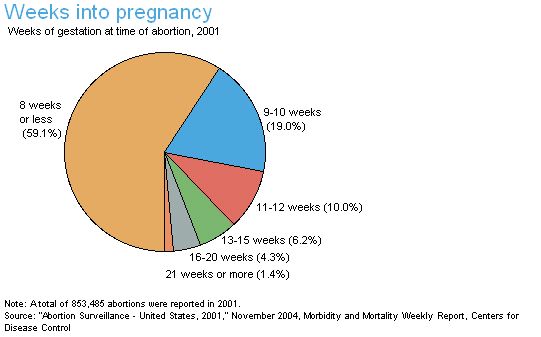
when in pregnancy abortions are performed

the following graph shows how having health insurance affects the abortion rate.

here are some charts on Planned Parenthood:

Number of Planned Parenthood Abortions
Planned Parenthood – abortions versus adoptions
Share on Facebook

FDA Report on RU-486

FDA report “Mifepristone US Postmarking Adverse Affects Summary through April 30, 2011”

“At least 2,207 cases of severe adverse reactions, including hemorrhaging, blood loss requiring transfusions, serious infections and death.”

Cited in “Chemical Abortion: What We Don’t Know Is As Scary Is What We Do”

http://www.aul.org/chemical-abortion-what-we-don%E2%80%99t-know-is-as-scary-as-what-we-do/#_ftn3

Share on Facebook

“I Couldn’t Look at Those Little Bodies Anymore…”

By Dr. Arnold Halpern, former director of a Planned Parenthood abortion clinic:

eight weeks

“There is no difference between a first trimester, a second trimester, a third trimester abortion or infanticide. It’s all the same human being in different stages of development. I finally got to the point I couldn’t look at those little bodies anymore.”

Krishna Dharma Dos “Dying to be Born” Congregations of UK and Ireland Jan 11, 2010

Share on Facebook