Survival rates for premature babies, week by week

According to a book written in 2009, the rates of survival for premature babies:

23 weeks – 33%

24 weeks – 50%

28 weeks – 95%

Lauri S Friedman. Abortion (San Diego, CA: Reference Point Press 2009)

22-24 weeks

Ads for clinics that do abortions after the baby can survive.

Another source says that the youngest baby born to survive was even younger: Kenya King, born in Plantation, Florida at 21 Weeks. She weighed 510 g “18 ounces” 10.5 inches Her story was in the Miami Herald.

JC Willke “Why Can’t We Love Them Both: Questions and Answers about Abortion” “Hayes publishing company and company” Cincinnati Ohio 1997 P91

Kenya, shown here after a long time in the hospital
Share on Facebook

Pro-life center open next to abortion clinic, offers support for women

In an article in The Daily News, the author describes how pro-lifers set up a center near an abortion clinic. The center would offer women help and support to carry their children to term, and would allow them to see ultrasound images of their unborn babies. They would provide the women with facts on abortion’s risks and information on alternatives.

According to Peter Ryan, executive director of New Brunswick Right to Life Association:

“The Mother and Child Welcome House will offer mothers another choice besides abortion. Most women who have abortions say they have no choice. They feel so overwhelmed. Trough the support we provide, we will offer these mothers the chance to be free from the dictates of fear and pressure.”

Dr. Morgentaler, the abortionist at the clinic, said the following:

“I hope many women will not be swayed into going there and receiving false information which would make them feel worse. A woman coming for an abortion already has the burden of making a decision which is often very difficult.”

“Morgentaler Getting New Neighbors, Anti-Abortionists Buy Home”  The Daily News (Nanaimo) Fri Jun 2000

Crisis pregnancy centers like The Mother and Child Welcome House often provide facts and information at clinics don’t. Read quotes from former clinic workers (and some current ones) that describe how abortion clinics routinely hide information from and sometimes even lie to women.

Read women’s stories of biased, coercive, or dishonest abortion counseling here.

Share on Facebook

Judge describes a late-term abortion procedure

In the article “Candor and the Court: The Supreme Court will confront as never before the violent nature of mid-and late-term abortion”by Richard Smith, Smith quotes a judge who opposes the partial-birth abortion ban. In this quote, the judge is explaining how abortions by D & E (where the unborn baby’s dismembered in the womb) might be banned by the laws forbidding D & X (partial birth) abortions. He describes the procedure for a D&E abortion. What he is describing is a legal abortion technique that he supports keeping legal:

“In a D&E procedure, the physician inserts forceps into the uterus, grasps a part of the fetus, commonly an arm or a leg, and draws that part out of the uterus into the vagina. Using the traction created between the mouth of the cervix and the pull of the forceps, the physician dismembers the fetal part which has been brought into the vagina, and removes it from the woman’s body. The rest of the fetus remains in the uterus while dismemberment occurs, and is often still living…”

This judge is knows that the common D&E procedure dismembers babies. While he describes tearing the arms and legs off these babies, he uses the term “fetuses” to dehumanize them. The fact that he can describe such a horrific procedure so calmly while advocating to keep it legal is disturbing.

Richard Smith “Candor and the Court: The Supreme Court will confront as never before the violent nature of mid-and late-term abortion” America April 1, 2000

Share on Facebook

Results of Survey of Women Who Had Abortions: Women’s feelings after abortion

David C Reardon conducted one of the most extensive interviews of postabortion women ever done. He asked them questions about their abortion experiences. The women he interviewed were involved in pro-life ministries that help postabortion women, and most of them, at some level at least, regretted their abortions. Here are the ways that many of the women answered his questions.

24% took a week to make the decision to have an abortion, 12% 2 to 3 weeks, 6% 4 to 6 weeks , 7% seven weeks or more

81% felt rushed

82% said there abortion decision was “not at all” “thought out.” Only 9% felt that it was moderately well thought out and only 8% believe the decision had been well thought out.

“Do you feel you had all the necessary information to make a decision?” 93% said no.

At the time of the abortion, only 24% were happy with their decision, secure in their choice

The rest were ambivalent

At the clinic, only 39% felt very firm in their decision to abort – 41% felt very uncertain, even at the clinic. 44% said they were still very actively looking for another option up to the final moments before their abortions.

75% said they would not have had an illegal abortion. Only 6% said they were very likely to have sought one

89% said they would’ve rejected a self-induced abortion, and only 5% said self abortion would’ve been strongly considered.

40 – 50% of women surveyed were wavering in their choice and were actually hoping for another option when they first went to speak with a counselor.

91% reported that their abortion counselors offer little or no help in exploring her decision and options.

Only 4% of the women gave their abortion counselors high grades for being informative and helpful.

66% believe that there abortion counselors are strongly biased toward selling them on abortion is the best solution.

Only 9% believe that their counselors had been free of pro-choice bias

90% of women surveyed felt they did not have enough information to make an informed choice.

76% complained they were not given an accurate description of the procedure.

For example, there was no mention of the physical pain involved.

Only 16% felt the counseling session had adequately informed them about the technical aspects of the abortion procedure

over 80% remarked that there were little or no discussion of risks

only 8% believe their counselors had adequately discuss the surgical risks of the procedure.

Over 90% of women stated that the biological nature of the fetus had not been discussed during a counseling session.

Only 2% said that the fetal development had been thoroughly or even moderately discussed

asked whether they felt “well-informed about the procedure and fetus through other sources before seeking an abortion.” 90% claimed they had little or no prior knowledge and 5% stated that they had only moderate prior knowledge. Only 4% claim to have been well informed about abortion, fetal development, through prior knowledge.

80% felt their counselors had not encouraged – or even attempt to discourage – questions about the abortion. only 5 to 13% believe that their counselors were open and willing to answer their questions. When questions were asked, only 8% thought the questions were thoroughly answered. 8% believe they receive moderately complete answers and 52 to 71% said the questions were trivialized or avoided

21% were at a Planned Parenthood facility for their counseling and/or abortions. 60% stated that there Planned Parenthood counselor had very strongly encouraged them to choose abortion as the “best solution to their problems. Over 90% of those encouraged to abort by their planned parenthood counselor said there was a strong chance they would’ve chosen against the abortion if they had not been so strongly encouraged to abort by others, including a counselor

Of the Planned Parenthood patients, over 60% were still hoping to find an alternative to abortion when they went for counseling. Only 25% were already firm in their abortion choice. All felt their Planned Parenthood counselor did little or nothing to help them explore their decision. 89% said the Planned Parenthood counselor was strongly biased in favor of abortion.

95% of Planned Parenthood counselors gave “little or no biological information about the fetus which the abortion would destroy.” And over 80% of the Planned Parenthood counselors gave little or no information about the potential health risks

Only 13% felt “adequately prepared” by Planned Parenthood counselors

56% were dissatisfied with Planned Parenthood’s abortion services.

Of the women surveyed, 94% said they’d experience negative psychological effects, over 70% said that there was a time when they would’ve denied the existence of any negative reactions for their abortions. For some this denial stage lasted only a few months, for others it lasted over 10 or 15 years

if they had known what their lives would be today, over 95% said they would not have chosen abortion

66% said they about their lives are worse because of their abortions, 8% said their lives were about the same

David C Reardon Aborted Women: Silent No More (Westchester, Illinois: Crossway books, 1987)

To women’s testimonies of abortions, go here

To read about deceptive abortion clinic counseling, go here.

Share on Facebook

Abortion doctor: “I do abortions because of my religion”

“You can be deeply religious and perform abortion services. I perform abortions because of my religion.”

Abortionist Dr. Curtis Boyd.

“Abortion And The Fight For God” Newsweek October 17, 1994

Here Dr. Boyd admits that abortion is killing.

He performs abortions up to 24 weeks.

Below: Aborted baby at 21 weeks

Share on Facebook

92% of women and 82% of men are depressed after selective abortions

“Depression after a selective abortion may be as high as 92% among women and 82% among men.”

Blumberg BD, Golbus MS, Hanson KH. The Psychological Sequelae Of Abortion Performed for a Genetic Indication. American Journal of Obstetrics and Gynecology 1975; 122; 799 – 808, P806

In this quote, “selective abortion” means an abortion that is done because the baby is handicapped. These are wanted pregnancies where a fetal anomaly (such as down syndrome) is discovered and the parents choose to abort.

Share on Facebook

Doctor: we tell the women their babies will be dismembered

An abortionist describes what he tells the women who come in for an abortion:

“But does that mean that we don’t share with them, that this involves dismemberment or separation of parts of the fetus or taking the fetus apart? We do. And we use that term. We say we take the fetus apart. We say, it is coming out in pieces and we make sure that that’s clear with the patients. And they understand it.”

Dr. Cassing Hammond, abortionist, in sworn testimony in National Abortion Federation, et. al. v. Ashcroft, U.S. District Court, Southern District of New York, April 1, 2004

Dismembered foot of a 20-week-old unborn baby who was aborted
Share on Facebook

Dr. Susan Robinson: Parents Hold Their Aborted Babies

From an interview with late term abortionist Dr. Susan Robinson on what she does with the babies she aborts in the third trimester:

Robinson:

“With fetal anomaly patients,[who are aborting because the baby is handicapped] we ask them right up front if they plan to hold their baby after it’s born. These patients, their emotional needs are so different from the ones who are looking at their pregnancy as an absolute disaster, who are just thinking, “Get it out of me, please, please, please.” Those patients—the maternal indications patients—they are not relating to their fetus as a baby, they’re relating to it as a problem.

But with a fetal indications patient—if she refers to it as her baby, I’ll refer to it as her baby. If she’s named the baby, I’ll use the baby’s name too. I would say that most of these patients do decide to see and hold their baby, although many of them have a hard time dealing with the idea at first. We’ll take remembrance photographs, we’ll give them a teddy bear, the footprints… I don’t want them to go home from the procedure with absolutely nothing to remember and honor the baby, and its birth.”

Interviewer:

Wow. You’ll say “birth”?

Robinson:

Yes. I try to mirror what will be the most consoling to the patient. In general, these patients—fetal indications—do talk about giving birth, so I’ll say that as well.

Interviewer:

To simultaneously sustain these ideas—that you desperately loved and wanted this baby that’s here in your arms, and also that you just committed yourself to ending its life—it’s one of the most complicated emotional situations I can imagine. In these cases—I am sorry for this macabre question—the baby is dead, right? They never meet their baby alive?

Robinson says that yes, indeed, the baby is dead.

Jia Tolentino “Interview with Dr. Susan Robinson, One of the Last Four Doctors in America to Openly Provide Third-Trimester Abortions” The Hairpin Sept 20, 2013

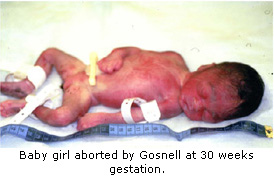
This baby girl was not aborted by Robinson, but this is the age of many of the babies she aborts


Share on Facebook

Abortion: “A sacrifice of life”

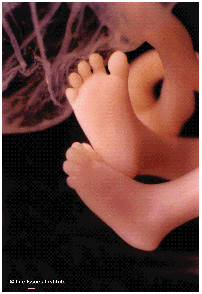
11 week legs. Hundreds of abortions a day are done at this time

Analyst Naomi Ruth Lowinsky, who is pro-choice, says that:

“… those who support a woman’s right to choose abortion also need to face the truth…. Abortion is not merely a medical procedure. It is the tearing from the womb our own flesh and blood. It is a sacrifice of life, hopefully for life.”

Naomi Ruth Lowinsky Stories from the Mother Line: Reclaiming the Mother-Daughter Bond, Finding Our Feminine Souls (Los Angeles: Jeremy P Tarcher, 1992) 207


Share on Facebook

Fetus looks human, evokes sympathy, says pro-choice author

From pro-choice author Bonnie Steinbock. on how pictures of unborn babies sway people away from the pro-choice cause:

“By 12 to 14 weeks gestation, a fetus looks human. It evokes in most people the same instinctive responses of protection that newborn babies do.”

Bonnie Steinbock Life before Birth: the Moral and Legal Status of Embryos And Fetuses (New York: Oxford University Press, 1993) 71

Steinbock is not entirely accurate. The unborn baby actually begins to look human much earlier. See this picture of an unborn baby in the 9th week.

10 week legs:

Share on Facebook