From one doctor:
“The fetus isn’t a human body but is more or acts more like a parasite.”
Quoted in William Brennan The Abortion Holocaust: Today’s Final Solution (St. Louis, Missouri, 1983) 149

They said it.
From one doctor:
“The fetus isn’t a human body but is more or acts more like a parasite.”
Quoted in William Brennan The Abortion Holocaust: Today’s Final Solution (St. Louis, Missouri, 1983) 149
From pro-abortion writer Valerie Tarico:
“Whether or not we are religious, deciding whether to keep or terminate a pregnancy is a process steeped in spiritual values: responsibility, stewardship, love, honesty, compassion, freedom, balance, discernment. But how often do we hear words like these coming from pro-choice advocates?”
Valerie Tarico “Abortion as a Blessing, Grace, or Gift: Changing the Conversation on Reproductive Rights and Moral Values” RH Reality Check April 3, 2014
Below: 8 week old preborn baby- before and after abortion


Is this love and compassion?
Share on FacebookAmerican psychiatrist Zigmond M Lebensohn:
“[Abortion is] the practice of humanitarian medicine at its very best.”
Zigmond M Lebensohn “Abortion, Psychiatry, and the Quality of Life” American Journal of Psychiatry 128 (February 1972): 950
Below: Preborn baby at 9-10 weeks before and after abortion.


“Fetuses, especially those as old as five or six months, elicit our sympathy…because they look disconcertingly like people; their physical features are recognizably human. But this sympathy is misplaced…. While a fetus of five or six months may, perhaps, possess some flickering of sensation, or some capacity to feel pain, this is equally true and probably even more true of creatures like fish or insects….a proper respect for the right to life requires that it not be respected where it does not exist.”
Mary Ann Warren, Commentary on “Can the Fetus be an Organ Farm?” Hastings Center Report October 1978, p 23-24
is this not life?

Is the child above really equivalent to an insect or fish?

Does this look like an insect?
Share on FacebookBiologist Dr. Garrett Hardin says an early preborn baby has never been seen “as a human being” because it “may, with impunity, be flushed down the toilet or thrown out with the garbage.”
Garrett Hardin “Abortion – Or Compulsory Pregnancy?” Journal of Marriage and the Family 30 (May 1968): 251

Share on Facebook
A book by a pro-choice author told the story of Nurit, from Israel, who had an abortion:
“… She was a research student studying about the development of the embryo in medical school in Israel when she aborted a pregnancy in her fourth month of gestation. She discovered that she had been pregnant with twins when she expelled a second male fetus as she rose from a sofa. Uncertain about what to do with the fetus, she decided take it to her lab where they preserved it in formaldehyde. Over 35 years later, Nurit still has the fetus preserved in a jar on her dresser.

She says this about keeping her aborted baby in a jar:
“I don’t know exactly why I kept the fetus all these years. I never think of it as my offspring, but I didn’t feel that it was right to just throw it away. I don’t know why I brought it with me to America; I guess that I have some attachment to it. It never occurred to me to bury it, and I never felt the need to name the fetus. I have always referred to my son as my firstborn. The fetus wasn’t born, so it didn’t exist for me in that sense, and yet I keep it with me. I don’t know why…I believe that preserving the fetus was a celebration of life.”
She later had another abortion.
From her husband, the father of the aborted baby:
“I didn’t want my wife to have the first abortion, but when I realized her attitude, we decided that it would be the best for us. I didn’t want her to abort our child because having a child for me meant the survival of the Jewish people. I was born in Belgium and lost most of my family in the Holocaust. I felt that abortion was killing a child, but that it was better to do it before we knew him…
Before he was born. My wife was more important to me than the fetus we lost. I didn’t think my wife was right to preserve the fetus. To this day I think that she was wrong to do that. But it was a part of her, and so it’s her right, even if I disagree. This fetus represents death for me, but I am not afraid to face death.”
Miriam Claire The Abortion Dilemma: Personal Views on a Public Issue (New York: Insight Books, 1995) 102 – 103
Share on FacebookJudith Jarvis Thompson, pro-choice professor at MIT:
“I am inclined to think also that we shall probably have to agree that the fetus has already become a person well before birth. Indeed, it comes as a surprise when one first learns how early in its life it begins to acquire human characteristics. By the tenth week, for example, it already has a face, arms and legs, fingers and toes; it has internal organs, and brain activity is detectable.”
Judith Jarvis Thompson Rights, Restitutions & Risk (Cambridge: Harvard University Press, 1968) 1

From pro-abortion author Miriam Claire:
“There are many reasons for choosing to have an abortion. Perhaps underlying them all is a deeply maternal, instinctive feeling that the time is not right to give birth and that to do so would be detrimental to all concerned… For some women, and abortion is one of the most profound events they will experience in life.”
Miriam Claire The Abortion Dilemma: Personal Views on a Public Issue (New York: Insight Books, 1995) 17
Is it “maternal” to kill a baby? Is it not detrimental to the baby to kill him or her?

One woman, on why she had an abortion:
“You just get your kids beyond the diaper stage and start to plan for doing things, getting out of the house more. There was just no way at this time for a little one, for starting all over again.”
Suzanne T. Poppema, MD and Mike Henderson Why I am an Abortion Doctor (Amherst, New York: Prometheus Books, 1996) 260
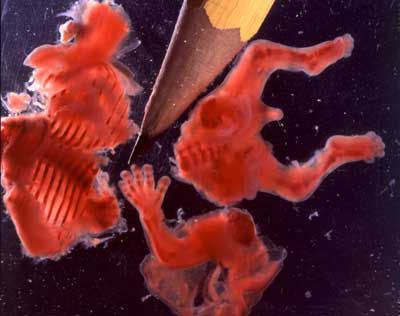
Below: baby aborted at 8 weeks. This is around the time most abortions are done.
From a woman who had abortion:
“I wanted to have a clear idea of what I was doing. A couple of weeks (the time between the moment when I missed my period and the test to make things clear) I turned the library upside down in my search for books that described gestation. I wanted to see with the fetus looks like in its various stages of development, what organs it already had developed, how its metabolism functioned, and so on. I learned that the point of a pregnancy at which an abortion takes place makes no difference: it is always a question of killing something. This became quite clear to me, but it didn’t at all change my decision.… I was also astonished that the idea of killing didn’t strike me as intolerable…”
Commenting on this, the author of the book says:
“To find one’s way through this state of mind, without telling oneself that abortion is nothing special, consciously accepting the idea of killing: such an attitude merits respect and the suspension of conventional judgments.”
Eva Pattis Zoja Abortion: Loss and Renewal in the Search for Identity (London: Routledge, 1997) 73 – 74
Share on Facebook