Presbyterian minister defends abortion: “we share the belief that all life is important”

Presbyterian minister Sarai Schnucker Beck wrote an essay defending legal abortion in a book collecting abortion-related essays from religious women.

She frames her essay as a letter to a pro-life friend. She wrote:

“Because of our faith, I think that we also share a belief that all life is important – human beings, animals, plants, germs in the sea, birds in the air, all part of God’s creation. For me, this has come to mean, more now than in the past, taking with great seriousness the potential human life that is the fetus.

But for both of us, I believe that it also means taking with great seriousness the present life of a woman in a difficult and complicated situation…

Perhaps it would be better to think of the fetus and the mother as having “concurrent” claims. That is, both claims occur at the same time, and both are important… At times the potential life that is the fetus may have a stronger claim, and at times the mother’s claim may override…

I am convinced that you and I agree that life is valuable because it is given by God.”

Sarai Schnucker Beck “A Common Language” in Phyllis Tickle, ed. Confessing Conscience: Churched Women on Abortion (Nashville, Tennessee: Abingdon Press, 1990) 35 – 36

She calls a preborn baby “potential life” and values the child the same as nonhuman life. But a baby in the womb is a human, not a germ, a bird, or a plant.

It’s interesting that she calls a pregnant woman a “mother.” How can a human mother be anything but a mother to a human baby?

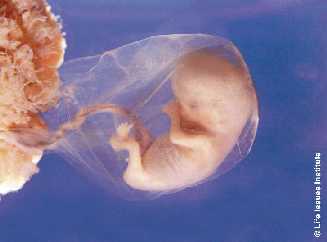
Picture of baby in womb at 10 weeks

Share on Facebook

Pro-abortion philosopher admits that legalizing abortion led to lack of respect for other human lives

Philosopher Peter Singer, who supports both abortion and infanticide, wrote: him

“The prohibition on the direct killing of the fetus was the first area in which the sanctity of life ethic was directly challenged by the quality of life ethic, and lost.

Abortion foreshadowed what was about to become accepted practice in other areas, including the withdrawal of treatment from patients in a hopeless condition, and the selective nontreatment of disabled infants. While opponents of abortion have made this point repeatedly, those who support abortion prefer…to see the issue as one of freedom of choice.”

Peter Singer Rethinking Life and Death: The Collapse of Our Traditional Ethics (New York: St. Martin’s Griffin, 1994) 90

Share on Facebook

Baptist pastor gives reasons for her pro-choice stand

Baptist pastor Lauren Jones Mayfield:

“…when I was invited to join Vice President Kamala Harris’ roundtable of patients and health care providers facing the impact of abortion restrictions in their states this month, I was grateful for the opportunity to represent the tens of thousands of clergy around the country who strongly support access to reproductive health care—including abortion access—as a moral issue and a calling supported by our faith’s first teaching to do no harm and love our neighbors.”

LAUREN JONES MAYFIELD “I Can’t Do My Job as a Pastor With Abortion Laws Like Texas’ S.B. 8 in Place” Time SEPTEMBER 20, 2021

Is this love? Is this compatible with “do no harm?”

Abortion at 8 weeks after conception
shout your abortion
10 weeks after conception
Remains of child after abortion at 15 weeks
Share on Facebook

Pro-Choice leader says abortion prevents “infant mortality”

In a very ironic comment, Terry O’Neill, president of pro-choice group NOW, said:

“From a public health point of view, abortion care, no less than contraception, is an essential measure to prevent the heartbreak of infant mortality….”

Terry O’Neill “Abortion, Like Contraception, Is Essential Health Care That Saves Lives” NOW May 13, 2014

This was originally published in the Huffington Post.

Below: Potential victim of an abortion.

Share on Facebook

Pro-Choice Author: Abortion carries “social shame” and “psychological burden”

From pro-choice author Melissa Harris-Perry:

“… Abortion still carries tremendous social shame in addition to its personal psychological burden.

Activists for reproductive rights have a hard time convincing women and families who have terminated to be part of a movement that protects the right to terminate. Many understandably prefer not to be publicly associated with the stigma and potential violence that comes with standing up for choice.”

Melissa Harris-Perry “Countering Antichoice Terrorism” The Nation June 2, 2009

I don’t think there are many pro-lifers who think being pro-choice brings with it a stigma.

Share on Facebook

Pro-Choice author: Women have abortions due to “maternal instinct”

From pro-choice author Miriam Claire:

“There are many reasons for choosing to have an abortion. Perhaps underlying them all is a deeply maternal, instinctive feeling that the time is not right to give birth and that to do so would be detrimental to all concerned…

It is a maternal instinct that prompts women to have an abortion, because they don’t believe that they can provide emotional and physical sustenance for a child (or another child) at that time in their life.”

Miriam Claire The Abortion Dilemma: Personal Views on a Public Issue (Xlibris Corporation, 2013) 15, 31

Below: 8-week old baby. Before and after abortion.

Fetus at 8 weeks

Abortion at 8 weeks


Share on Facebook

Pro-choice author supports eugenics, says only “delicate” people are offended

Although he admits being “extremely conflicted” about abortion, Brent Elisens writes:

“consciousness cannot emerge before 24 gestational weeks… To me this would mean that abortions before 16 weeks (giving the 24 weeks a wide berth) would be morally sound.”

He also supports eugenics:

“Eugenics is a controversial subject. Often an offensive one. However, only for delicate people… Obviously, saying that a specific race or class of people is not allowed to reproduce is morally disgusting… [But] why are welfare people allowed to have four, five, and six kids? While on welfare?”

Brent Elisens The Adoption Option With a Portion of Abortion (2021)


Share on Facebook

Feminist: abortion gives women power

Feminist Catherine McKinnon writes:

“[Abortion] provides a moment of power in a life otherwise led under unequal conditions that preclude choice in ways [women] cannot control… [Abortion is] a window of relief in an unequal situation from which there is no exit.”

Catherine McKinnon Women’s Lives, Men’s Laws (Cambridge, Massachusetts: Harvard University Press, 2005) 141

Any “power” abortion gives a woman is the power to kill her vulnerable child. No human being should have that power over life and death for another.

Share on Facebook

Pro-Choice author: Question of whether abortion is murder is “risky”

Pro-choice author Miriam Claire wrote:

“Somehow, the key issue is not being addressed [by the pro-choice movement] and is “off the page,” because the question of whether abortion is murder is risky and unanswerable in an absolute sense.”

A few pages later, though, she answers the question. She wrote:

“When you choose to have an abortion, you are responsible for a decision to halt the development of a human life. That is the most significant difference between abortion and miscarriage. It is somehow easier to accept “fate” or “the will of nature,” than it is to accept responsibility for our actions.”

Miriam Claire The Abortion Dilemma: Personal Views on a Public Issue (Xlibris Corporation, 2013) viii, 1

Perhaps “halt the development” is an easier thing to say than “kill.”

Share on Facebook

Pro-choicer: ultrasound laws allow people to discriminate against “low income and minority women and people with disabilities.”

Pro-choice author Lisa M Mitchell writes:

“Some American lawmakers have attempted to legislate mandatory viewing of ultrasound fetal images as a means of dissuading pregnant women from having an abortion…

A growing number of feminist perspectives on this issue assert “a woman’s right to choose,” yet also reveal how the very existence of technologies such as ultrasound tend to structure “choice” in ways that “have increased the potential for others to exercise an even greater control over women’s lives” and to discriminate in particular against low income and minority women and people with disabilities.”

Lisa M Mitchell Baby’s First Picture: Ultrasound and the Politics of Fetal Subjects (Toronto: University of Toronto Press Inc., 2001) 6-7

The quote within the quote is from:

Michelle Stanworth Reproductive Technologies: Gender, Motherhood and Medicine (Minneapolis: University of Minnesota Press, 1987) 4

Mitchell never reveals how the use of ultrasound allows pro-lifers to discriminate against people. In reality, ultrasound screening allows doctors to abort disabled babies in the womb – but this is not what Mitchell is talking about, of course.

Share on Facebook