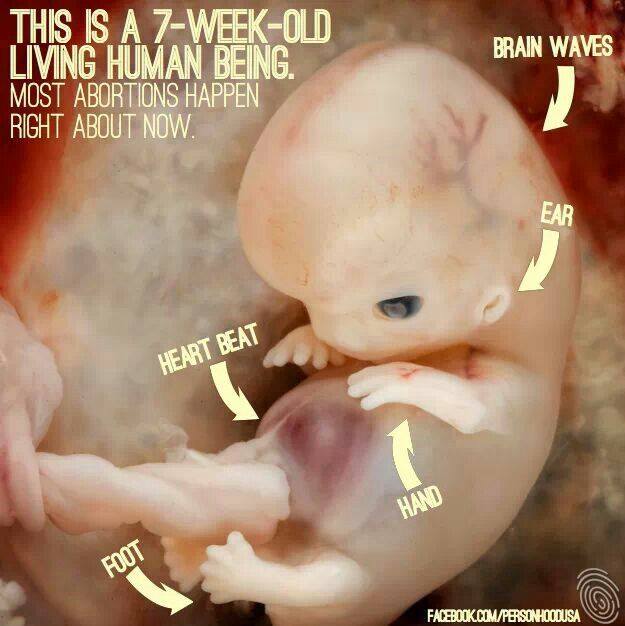
Amanda Marcotte calls her preborn baby “brainless” and “lentil-sized”

From pro-abortion activist AMANDA MARCOTTE on her abortion:

“Given the choice between living my life how I please and having my body within my control and the fate of a lentil-sized, brainless embryo that has half a chance of dying on its own anyway, I choose me.”

AMANDA MARCOTTE “The Real Debate Isn’t About “Life” But About What We Expect Of WomenRaw Story 14 MAR 2014

7-wk-dia

Share on Facebook

President of Catholics for Free Choice on preborn baby

President of Catholics for Free Choice, Frances Kissling:

“The Catholic religion makes the fetus into an icon, a figure of religious veneration, which I think is sick, really sick.”

Ron Brackin. “‘Sister’ Frances Kissling: Cardinal of Death.” Liberty Report, January 1987.

Share on Facebook

Pro-Choicer: women “find justifications” to abort down syndrome babies

Mary Ann Bailey, pro-choice, commenting on aborting babies with down syndrome:

“Most people are not analytical thinkers; they tend to know what they want to do and then look for justifications.”

Mary Ann Bailey “Why I Had Amniocentesis” in E Parens and A Asch (eds.) Prenatal Testing and Disability Rights (Washington, DC: Georgetown University Press, 2000) 70

She explains how many women having abortions want to abort, and make the decision, and then look for reasons to support that decision.

Share on Facebook

Pro-Choice activist compares preborn baby to severed hand

Pro-Choice activist Virginia Ramey Mollenkott writes:

“Anti-abortionists claim that fetal personhood is a biological fact rather than a theological perspective.

However, the fetus is human only in the sense that any part of a human body is human: Every cell carries the full genetic code (a severed hand is genetically human, as well, but we do not call it a person)….six hundred million sperm are “aborted” in every masturbation or wet dream.”

Virginia Ramey Mollenkott “Respecting the Moral Agency of Women.” Religious Coalition for Abortion Rights pamphlet

Below: picture of preborn baby at 10 weeks, still in the first trimester. Is he the same as a severed hand?

crossed-ankles-1

Share on Facebook

Woman who had abortion: I am the most important person

From one woman who had an abortion:

“I feel proud of myself that I made the choice to have an abortion and finish college. I never made a decision before that said I was the most important person. Choosing abortion is about empowerment. It’s about making a choice in favor of myself and my own future. It was giving myself a vote of confidence.”

Anonymous woman

Quoted in The Boston Women’s Health Book Collective. The New Our Bodies, Ourselves. (Touchstone Books, 1992) 369.

7-wk-dia

Share on Facebook

Pro-choicer: Killing a fly is worse than having abortion

One pro-abortion person wrote:

“As far as abortion is concerned, I can speak for myself in that the killing of a pre-sentient fetus does not equate to murder, any more so than the killing of a fly amounts to murder (and I can actually make the case that killing a fly is MORE heinous a moral act than permanently interrupting the development of a potential being).

In your “for instance,” killing is not necessarily moral, but it is almost certainly not immoral.”

Comment on the blog “Rationally Speaking” May 19 2006

Preborn baby at 9 weeks after abortion. Is this less wrong than killing a fly?

Arms torn off aborted baby at 9 weeks
8 weeks
8 weeks
10 weeks
10 weeks
Share on Facebook

NARAL uses the word “baby”; admits child in the womb feels pain

In 2015, NARAL Pro-Choice America, one of the most extreme pro-abortion groups in America, sent out a fundraising letter that called a preborn child a “baby” and admitted that a child in the womb feels pain at 20 weeks, which almost all pro-choice individuals vehemently deny.

The letter was signed by a NARAL supporter, Dana Weinstein, asking for donations to NARAL to fight HR 36, the Pain Capable Unborn Child Protection Act, which would ban abortions after 20 weeks (5 months).

The text was:

“When I was more than 20 weeks pregnant, my doctor discovered our baby had horrifying severe fetal anomalies that could not have been discovered earlier in pregnancy.

If I’d carried our wanted and loved baby to term, she would have survived only for a short time, in a world of immense suffering. So we chose to end our baby’s pain.”

Below is a scan of the letter.

naral-babyThese pro-abortion activists publicly admitted that a “fetus” is a baby and that when pro-lifers say the child can feel pain at 20 weeks, they are telling the truth.

Share on Facebook
Pro-choicer: Newborn isn’t human until “socialization”

Pro-Choice activist Ashley Montague:

“the embryo, fetus and newborn of the human species do not…become functionally human until humanized in the human socialization process.”

Pro-Choice authors Carole Dornblaser and Uta Landy:

“Essentially, he is saying that newborns are primitive creatures who do not become human until they have acquired at least a veneer of civilization.”

Carole Dornblaser and Uta Landy, PhD The Abortion Guide: A Handbook for Women and Men (Rockville Center, New York: Playboy Paperbacks 1982) 27

Share on Facebook

Pro-Choice activist: You can think fetus is a person and still be pro-choice

Pro-choice activist:

“I think it is entirely possible to believe that the fetus is a person – to absolutely accept that humanity of a fetus and still support abortion.”

Quoted by Kristin Luker, Interview 102, Archived at the Murray Research Center, Radcliffe College, Cambridge, Massachusetts, P7

Eileen L McDonagh Breaking Abortion Deadlock: from Choice to Consent (New York: Oxford University Press, 1996) 186

Is it possible to admit that this baby is a person and still support aborting her?

Share on Facebook

Feminist: nothing Supreme Court has done was as important as Roe v. Wade

Pro-choice activist Sylvia Law, referring to Roe V Wade:

“… Nothing the Supreme Court has ever done has been more concretely important for women.”

Sylvia a Law “Rethinking Sex and the Constitution” University of Pennsylvania Law Review 132.5 (1984) 973 – 975

Share on Facebook