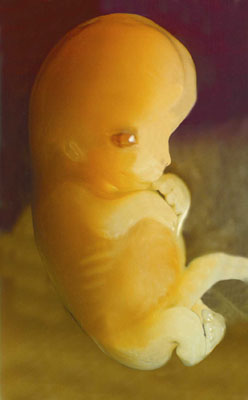
Doctor discusses the fetus as patient

Dr. Alan Fleishmann, New York specialist in the care of newborns, told London Standard correspondent Jeremy Campbell:

“The fetus is being looked upon as a patient now. This is a big difference and it has come about suddenly… This has increased the moral standing of the unborn. It has changed the way we think about abortion. People will decide that the fetus has a moral status as early the first 10 weeks of pregnancy. That is when we can do a biopsy, screen for genetic defects. Irregular heartbeats and vitamins deficiencies can be corrected at 15 weeks.

Legs of preborn baby at 14 weeks

The question now is, if some fetuses have the same rights as a patient, shouldn’t all fetuses have those rights?”

Mary Kenny Abortion: The Whole Story (London: Quartet Books, 1986) 295

Share on Facebook

Abortion patient: women in Moscow have multiple abortions

Lydia, who was having her fourth abortion, to author Mary Kenny :

“You think I’m bad to have three – I know women in Moscow who’ve had 33.”

Mary Kenny Abortion: The Whole Story (London: Quartet Books, 1986) 173

article-2300983-18fd14fe000005dc-202_634x436


Share on Facebook

Abortion “poisoned marriage” and led to divorce

From one woman who had an abortion:

“I sit alone in my rented flat, work full time to keep myself occupied, and think of the child who would be 7 ½ now if we had allowed it to live,” recalls a divorced woman in her 40s. Her husband had been “horrified” when she discovered she was pregnant, and he told her it would make him unhappy for the rest of his life. Reluctantly, she had the abortion under pressure from her husband, but it poisoned the marriage and they subsequently got divorced. “The worst aspect of the whole business is that he now says he regrets terribly “the baby business”. He realizes that he was quite wrong. But nothing can heal the divisions of the past. We are both to bitter.”

Mary Kenny Abortion: The Whole Story (London: Quartet Books, 1986) 69 – 70

Share on Facebook

Doctor complains about not having access to fetal organs

From one doctor:

“It’s absolutely absurd that I have a legal right to abort that baby out of the mother within a week of delivery and throw it out, but because it’s delivered, I have no access to it [for its organs].

Dr. Leonard Bailey, who gained fame for transplanting a baboon’s heart into a newborn baby.

Quoted in David H. Andrusko. “A Time to Stop.” National Right to Life News, March 10, 1988, pages 2 and 10.

8 months
8 months
Share on Facebook

Abortion activist brags about breaking the law

From a pro-choice activist:

“Abortion activists have a rich history of taking the law — and their lives — into their own hands. When the law doesn’t respect women, women won’t respect the law.”

Ninia Baehr. Abortion Without Apology: A Radical History for the 1990s [Boston: South End Press], 1990, page 30.

Share on Facebook

“A fetus becomes a human being when the woman decides it does”

From pro-abortion supporter Joyce Arthur:

“So all in all, a woman’s reasons for having an abortion are ethical. … A fetus becomes a human being when the woman carrying it decides it does. Pro-choice leaders and activists are wrong to encourage debate on the status of the fetus. They are wrong to publicly speculate on its moral value. Their opinion about the fetus is just as irrelevant and just as dangerous as the opinion of the most fanatical anti-choicer. Because when we inject our opinions about the fetus into the public square, it just shows our lack of respect and trust for the moral authority of pregnant women. “

Joyce Arthur. “The Fetus Focus Fallacy.Pro-Choice Press [Pro-Choice Action Network], March 2005

If a woman decides her five year old is not a human being, does that make him not one?

Is this baby only human if her mother wants her to be?
Share on Facebook

Abortionist Willie Parker describes seeing body parts

Abortionist Willie Parker describes seeing the body parts of the babies he aborts. He describes how he commits a first trimester abortion:

… I insert a straw, called a cannula… and attach that to a suction tube which leads to a canister by my feet. I flip a switch on the canister body, which turns on the vacuum, and, with a circular motion, I sweep the walls of the uterus with the tube. Within the space of a couple of minutes, the products of conception are sucked through the tube and into the canister.

crossed-ankles abortionist willie Parker

I place the small mass of tissue and blood into a fine mesh strainer that looks like something you’d find in an industrial kitchen, and I run the whole thing for a minute under running water. Then I transfer the contents of the strainer into a square Plexiglas dish, which I place on top of a lightbox. And there, I inspect what has just come out of the woman’s body: what I’m looking for is the fetal sac, which, at a later gestational age, becomes the placenta, and, after nine weeks, every one of the fetal parts – head, body, limbs – like a puzzle that has to be put back together…

hand-in-motion

I make sure I find every part, and I place them together, re-creating the fetus in the pan. I have done this so many times that it is has become routine: no matter what these parts may look like, this is organic matter that does not add up to anything that can live on its own. This phase of the process is crucial as any other.

Abortionist Willie Parker claims to be a devout Christian.

Willie Parker Life’s Work: from the Trenches, A Moral Argument for Choice (New York: 37INK, Atria, 2017) 95 – 96

Share on Facebook
Abortion worker: “there was blood and urine all over the place”

In the National Review, a former abortion clinic worker described the scene in the abortion clinic where she worked:

“…there were times when there was blood and urine all over the place . . . . There were so many patients that staff had to step over them. The patient that delivered in front of me was on the floor with her head near one of the doors. She was screaming and asking God to help her.”

“Complete DisregardNational Review  11-23-98

This was an abortion clinic that was operating legally.

Share on Facebook

Reverend Carlton Veazey on abortion

The Reverend Carlton Veazey, who heads the Washington, D.C.-based Religious Coalition for Reproductive Choice and founded its Black Church Initiative said:

“I was raised by my father, who was also a minister, to believe in the moral agency of individuals, that they had a right to make moral choices. Choice is a God-given right. To have a child can be a sacred choice. By the same token, to not have a child can be a sacred choice.

The woman may not be prepared to bring a new life into the world. She may not be able to provide for a child. She may decide, `My life is not where it should be.”

CONNIE SCHULTZ “Abortion Can Be a Sacred Choice” Newhouse News Feb. 3, 2006

Preborn baby at nine weeks, before and after an abortion. This is what Reverend Carlton Veazey calls a “sacred choice”

9week_side Reverend Carlton Veazey:

week-9-3 Reverend Carlton Veazey:

Share on Facebook

Pro-choicer Abortion is like pulling up a weed

A pro-abortion teenager says abortion is like pulling up a weed:

“… I really don’t think it could be called murder; I think it’s silly when people go on like that. It’s alive but it’s not an animal or person really yet. It’s like pulling up a weed in your garden… I don’t think that through most of the pregnancy the unborn child really enters into it.”

Judith G. Smetana Concepts of Self and Morality: Women’s Reasoning about Abortion (New York: Praeger Special Studies, 1982) 125

A preborn baby is a developing human being. By the time most abortions take place, the baby has a heartbeat and brainwaves. Most abortions take place between 7-9 weeks. Below is a picture of a seven week old preborn baby:

7wkbaby weed

After an abortion, the 7 week old child looks like this:

prolifesociety.com weed

abort7w3 weed

This is not like weeding a garden.

Share on Facebook