Performing abortions can be a very difficult thing for doctors to do. Besides the stigma that persists about abortion providers, many doctors are troubled by the procedures themselves. Sometimes these stresses lead to bizarre or disturbing behavior of abortions providers. For example, in an article in the Philadelphia Inquirer, a nurse said that an abortionist:
“walked out of the operating room after doing six abortions. She smeared her hand [which was covered with blood] on mine and said, “Go wash it off. That’s the hand that did it.”
Mark Crutcher “Lime 5: Exploited by Choice ” (Denton, Texas: Life Dynamics Incorporated, 1996) 173
Planned Parenthood 79th annual conference where it bestowed its highest honor The Margaret Sanger award on Minnesota Abortionist Jane Hodgson.
At a staff meeting in 1990 Hodgson said:
“When I first started doing abortions, I took my boards in Obstetrics and Gynecology, and therefore I knew I was competent to do it. After I had done my first few hundred I realized how silly I had been. At this point, having done somewhere around 12,000 procedures, I’m beginning to think I am reasonably competent.”
“Who Will Provide Abortions” National Abortion Federation 1991
Quoted in Mark Crutcher Lime 5: Exploited by Choice (Denton, Texas: Life Dynamics Incorporated, 1996) 129-130
Abortion clinic owner “Michelle” only allows abortions to be performed at her clinic up to 17 weeks. Of abortions at 24 weeks (which are legal in every state), she says:
“I visited a clinic that did them routinely. I wanted to see what a 24 week abortion looked like… It looks like a baby. You know, you’re getting too close. And I thought, how tragic that some women would wait until they were 24 weeks to have an abortion. How sad that we live in a society where that happens.”
James D Slack Abortion, Execution, and the Consequences of Taking Life (New Brunswick: Transaction Publishers, 2009) 49
Rayna Rapp, who herself aborted it down syndrome baby, discusses abortions of disabled fetuses:
“New developments in reproductive technologies assist in the quest for the perfect baby not only by genetically creating “better” children but also by detecting and eliminating fetuses deemed abnormal and defective. In a world where babies are bred for desired characteristics, having a healthy, normal baby becomes nothing less than a duty. While it may appear that medicine simply offers procedure such as diagnostic ultrasound, fetal electrocardiography, and amniocentesis as options for those who desire them, the fear of producing a child that falls outside the boundary of “normal” compels many women to seek premonitory information regarding the status of the fetus. As one of [Rayna Rapp’s] interviewees explained regarding her tests, “if he was gonna be slow, if he wasn’t gonna have a shot at being President, that’s not the baby we wanted.”
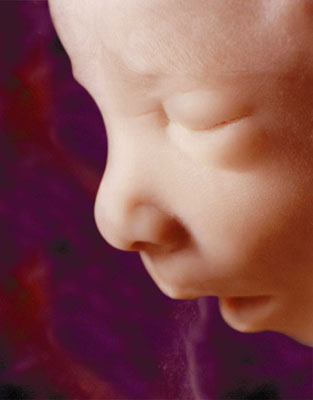
16 week-old unborn baby
Rayna Rapp “Moral Pioneers: Women, Men, and Fetuses on a Frontier Of Reproductive Technology,” and Hoffman et al., Embryos, Ethics and Women’s Rights, 110, from Kathy Rudy. Beyond Pro-Life and Pro-Choice: Moral Diversity in the Abortion Debate (Boston, Massachusetts: Beacon Press, 1996) 11
Incidentally, abortions for fetal anomaly are almost always late-term abortions – the tests that detect problems such as down syndrome can only be performed in the second trimester.
A large percentage of abortions are performed on college-age women. These women often feel forced to choose between their education and their baby. Groups like Feminists for Life have college outreach programs where they try to encourage colleges and universities to provide services to pregnant and parenting students. This pro-life group believes that no woman should be forced to sacrifice her baby in order to have an education.
The problem is real. Frederica Mathews-Green writes:
“A student at an Ivy League college told the author that the campus health center refers about 50 women a year for abortions; yet in the previous five years the number of students who continued their pregnancies totaled zero.”
Frederica Mathews-Green. Real Choices: Offering Practical, Life-Affirming Alternatives to Abortion (Sisters, Oregon: Multnomah Books, 1994) 162
“Perhaps the major problem of pro-choice public relations is that the image of this procedure we so believe in – of someone scraping or vacuuming out a woman’s insides, digging between her legs into her tender sexual passage, blood, gooey tissue, injured fetus all falling out – is aesthetically a disaster. Are we really pro- that ?
Nora Johnson, “Whose Life Is It?”, “Hers” column, the New York Times Magazine, January 23, 1994 quoted in Frederica Mathews-Green. Real Choices: Offering Practical, Life-Affirming Alternatives to Abortion (Sisters, Oregon: Multnomah Books, 1994)
Abortion clinic workers often struggle emotionally with the difficult task of performing abortions. Ripping apart a fully formed unborn baby whether via suction or via forceps, can be very visually disturbing. In one study, 77% of abortion clinic workers in San Francisco saw abortion as “a destructive act against a living thing.”
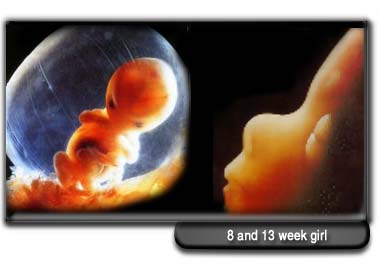
eight week-old unborn baby
According to the study
“Particularly striking was the fact that discomfort with abortion clients or procedures was reported by practitioners who strongly supported abortion rights and expressed strong commitment to their work. This preliminary finding suggested that even those who support a woman’s right to terminate a pregnancy may be struggling with an important tension between their formal beliefs and the situated experience of their abortion work.”
…
seen as murder:
“This theme was unexpected among pro-choice practitioners yet 18% of the respondents talked about involvement with abortion this way at some point in the interview. This theme tended to emerge slowly in the interviews and was always presented with obvious discomfort.”
Kathleen M. Roe “Private Troubles and Public Issues” Social Science and Medicine, Vol 29, No 10
“Later term abortions may be necessary, but you cannot read about them without feeling diminished as a human being. Something awful has happened, and simply as a matter of principle, we ought to be opposed.”
He said of pro-choice feminists:
“[they] talked as if late-term abortions affect only the woman, no mention of the fetus-child with the collapsed skull.”
Quoted in Suzanne Fields “Feminists Support an Evil Practice” The Washington Times, July 10, 2000
A lawsuit was aimed at the Queen’s Park Hospital in England, after an abortion led to a live birth:
From the “My Beautiful Abortion Baby” Lancashire Evening Telegraph, first published Wednesday 1st Nov 1995.
Office manager Julie Robb, 38, was admitted to Queen’s Park Hospital for a “therapeutic termination” after a scan revealed that her 23-week-old foetus could have serious abnormalities, [(cerebral palsy, water on the brain, or downs’ syndrome)]…. A team of medics induced Mrs Robb who gave birth to Elizabeth, weighing 696 grams (1lb 8oz), at 2.25am on December 7 last year
According to the testimony of medical experts, the baby “gasped” after it was born and showed signs of life.Also had heartbeat. The team (2 midwives and 2 specialists) decided not to revive the baby. Death certificate showed baby was alive for 90 minutes, Medical personnel testified it was less than 35 minutes.
Verdict was in favor of hospital
There have actually been many similar cases of babies born alive after abortions.
The Born Alive Infant Protection Act, which became law in 2001, forbids hospitals and clinics from aborting babies alive and leaving them to die. It was opposed by a number of pro-choice groups. It was also voted against by Barack Obama, then a senator.
When commenting about the uproar surrounding the partial-birth abortion ban, the Royal College of Obstetricians and Gynaecologists put out a statement that said `
“it could be considered more respectful to the foetus than established methods of abortion such as vacuum aspiration . . . in which the foetus is removed in fragments’
“Abortion: New and Disturbing Questions.” The Daily Mail. July 17, 1996. 11.
Here is a diagram of a vacuum aspiration, or suction abortion.