“Mostly, this must seem selfish, when I had an abortion a decade ago, I knew I was killing. There was no other way to think about it, to describe it… But I was killing a very small piece of life in favor of my bigger life. That’s important, it makes you get your priorities straight.”
Rayna Rapp Testing Women, Testing the Fetus: the Social Impact of Amniocentesis in America (New York: Routledge, 1999) 137
“[Hospital administrators say] abortion is a sleazy and offensive procedure… The doctor who does abortions – even if they are only a small part of her practice – is known as an abortionist… This label is the kiss of death for any professional hopes a doctor might have.”
Glamour, October 1993
Quoted in Mark Crutcher “Access: the Key to Pro-Life Victory” Life Dynamics Incorporated
“I do, as a humanist, believe that the concept “unborn child” is a real one and I think the concept is underlined by all the recent findings of embryology about the early viability of a well conceived human baby, one that isn’t going to be critically deformed (or even some that are) will be able to survive outside the womb earlier and earlier, and earlier and I see that date only being pushed back. I feel the responsibility to consider the occupant of the womb as a candidate member of society in the future, and thus to say that it cannot be only the responsibility of the woman to decide upon it, that it’s a social question and an ethical and a moral one. And I say this as someone who has no supernatural belief.”
An abortion clinic worker talks about stigma. After saying that she finds it easy to dismiss criticism when it comes from pro-lifers, she says:
“What’s harder, though, is to talk about how our parents sidestep friends’ questions about what their progeny are doing these days, or how high school reunions are at even greater risk of being depressing/distressing/disastrous than for everyone else, or how we worry about our kids learning what we do not because we aren’t proud but because their classmates’ parents might shame or punish them.
We go to schools that don’t want to talk too much about abortion because some nebulous outside audience may object; we attend reproductive health lectures by professors who feel comfortable accommodating the opinion that it’s OK to be anti-reproductive health; we don’t get hired because someone thought we’d bring unnecessary attention to an organization that doesn’t even really care about abortion either way, maybe they even support what we do, but just wants to get its own work done without pointless interference. You will never see an abortioneer nominated to the Department of Health and Human Services.”
From a woman waiting for the results of her amniocentesis, who intends to abort if the baby has down syndrome or another defect:
“I would have a very hard time dealing with a retarded child. Retardation is relative, it could be so negligible that the child is normal, or so severe that the child has nothing… All of the sharing things you want to do, the things you want to share with a child – that, to me, is the essence of being a father. There would be a big void that I would feel. I would feel grief, not having what I consider a normal family.”
Rayna Rapp Testing Women, Testing the Fetus: the Social Impact of Amniocentesis in America (New York: Routledge, 1999) 133
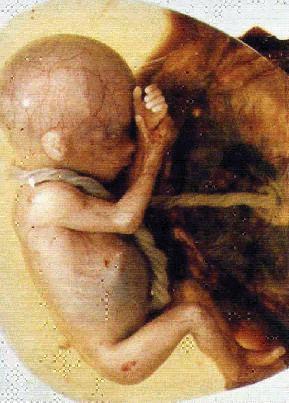
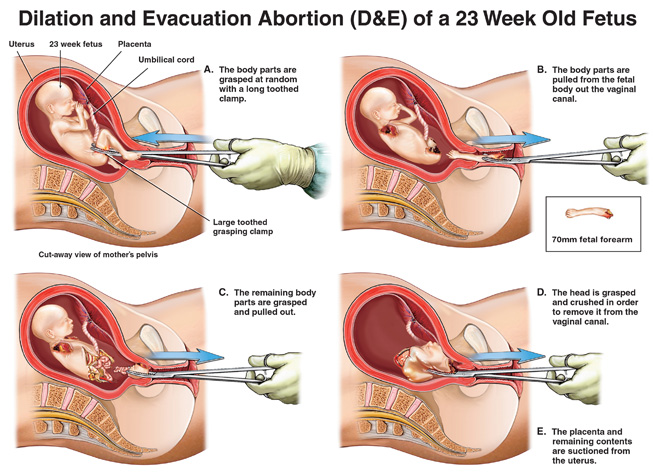
At the time the book was written, 1999, the only available test for down syndrome was amniocentesis, which is used at about 16 weeks. By this time, the baby is fully developed. (See picture below of a on the left at only 14 weeks) at this stage, the method of abortion used most is D&E, in which a baby is dismembered in the womb, her arms and legs pulled off and extracted by forceps and her skull crushed.
Beverly Wildung Harrison, professor of Christian ethics at the Union Theological Seminary:
“Presidents, members of Congress, and other leaders have made life or death decisions that resulted in thousands of deaths. Some of these decisions – such as the bombing of Hiroshima and Nagasaki – are justified by many Americans, even if many deaths occurred. Other decisions were clearly mistakes. In 1988 a U.S. Navy officer in the Persian Gulf fired a missile into civilian airliner, killing 290 people, including 66 children. Somehow we can tolerate our leaders making life or death decisions affecting many lives when they are faced with difficult situations such as international aggression. We find understanding and empathy for them if they make a mistake – even if their decision brings death to other human beings, yet we don’t want to let a woman make a decision affecting only her own life and the life within her.”
Anne Eggebroten, ed Abortion: My Choice, God’s Grace (Pasadena, California: New Paradigm Books, 1994) 222
16 week old unborn baby. Could be a victim of abortion in any state in the US
“I had a fairly long phone conversation with Dr. Hern (Colorado [late term] abortionist) today which was really interesting. He had a number of criticisms not only of the Democratic Party (which you’ve read about if you’re a reader here), but also of the pro-choice movement in general. …. He expressed concern that doctors are not included in the movement as much as he believes they should be. He was annoyed that the pro-choice movement doesn’t support him as much as he thinks they should. It was just very interesting to hear a doctor, who has a permanent, serious threat against his life for his work, criticize the very movement that should be helping both him & his patients.”
26 weeks
Reproductive Rights Blog, Talking to Dr. Hern: 8-17-2005
Quoted by Life Dynamics
Perhaps even many of those who claim to be pro-choice are uncomfortable with the actual process of abortion, in particular, of late term abortion. The baby on the left, at 26 weeks, could have been killed in Hern’s Boulder clinic.