Biologist Dr. Garrett Hardin says an early preborn baby has never been seen “as a human being” because it “may, with impunity, be flushed down the toilet or thrown out with the garbage.”
Garrett Hardin “Abortion – Or Compulsory Pregnancy?” Journal of Marriage and the Family 30 (May 1968): 251
Cheryl Sabel, President, Montgomery chapter of the National Organization for Women, about a clinic that was shut down due to filthy conditions
“Every time a women’s health clinic closes, it is a huge blow for women and it’s very unfortunate. But women must be protected, and there are standards — as there are for every health care facility — and every facility needs to abide by the rules.”
“Alabama Abortion Clinic to Stay Shut” Washington Post 6-15-2006
On the blog “Abortion Witness” in a post entitled “Talking about the babies: saying the things we cannot say,” a clinic worker writes:
“You’ve written in your chart that you feel guilty.” I say to the patient I am screening. “Can you tell me more about this? Why do you feel guilty?”
“I feel guilty because I am killing my baby,” she answers. “That’s why I feel guilty.”
The first time an abortion patient said this to me, I was completely unprepared for it. Although I was a long-time pro-choice activist, a Ph.D. who had studied feminist theory , and a former abortion patient myself, nothing in my experience had prepared me to talk with a woman about killing babies.
“Oh no,” I said to her as gently as I could. “It’s not a baby- it’s just tissue.”
But the clinic worker later came to feel that her response was wrong.
She describes how pro-choice activists have trouble with using the word “baby” to describe the child who is killed in an abortion and says:
We all know that an unborn child dies in each abortion. And the majority of abortion care workers accept responsibility for our roles in these deaths.
We have, for various reasons, determined for ourselves that having a part in these deaths is an important- and ethical- thing for us to do[.]
The blogger describes how a female abortionist who was 18 weeks pregnant performed an abortion on an 18-week-old unborn baby and felt her wanted baby kick just as she was pulling a leg off of the baby she was aborting. The blogger says:
We might start these honest conversations by asking what differentiates these two eighteen week unborn babies?
The short answer – which is both incredibly simple and very complicated – is that the unborn baby moving inside the physician/mother is being carried by someone who has chosen to complete her pregnancy and deliver a living child, and the other unborn baby is being carried by someone who, for reasons that we may or may not understand, has decided that she cannot complete her pregnancy.
In other words, the life or death of the unborn baby is determined by the mother’s decision about whether she wants to share her body with another being[.]
The blogger admits that “the distinction can feel unsatisfying to many people” but reiterates that it is moral to kill an unborn baby whose mother does not want her. She goes on to say:
… We should never deny that abortion kills an unborn child. When the topic comes up, a simple “yes, I know – and so do women who have abortions” will often suffice. Several years ago, the director at the clinic where I worked was on a radio talk show about second trimester abortion. A caller said, “You can’t tell me it’s not a baby. And you can’t tell me that baby won’t die!” Yes, she said calmly, it is a baby and yes, it is killed. Women know this, and they have abortions anyway. This is exactly why abortion is complicated, like many of life’s challenges. We must remember, though, that complicated does not necessarily mean wrong.
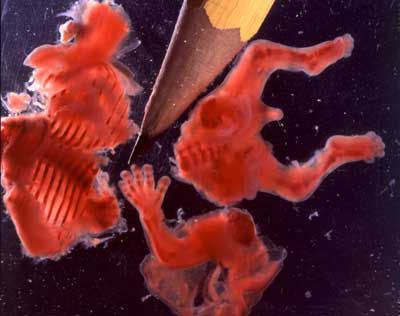
Remains of abortion at 10 weeks
The clinic worker now suggests that the proper response to a woman in an abortion clinic who says “I feel like I’m killing my baby” is something like:
“Ok. Let’s talk about how you are going to cope with knowing that you’ve killed your baby. What do you believe happens to us when we die?” From this point, the woman and I could have an honest conversation about how she understood her abortion decision within the context of her own life circumstances, beliefs, and ethics.
The blogger then finishes her post by saying:
Women have always known that pregnancy means a baby and abortion means the baby will die. When women care enough about the lives of their children – born and unborn – and about the role lives to make that decision, we owe them the respect and support that honesty conveys.
Peg Johnston, who worked at Southern Tier Women’s Services, an abortion clinic, in Binghamton, NY:
“I don’t know if I just started getting bored with Operation Rescue,but I definitely started to get interested in what women were saying instead.”
She’d sit in on a counseling session with a woman who’d say,
“I feel like I’m killing my baby.”
9 weeks
At first, she said, she assumed that the patients were simply repeating what they’d heard outside, having internalized right-wing disinformation that Johnston needed to “correct.” Then she says:
“once I began listening more intently to her,I learned that she wasn’t saying what the picketer was saying–although she used the same words.Frequently [abortion patients] were already mothers and they knew a time when,at that same stage of pregnancy, they had welcomed the lifeand felt like it was their baby.They weren’t mouthing an anti-choice message–they were acknowledging that this was serious stuff.How can I want one kid and not the other?”
“Listening to women about abortion” Fairfield County Weekly May 26, 2005
From Pamela De Almeida whose has a child with down syndrome:
“I don’t live in a bubble. I know there is hate in the world. I know there is racism, prejudice and discrimination. I just didn’t know how real it was until I became a special needs mom, I’ve been told I should have aborted my child. I’ve been told she will be a ‘drain on society.’ I’ve been told I am lucky I have one ‘normal’ kid at home. These words hurt. I know it seems like I let them just roll off my back. I know it seems like I have thick skin. But I cry. I cried every time someone said those mean things.”
She does not regret having her daughter. She says:
I wouldn’t change any of it. Not for a day, not for a minute, not even for a second.”
No matter how hard or challenging things become, no matter how many friends walk away, no matter how many cruel comments, no matter what health issues we will face, we will face them together.”
Margot, a former abortion clinic worker, was interviewed by Abby Johnson on a webcast done by And Then There Were None. And Then There Were None is an organization that helps abortion center workers leave the abortion industry. The organization has helped over 200 abortion facility workers and 7 full time abortionists leave their jobs.
Former abortion worker Margot worked in a late-term abortion facility in the POC room. POC stand for “products of conception,” a term clinic workers use for aborted babies. Jackie handled and inspected the fully formed body parts of late term babies killed in abortions.
At one point in the webcast, Abby Johnson asks her:
You worked at a late-term clinic. Can you share just a little bit, was there a specific profile of the women who came in? You know, we always hear from the abortion movement that the only women who have late-term abortions are women who have been given an extremely grave fetal diagnosis. Was that always the case in your clinic? Because I, you know for us, we referred women who had completely healthy pregnancies, who had completely healthy babies, to places like Doctor Tiller and Doctor Warren Hern in Colorado. So could you just speak to that a little bit. I’m sure that there were cases where there had been the anomaly diagnosed, but was that always the case in your clinic?
Johnson is responding to the common pro-abortion argument that all late term abortions are done because of horrible health problems experienced by the mother or baby. Many pro-choice organizations claim that late term abortions are only done in these dire circumstances- when the baby will die shortly after birth or be born horribly disabled.
Margot replies:
Almost never, Abby. Almost never. Almost never. I would say that the highest profile of women that were having the late-term abortions were completely normal pregnancies, quite often young, and sometimes had just had more fear of having to tell someone they were pregnant, or being so completely out of touch with their own body that they didn’t understand and how rapidly the pregnancy was progressing, or I don’t know.…
Overwhelmingly, the late-term procedures that we did were not for fetal anomalies. We did late-term procedures on women who were perimenopausal and didn’t want to be pregnant. We did them on teenagers.
It is a myth that late-term abortions are only done for fetal anomalies or disabilities. Of course, even in such cases one can argue that it is wrong to take a baby’s life just because they will be disabled. No one has the right to judge another person’s life not worth living and act as executioner for that person.
A book by a pro-choice author told the story of Nurit, from Israel, who had an abortion:
“… She was a research student studying about the development of the embryo in medical school in Israel when she aborted a pregnancy in her fourth month of gestation. She discovered that she had been pregnant with twins when she expelled a second male fetus as she rose from a sofa. Uncertain about what to do with the fetus, she decided take it to her lab where they preserved it in formaldehyde. Over 35 years later, Nurit still has the fetus preserved in a jar on her dresser.
4 month living unborn child. This is the age of the dead baby Nurit kept in a bottle
She says this about keeping her aborted baby in a jar:
“I don’t know exactly why I kept the fetus all these years. I never think of it as my offspring, but I didn’t feel that it was right to just throw it away. I don’t know why I brought it with me to America; I guess that I have some attachment to it. It never occurred to me to bury it, and I never felt the need to name the fetus. I have always referred to my son as my firstborn. The fetus wasn’t born, so it didn’t exist for me in that sense, and yet I keep it with me. I don’t know why…I believe that preserving the fetus was a celebration of life.”
She later had another abortion.
From her husband, the father of the aborted baby:
“I didn’t want my wife to have the first abortion, but when I realized her attitude, we decided that it would be the best for us. I didn’t want her to abort our child because having a child for me meant the survival of the Jewish people. I was born in Belgium and lost most of my family in the Holocaust. I felt that abortion was killing a child, but that it was better to do it before we knew him…
Before he was born. My wife was more important to me than the fetus we lost. I didn’t think my wife was right to preserve the fetus. To this day I think that she was wrong to do that. But it was a part of her, and so it’s her right, even if I disagree. This fetus represents death for me, but I am not afraid to face death.”
Miriam Claire The Abortion Dilemma: Personal Views on a Public Issue (New York: Insight Books, 1995) 102 – 103
Judith Jarvis Thompson, pro-choice professor at MIT:
“I am inclined to think also that we shall probably have to agree that the fetus has already become a person well before birth. Indeed, it comes as a surprise when one first learns how early in its life it begins to acquire human characteristics. By the tenth week, for example, it already has a face, arms and legs, fingers and toes; it has internal organs, and brain activity is detectable.”
“There are many reasons for choosing to have an abortion. Perhaps underlying them all is a deeply maternal, instinctive feeling that the time is not right to give birth and that to do so would be detrimental to all concerned… For some women, and abortion is one of the most profound events they will experience in life.”
Miriam Claire The Abortion Dilemma: Personal Views on a Public Issue (New York: Insight Books, 1995) 17
Is it “maternal” to kill a baby? Is it not detrimental to the baby to kill him or her?
Perfectly formed legs of baby aborted at just 8 weeks, still around the time when most abortions take placeShare on Facebook
“You just get your kids beyond the diaper stage and start to plan for doing things, getting out of the house more. There was just no way at this time for a little one, for starting all over again.”
Suzanne T. Poppema, MD and Mike Henderson Why I am an Abortion Doctor (Amherst, New York: Prometheus Books, 1996) 260
Below: baby aborted at 8 weeks. This is around the time most abortions are done.