Dr. Warren Hern discusses late-term abortions and the reasons why women get them

Warren Hern, late term abortionist, on the abortions he performs. He does abortions up to 32 weeks and sometimes beyond at his clinic in Boulder:

“The generally accepted point of level viability is around 24-26 weeks. But you can’t take a given point in fetal development and apply that 100 percent of the time. It just doesn’t happen that way. If you look at premature deliveries and survival percentages at different weeks of gestation, you’ll get 24-week fetuses with some survival rate. The fact that you get some survivors demonstrates the difficulty in defining a point. ….

17 weeks
17 weeks

I don’t know that there is a typical second-trimester abortion. But if you look at the spectrum of abortions (most women are between the ages of 19 and 29) they tend to be younger. Some are older. The typical thing that happens with older women is that they never realize they were pregnant because they were continuing to bleed during the pregnancy. The other thing we see with older women is fetal malformations or Down’s Syndrome. These are being diagnosed much earlier now than they used to be. We’re seeing a lot of genetic diagnoses with ultrasound and amniocentesis at 17-18 weeks instead of 22-24 weeks. With the teenagers, anybody who has ever worked with or had teenagers can appreciate how unpredictable they can be at times. They have adult bodies, but a lot of times they don’t have adult minds. So their reaction to problems tends to get much more emotional than an adult’s might be.

20 – 22 weeks
20 – 22 weeks

It’s a question of maturity. So even though they may have been educated about all kinds of issues in reproductive health, when a teenager becomes pregnant, depending up on her relationship with her family, the amount of peer support she has–every one is a highly-individual case–sometimes they delay until they can no longer contain their problem and it finally comes out. Sometimes it’s money: It takes them a while to get the money. Sometimes its just denial….”

Discharging the Committee on the Judiciary from Further Consideration Of the President’s Veto of HR 1833, Partial-Birth Abortion Ban Act of 1995 Can be found here.

So we see there are various reasons why late term abortions can be performed, and its interesting he did not cite a single case where abortion was needed to preserve a woman’s life or health. Does a baby with down syndrome really deserve to die?

This is what Dr. Hern does to babies at 23 weeks:

de


Below: ultrasound of baby between 22 and 24 weeks

z22to24wk4 (1)

Below: pieces of baby aborted at 20 weeks

z20w2

Share on Facebook

Accurate figures on how many 2nd and 3rd trimester abortions are done are elusive, says writer

“Accurate figures on 2nd and 3rd trimester abortions are elusive because A number of states don’t require doctors to report abortion statistics. For example, one third of all abortions are said to occur in California, but the state has no reporting requirements.”

Diane Gianelli, commenting on her article which discussed the number of 3rd trimester abortions done in America

Nat Hentoff “It’s Just Too Late: 3rd Trimester Abortions Are an Outrage and an Insult to the Human Race” Pittsburg Post – Gazette July 27, 1993

above: 2nd trimester

Share on Facebook

Some women don’t realize they’re pregnant until late in pregnancy, says pro-choice author

Pro-choicers argue that women who have late-term abortions are all carrying wanted pregnancies until they discover that their babies have horrible disabilities and that they “must” abort. However, late-term abortionists have admitted that many of their patients have no health problems and are carrying healthy babies. Former clinic workers have also revealed this. They did not know they were pregnant right difficulty making arrangements. Pro-choice author Mary Pipes  explains why some women do not realize they are pregnant until many months have passed.

“Women who have irregular periods – because they have only recently begun to menstruate or are approaching the menopause or who have irregular or long cycles – may not receive any indication that they are pregnant for some time because they do not expect to menstruate on a particular day. Furthermore some of the symptoms of pregnancy, such as swollen breasts, irritability, abdominal pain and tiredness, are very similar to premenstrual syndrome (PMS), and we may often think that we are about to start bleeding… It is possible that bleeding may occur and be confused with a period. Although this bleeding is usually short, if it is unaccompanied by any other symptoms we can be unaware of having conceived for several months.”

Mary Pipes Understanding Abortion (London: The Women’s Press, 1998) 30 – 31 

Share on Facebook

Late term abortions and teenagers

Warren Hern, late term abortionist, on the abortions he performs:

17 weeks

“I don’t know that there is a typical second-trimester abortion. But if you look at the spectrum of abortions (most women are between the ages of 19 and 29) they tend to be younger. Some are older. The typical thing that happens with older women is that they never realize they were pregnant because they were continuing to bleed during the pregnancy. The other thing we see with older women is fetal malformations or Down’s Syndrome. These are being diagnosed much earlier now than they used to be.

18 weeks

We’re seeing a lot of genetic diagnoses with ultrasound and amniocentesis at 17-18 weeks instead of 22-24 weeks. With the teenagers, anybody who has ever worked with or had teenagers can appreciate how unpredictable they can be at times. They have adult bodies, but a lot of times they don’t have adult minds. So their reaction to problems tends to get much more emotional than an adult’s might be. It’s a question of maturity. So even though they may have been educated about all kinds of issues in reproductive health, when a teenager becomes pregnant, depending up on her relationship with her family, the amount of peer support she has–every one is a highly-individual case–sometimes they delay until they can no longer contain their problem and it finally comes out. Sometimes it’s money: It takes them a while to get the money. Sometimes its just denial….”

Discharging the Committee on the Judiciary from Further Consideration Of the President’s Veto of HR 1833, Partial-Birth Abortion Ban Act of 1995 Can be found here.

Share on Facebook

Third trimester abortionist on the women who get abortions late in pregnancy

Dr Susan Robinson, a former colleague of George Tiller who still performs late term abortions, discusses the women who come in for late second trimester and third trimester abortions:

“Women whose fetuses have terrible abnormalities are a lot easier for people to understand. The husband and wife want to spare their baby whatever suffering that baby would have.

‘Then there’s the group of women who didn’t know they were pregnant,’ she said. ‘They were told they were not pregnant for one reason or another and they are just as desperate.’”

“After Tiller: Meet the only four doctors in the U.S. who still perform third-trimester abortions despite constant threats to their lives” Mail Online Jan 21, 2013

Thus we see that these late term abortions are not always done because of health problems in the baby, but are also done on healthy mothers with healthy babies who “didn’t’ know they were pregnant” until the third trimester.

7 months. This abortionist does abortions at this time and later
Share on Facebook

Dr. James MacMahon performed abortions in the 3rd trimester

“The July 5, 1993 edition of The American Medical News writes that he [Dr. James MacMahon] does abortions “through all 40 weeks of pregnancy.” In 1995, he informed the House Judiciary Committee in writing that he performed such abortions during the third trimester on babies who had no “flaw” at all for reasons such as the mother’s youth or for “psychiatric” problems. McMahon further admitted that one-fourth of the babies he aborted well into the seventh month had no flaws whatsoever. McMahon said that of the approximately 2000 partial birth abortions he performed, only 9% were performed for “maternal [health] indications” and then the most common reason was “depression.”

Raymond Dennehy “Anti-Abortionist at  Large: How to Argue Intelligently About Abortion and Live to Tell About It” (St. Victoria, B.C., Canada: Trafford, 2002) p 149

7 months

Dr. MacMahon is now deceased.

Read an eyewitness’s description of partial birth abortion 

Share on Facebook

Dr. Susan Robinson: Parents Hold Their Aborted Babies

From an interview with late term abortionist Dr. Susan Robinson on what she does with the babies she aborts in the third trimester:

Robinson:

“With fetal anomaly patients,[who are aborting because the baby is handicapped] we ask them right up front if they plan to hold their baby after it’s born. These patients, their emotional needs are so different from the ones who are looking at their pregnancy as an absolute disaster, who are just thinking, “Get it out of me, please, please, please.” Those patients—the maternal indications patients—they are not relating to their fetus as a baby, they’re relating to it as a problem.

But with a fetal indications patient—if she refers to it as her baby, I’ll refer to it as her baby. If she’s named the baby, I’ll use the baby’s name too. I would say that most of these patients do decide to see and hold their baby, although many of them have a hard time dealing with the idea at first. We’ll take remembrance photographs, we’ll give them a teddy bear, the footprints… I don’t want them to go home from the procedure with absolutely nothing to remember and honor the baby, and its birth.”

Interviewer:

Wow. You’ll say “birth”?

Robinson:

Yes. I try to mirror what will be the most consoling to the patient. In general, these patients—fetal indications—do talk about giving birth, so I’ll say that as well.

Interviewer:

To simultaneously sustain these ideas—that you desperately loved and wanted this baby that’s here in your arms, and also that you just committed yourself to ending its life—it’s one of the most complicated emotional situations I can imagine. In these cases—I am sorry for this macabre question—the baby is dead, right? They never meet their baby alive?

Robinson says that yes, indeed, the baby is dead.

Jia Tolentino “Interview with Dr. Susan Robinson, One of the Last Four Doctors in America to Openly Provide Third-Trimester Abortions” The Hairpin Sept 20, 2013

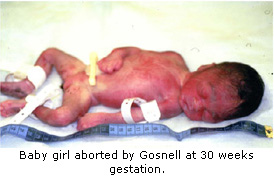
This baby girl was not aborted by Robinson, but this is the age of many of the babies she aborts


Share on Facebook

Planned Parenthood director: 3rd trimester abortions for health reasons are nonexistent

Dr. Rose R  Middleman, medical director of Pittsburgh Planned Parenthood clinic:

“It’s extremely rare, if nonexistent, for a physician to have a medical reason to abort a woman in the 7th or 8th month.”

“Doctor Refutes Abortion Claim” Reading Eagle June 14, 1972

If it was rare in 1972, one can only wonder how rare it is now with all the medical advances that have taken place since then.

Share on Facebook

“I like that we go up to 26 weeks” says clinic worker

A clinic worker praises late-term abortions at 26 weeks (the beginning of the third trimester), said the following:

“I like that we go up to 26 weeks. For a while it kind of gave me some things to learn… Plus it gives a whole new dimension to working with those women who come in for later abortions. It’s, like, great because they almost can’t have an abortion. They’re almost about to have a baby, and they don’t want to. And they’re really appreciative.”

Wendy Simonds. Abortion at Work: Ideology and Practice in a Feminist Clinic (New Brunswick, New Jersey: Rutgers University Press, 1996) 63

Sonogram of baby at 26 weeks
Share on Facebook

“Denial and Ambivalence” of late term abortions

From an article on late term abortions:

Even abortion-rights advocates are beginning to say that late abortions pose special problems. Compared with early abortions, post-20-week procedures are four times more costly, seven times more likely to lead to medical complications, and far more physically and emotionally traumatic to the woman. In recognition of these problems, more and more clinics are offering counseling before the abortion. “I don’t want laws to stop abortion at 20 weeks,” says Charlotte Taft, an abortion counselor and consultant in Santa Fe, N.M. “But I’d like us to consider how we, as a society, can take responsibility for the denial and ambivalence” that lead to late abortions.

When abortions come late in a pregnancy.,  By: Lavelle, Marianne, Glastris, Paul, Gerson, Michael J., Daniel, Missy, Meyer, Michele, U.S. News & World Report, 00415537, 01/19/98, Vol. 124, Issue 2

20 weeks

Share on Facebook