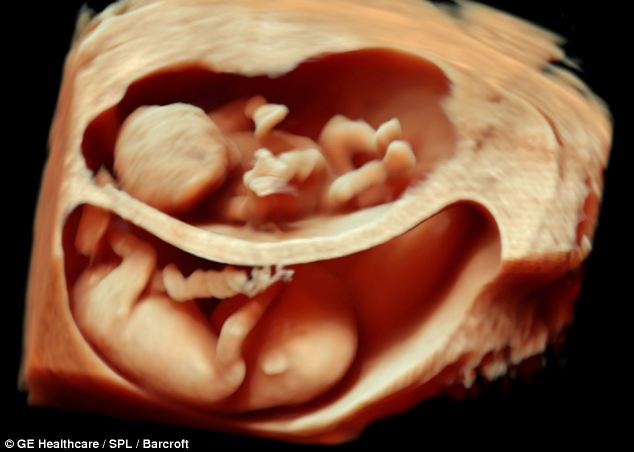
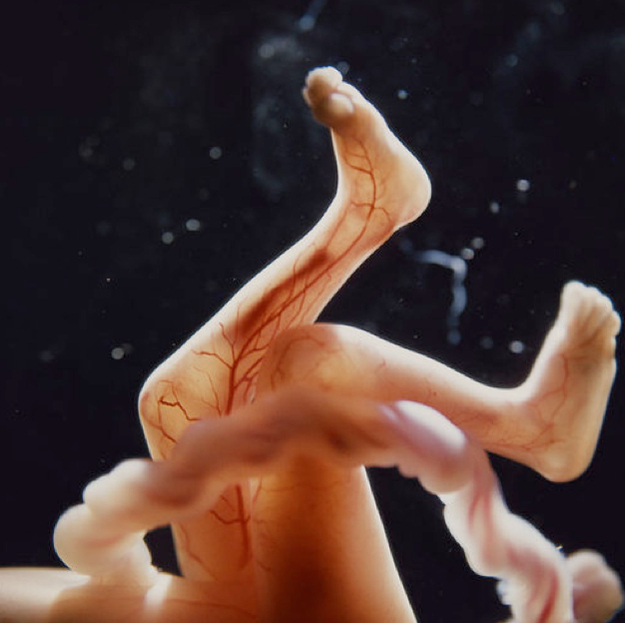
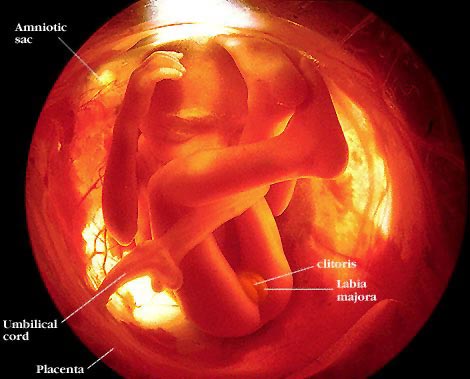
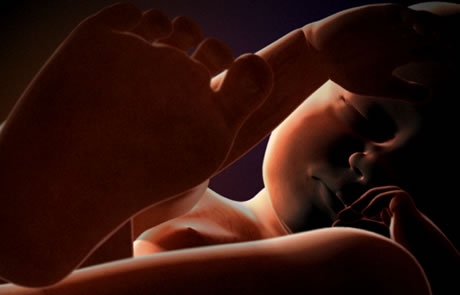
By midpregnancy the fetus has begun to explore its own body and environment using its hands. It often holds on to the umbilical cord, and when a thumb approaches its mouth, it will turn and begin to make sucking motions with its lips… The fetus is also using its sense of hearing for orientation. Its most familiar sounds are surely the noises of the mother’s digestive system and the swishing from her major blood vessels, but gradually the fetus also begins to perceive the sounds of the mother’s world, such as music and the father’s voice. The eyes of the fetus are sensitive to light, even though the eyelids are still shut tight… We have no way of knowing whether the fetus tastes the slight salinity of the amniotic fluid. Still, we have indirect evidence that the fetus tastes and smells, since a newborn immediately reacts positively or negatively to tastes that are sweet, salty, or bitter…
Lennart Nilsson and Lars Hamberger, A Child is Born, 4th edition. New York: Bantum Dell, 2003. p. 141.
As identical twins grow bigger [in the womb], they’re almost always in contact, touching hands, faces, feet and gradually becoming more aware of themselves and each other.
National Geographic, in their video, In the Womb: Multiples
“Every baby begins life within the tiny globe of the mother’s egg… It is beautifully translucent and fragile and it encompasses the vital links in which life is carried from one generation to the next. Within this tiny sphere great events take place. When one of the father’s sperm cells, like the ones gathered here around the egg, succeeds in penetrating the egg and becomes united with it, a new life can begin.”
Geraldine Lux Flanagan, Beginning Life. (New York: DK, 1996) p. 13.
There is simply no doubt that even the early embryo is a human being. All its genetic coding and all its features are indisputably human. As to being, there is no doubt that it exists, is alive, is self-directed, and is not the the same being as the mother–and is therefore a unified whole.
Bernard N. Nathanson, M.D., The Hand of God (Washington, DC: Regnery Publishing, 1996), 131.
Twins, and other multiples, are known for a particular characteristic in utero. Scientists have even witnessed them playing games together… Scientists think their prenatal behavior [carries] over into early childhood.
Kellie Copeland, executive director of NARAL Pro-Choice Ohio, on HB 125, a bill that would ban abortions after a fetal heartbeat can be heard. It was dubbed, “the Heartbeat Bill”:
“They can give it whatever cute name they want. (HB 125) is a virtual ban on abortion. It’s a direct challenge to Roe v. Wade. By the time you find out you’re pregnant, abortion is already illegal.”
Day 1: Sperm joins with ovum, to form one cell smaller than a grain of salt. The new life has inherited 23 chromosomes from each parent, 46 in all. This one cell contains the complex genetic blueprint for every detail of human development – the child’s sex, hair and eye color, height, skin tone
Days 3 – 4: The fertilized egg travels down the fallopian tube into the uterus, where the lining has been prepared for implantation
Days 5 – 9: During this time, the fertilized egg implants itself in the rich lining of the uterus and begins to draw nourishment.
Days 10 – 14: The developing embryo signals its presence through placental chemicals and hormones, preventing the mother from menstruating
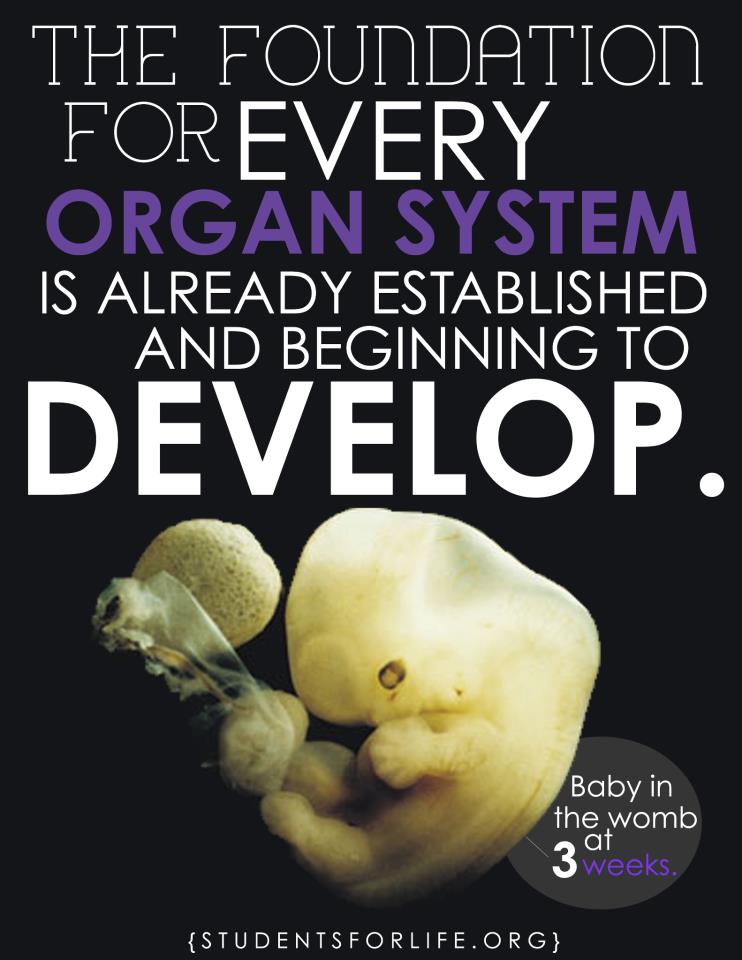
Day 20: Foundations of the brain, spinal cord, and nervous system are already established
day 21-25
Day 21: The heart begins to beat
Day 28: The back bone and muscles are forming. Arms, legs, eyes and ears have begun to show.
Day 30: At 1 month old, the embryo is 10,000 times larger than the original fertilized egg – and developing rapidly. The heart is pumping increasing quantities of blood through the circulatory system. The placenta forms a unique barrier that keeps the mother’s blood separate while allowing food and oxygen to pass through to the embryo.
Day 35:5 Fingers can be discerned on the hand. The eyes darken as pigment is produced.
day 37-40
Day 40: Brain waves can be detected and recorded
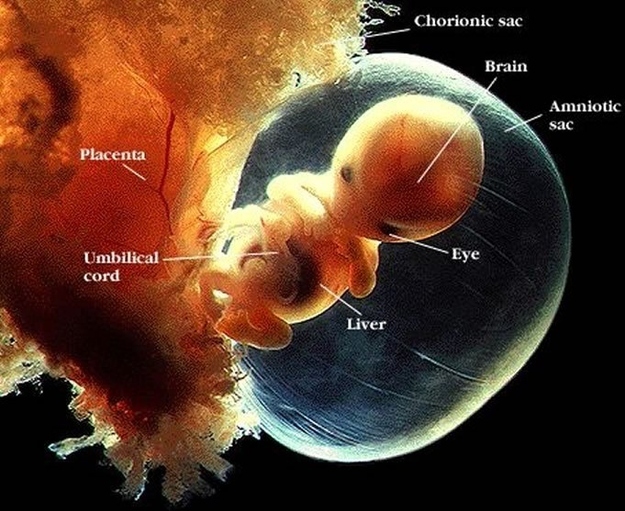
Week 6: The liver is now taking over the production of blood cells, and the brain begins to control movement of muscles and organs. The mother is about to miss her 2nd period and has probably confirmed that she is pregnant.
Week 6
Week 7: The embryo begins to move spontaneously. The jaw forms, including teeth buds in the gums. Soon the eyelids will seal to protect the embryo’s developing light-sensitive eyes, and will reopen at about the 7th month
week 7
Week 8: At a little more than an inch long, the developing life is now called a fetus – Latin for “young one” or “offspring.” Everything is now present that will be found in a fully developed adult. The heart has been beating for more than a month, the stomach produces digestive juices and the kidneys have begun to function. 40 muscle sets begin to operate in conjunction with the nervous system. The fetus’s body responds to touch, although the mother will not be able to feel movement until the 4th or 5th month.
Week 9: Fingerprints are already evident in the skin. The fetus will curl its fingers around an object placed in the palm of its hand.
week 9-10
Week10: The uterus has now doubled in size. The fetus can squint, swallow and wrinkle its forehead.
Week 10
Week 11: At this time, the fetus is about 2 inches long. Urination occurs. The face has assumed a baby’s profile, and muscle movements are becoming more coordinated
Week 12
Week 12: The fetus now sleeps, awakens and exercises its muscles energetically – turning its head, curling its toes, and opening and closing its mouth. The palm, when stroked, will make a tight fist. The fetus breathes amniotic fluid to help develop its respiratory system.
Week13: Fine hair has begun to grow on the head, and sexual differentiation has become apparent
Month 4: By the end of this month, the fetus is 8 to 10 inches in length and weighs a half pound or more. The mother will probably start to “show” now. The ears are functioning, and there is evidence that the fetus hears quite a bit: the mother’s voice and heartbeat as well as external noises. The umbilical cord has become an engineering marvel, transporting 300 quarts of fluids per day and completing the round-trip of fluids every 30 seconds.
14 weeks
Month 5: Half the pregnancy has now passed, and the fetus is about 12 inches long. The mother has definitely begun to feel movement by now. If a sound is especially loud or startling, the fetus may jump in reaction to it
Week 16- 4th monthWeek 20 (5th month)
Month 6: Oil and sweat glands are functioning. The delicate skin of the growing baby is protected from the fetal waters by a special ointment called “vernix.” If the baby were born in this month and given the proper care, he would survive.
Month 7: The baby now uses the 4 senses of vision, hearing, taste and touch. He can recognize his mother’s voice.
Month 7
Month 8: The skin begins to thicken, with a layer of fat stored underneath for insulation and nourishment. Antibodies increasingly build up. The baby absorbs a gallon of amniotic fluid per day; the fluid is completely replaced every 3 hours.
Month 9: Toward the end of this month, the baby is ready for birth. The average duration of pregnancy is 280 days from the 1st day of the mother’s last menstrual period, but this varies. Most babies (85% to 95%) are born somewhere between 266 and 294 days. By this time the infant normally weighs 6 to 9 pounds and his heart is pumping 300 gallons of blood per day. He is fully capable of life outside the womb.
Month 8
Source: “The First 9 Months” Focus on the Family 1989
Lennart Nilsson, who captured groundbreaking photos of unborn babies in the womb gave the following caption on the picture of a six week old unborn baby that appeared in Life Magazine.
“Its length is only about half an inch and it weighs only 1/25 of an ounce, yet it has already begun to take on a human appearance.”
“Embryo’s Face” Life, March 30, 1950
Sara Dubow Ourselves Unborn: A History of the Fetus in Modern America (Oxford: Oxford University Press, 2011) 115
An article in the British periodical The Daily Mail discusses an article in The Journal Developmental Psychobiology which describes the cognitive development of unborn babies. Based on conclusions reached by researchers from Durham and Lancaster Universities in the U.K.
“For the first time, psychologists discovered that foetuses were able to predict, rather than react to, their own hand movements towards their mouths as they entered the later stages of gestation compared to earlier in a pregnancy….
Psychologist Dr Nadja Reissland explained: ‘Increased touching of the lower part of the face and mouth in foetuses could be an indicator of brain development necessary for healthy development, including preparedness for social interaction, self-soothing and feeding.’
The discovery comes after a previous study found babies make faces in the womb, potentially as practice before coming in to the world.
Dr Reissland and a team of researchers from Lancaster University and Durham University, which led the study, used ‘4D’ ultrasound scans – 3D scans that can be seen in real time – to image eight girls and seven boys once a month between the 24th and 36th week of pregnancy.
Both boys and girls showed the same rate of development during the study.
In the earlier stage of gestation they saw babies touch the upper part and sides of their heads, although later on they began to touch the the lower, more sensitive, part of their faces and mouths.
By the 36th week the majority of fetuses were seen opening their mouths before they touched them, which scientists say is a sign that they were anticipating touch…..
Scientists believe that moving in sequence, opening mouths before sucking on a finger or thumb, shows intention is developing in the fetuses….”
Dutch researchers say unborn children may have their short-term memory formed at 30 weeks into the pregnancy. Dr. Jan G. Nijhuis, director of the Centre for Genetics, Reproduction and Child Health at Maastricht University Medical Centre in Holland, conducted the research.From the article in LifeNews:
He [Nijhuis] and his team published their findings in the July/August issue of Child Development.
“This is the next step into a better insight in the development of the fetal central nervous system,” he told HealthDailyNews. “We aim to develop an ‘intra-uterine neurologic examination,’ which could then be used in fetuses at risk.”
In the research, the Netherlands scientists surveyed 93 pregnant women and they measured the responses from unborn children to repeated “vibroacoustic” stimulation.
“We used a vibroacoustic stimulator, which leads to a combined stimulus of vibration and sound,” Nijhuis told HDN. “The stimuli were applied to the maternal abdomen above the fetal legs for a period of one second every 30 seconds. We counted the number of stimuli after which the fetus does not respond anymore.”
When the unborn baby no longer responds to the audio stimulus, the child is referred to as “habituated” — in other words, they consider the sounds safe.
Researchers consider that a form of learning, where unborn children are aware of potential danger and recognize the sounds as something that will not harm them.
Dr. Richard O. Jones, an assistant professor of obstetrics and gynecology at Texas A&M Health Science Center College of Medicine, responded to the study.
“I’m almost certain the baby heard it quite clearly and it was probably pretty loud,” he said.
“I almost wish I could do an ultrasound looking at the baby while they were making these loud noises. I would not be at all surprised to see the baby putting its hands over its ears,” he added.