Amicus brief submitted to the Supreme Court before Roe V Wade, submitted on October 1971 by a group of 220 physicians, scientists, and professors:
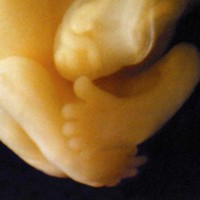
Close-up of seven week preborn baby’s feet
“In its seventh week [the preborn child] bears the familiar external features and all the internal organs of the adult… The brain in configuration is already like the adult brain and sends out impulses that coordinate the functions of other organs… The heart beats sturdily. The stomach produces digestive juices. The liver manufactures blood cells and the kidneys begin to function by extracting uric acid from the child’s blood… The muscles of the arms and body can already be set in motion. After the eighth week…everything is already present that will be found in the full-term baby.”
Motion filed in the Supreme Court of the United States, October 15, 1971 these re-: no. 70 – 18 and no. 70 – 40) Motion and Brief Amicus Curiae of Certain Physicians, Professionals and fellows of the American College of Obstetrics and Gynecology in Support of Appellees, Dennis J Horan et al., United States District Court 1971, P 19, 29 – 30
Professor William Brennan recalls the following story about how a preborn baby reacts to bright lights:
“A dramatic example of how early the unborn baby responds to painful stimulus was revealed in the television special The Miracle Months, which features films of fetal development taken inside the womb. One particular sequence shows an unborn child of only 9 weeks gestation trying to shield himself from the camera lights by placing his hands over his eyes.”
William Brennan The Abortion Holocaust: Today’s Final Solution (St. Louis, Missouri, 1983)
Dr. Albert W. Liley, a widely recognized authority in fetal medicine, explains why conception, not quickening, should be the deciding factor in when a preborn baby should be protected:
“Historically, “quickening” was supposed to delineate the time when the fetus became an independent human being possessed of a soul. Now, however, we know that while he may have been too small to make his motions felt, the unborn baby is active and independent long before his mother feels him. Quickening is a maternal sensitivity and depends on the mother’s own fat, the position of the placenta and the size and strength of the unborn child. Quickening is hardly an objective basis for making a decision about the existence or the value of the life of the unborn child.”
H.M. Liley, Modern Motherhood (1969), cited by Heffernan, “Early Biography of Everyman,” p.18
In the article “Fetal Psychology” scientists explain how a baby learns to differentiate between voices while in her mother’s womb. This article appeared in the reputable publication Psychology Today.
“Along with the ability to feel, see, and hear comes the capacity to learn and remember. … For example, a fetus, after an initial reaction of alarm, eventually stops responding to a repeated loud noise. The fetus displays the same kind of primitive learning, known as habituation, in response to its mother’s voice, Fifer has found.
But the fetus has shown itself capable of far more. In the 1980s, psychology professor Anthony James DeCasper, Ph.D., and colleagues at the University of North Carolina at Greensboro, devised a feeding contraption that allows a baby to suck faster to hear one set of sounds through headphones and to suck slower to hear a different set. With this technique, DeCasper discovered that within hours of birth, a baby already prefers its mother’s voice to a stranger’s, suggesting it must have learned and remembered the voice, albeit not necessarily consciously, from its last months in the womb. More recently, he’s found that a newborn prefers a story read to it repeatedly in the womb – in this case, The Cat in the Hat – over a new story introduced soon after birth.
DeCasper and others have uncovered more mental feats. Newborns can not only distinguish their mother from a stranger speaking, but would rather hear Mom’s voice, especially the way it sounds filtered through amniotic fluid rather than through air. …
By monitoring changes in fetal heart rate, psychologist JeanPierre Lecanuet, Ph.D., and his colleagues in Paris have found that fetuses can even tell strangers’ voices apart.”
A psychologist talking about how a baby’s brain develops in the uterus remarks on what a preborn baby does:
Heidelise Als, Ph.D., a developmental psychologist at Harvard Medical School, is fascinated by the amount of tactile stimulation a fetus gives itself. “It touches a hand to the face, one hand to the other hand, clasps its feet, touches its foot to its leg, its hand to its umbilical cord,” she reports.
From an article in Psychology Today. showing that a preborn baby in the womb enjoys being read to:
A new wave of research suggests that the fetus can feel, dream, even enjoy The Cat in the Hat. The abortion debate may never be the same.
One psychologist weighs in on how a preborn baby moves:
Heidelise Als, Ph.D., a developmental psychologist at Harvard Medical School, is fascinated by the amount of tactile stimulation a fetus gives itself. “It touches a hand to the face, one hand to the other hand, clasps its feet, touches its foot to its leg, its hand to its umbilical cord,” she reports.
Preborn baby at 10 weeks after conception- within the time frame that most abortions take place
The article goes on to say the following about unborn babies:
Along with the ability to feel, see, and hear comes the capacity to learn and remember. These activities can be rudimentary, automatic, even biochemical. For example, a fetus, after an initial reaction of alarm, eventually stops responding to a repeated loud noise. The fetus displays the same kind of primitive learning, known as habituation, in response to its mother’s voice, Fifer has found.
But the fetus has shown itself capable of far more. In the 1980s, psychology professor Anthony James DeCasper, Ph.D., and colleagues at the University of North Carolina at Greensboro, devised a feeding contraption that allows a baby to suck faster to hear one set of sounds through headphones and to suck slower to hear a different set. With this technique, DeCasper discovered that within hours of birth, a baby already prefers its mother’s voice to a stranger’s, suggesting it must have learned and remembered the voice, albeit not necessarily consciously, from its last months in the womb. More recently, he’s found that a newborn prefers a story read to it repeatedly in the womb – in this case, The Cat in the Hat – over a new story introduced soon after birth.
DeCasper and others have uncovered more mental feats. Newborns can not only distinguish their mother from a stranger speaking, but would rather hear Mom’s voice, especially the way it sounds filtered through amniotic fluid rather than through air. They’re xenophobes, too: they prefer to hear Mom speaking in her native language than to hear her or someone else speaking in a foreign tongue.
16 weeks, Legal to abort.
By monitoring changes in fetal heart rate, psychologist JeanPierre Lecanuet, Ph.D., and his colleagues in Paris have found that fetuses can even tell strangers’ voices apart. They also seem to like certain stories more than others. The fetal heartbeat will slow down when a familiar French fairy tale such as “La Poulette” (“The Chick”) or “Le Petit Crapaud” (“The Little Toad”), is read near the mother’s belly. When the same reader delivers another unfamiliar story, the fetal heartbeat stays steady.
Another scientist said:
Birth may be a grand occasion, says the Johns Hopkins University psychologist, but “it is a trivial event in development. Nothing neurologically interesting happens.”
“Looking back on the newspaper cuttings of the great abortion debate, the editorials in serious newspapers such as the Observer and the Sunday Times constantly referred to the foetus as “a blob of jelly”, “a piece of tissue”. But in the years in between the science of embryology has developed extraordinarily, and the “blob of jelly” is now known to have human organs all in place after eight weeks and an entire nervous system after ten weeks. I have watched many abortions taking place, and in the early stages the operation is so swiftly destructive that nothing can be properly perceived by the naked eye. Into the second trimester (after thirteen weeks) however, it is evident that this is a very tiny human being. Once past twenty weeks, the baby begins actually to try to resist the needle, which draws away its amniotic fluid.”
Mary Kenny Abortion: The Whole Story (London: Quartet Books, 1986) 6
“The fetus could not be taken seriously as long as he remained a medical recluse in an opaque womb; and it was not until the last half of this century that the prying eye of the ultrasound rendered the once opaque womb transparent, stripping the veil of mystery from the dark inner sanctum, and letting the light of scientific observation fall on the shy and secretive fetus….
Sonography can accurately delineate normal and abnormal fetal anatomy with astounding detail. It can produce not only static images of the intact fetus, but real time “live” moving pictures…
The sonographic voyeur, spying on the unwary fetus finds him or her a surprisingly active creature, and not at all the passive parasite we had imagined.”
Michael R Harrison “Unborn: Historical Perspectives of the Fetus As Patient” Pharos (Winter 1982): 19 – 24
One doctor describes seeing unborn babies playing on the ultrasound screen:
“When we’re watching the fetus on ultrasound and the mother starts to laugh, we can see the fetus, floating upside down in the womb, bounce up and down on its head, bum-bum-bum, like it’s bouncing on a trampoline. When mothers watch this on the screen, they laugh harder, and the fetus goes up and down even faster. We’ve wondered whether this is why people grow up liking roller coasters.”
“Our own repeated observation of a large group of fetal infants…left us with no doubt that psychologically they were individuals. Just as no two looked alike, so no two behaved precisely alike… These were genuine individual differences already prophetic of the diversity which distinguishes the human family.”
Arnold Gesell “The Embryology of Behavior” cited by Bart T Heffernan “The Early Biography of Everyman” in W Hilgers and Dennis J Horan, eds. Abortion and Social Justice (New York: Sheed and Ward, 1972) 17, 18