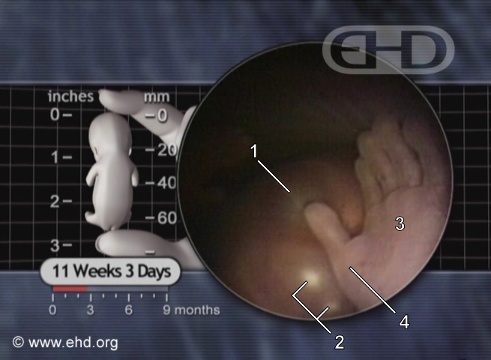
eight week-old unborn baby – most abortions are done at this stage or later
From one clinic worker:
“… workers in abortion clinics are often not pro-choice activists or “radicals.” Although most workers in these settings are committed to women’s access to legal and safe abortions, the cultural and religious ambivalence that surrounds abortion is also reflected in our daily struggles with the nature of our jobs.”
Sarah Todd “Abortion Providers Should Not Have To Work with Fear, Threats, and Violence” Lucinda Almond The Abortion Controversy (New York: Greenhaven Press, 2007) 137
Director of nurses at Mount Sinai Hospital in New York, where they did abortions:
17 weeks
“Most nurses find the destruction of life the very antithesis of what they believe… Nurses in delivery rooms had been accustomed to every conceivable effort to save babies, even those of 1 to 3 pounds, and they found that sometimes they were “salting out” bigger babies than those they had worked to save.”
The hospital hired a psychiatrist to bring them around, to help them see that, “physicians help people in what they need, and a nurse should feel that way.”
Enid Nemy, “From Saving Life to Ending Them: Why Many Nurses Shun Abortion Duty” New York Times February 1, 1972, P 32
“Salting out” is another name for the seeming abortion method, were concentrated salt solution is injected into the gestational sac, mixing with the amniotic fluid and slowly poisoning the baby and burning it skin over the course of several hours. The mother then goes into labor and delivers a dead baby. The technique caused so many live births and was so dangerous to women that it was abandoned in the 1990s. Now a D&E is the most common procedure for late abortions.
Researchers discussed the emotional impact of abortion on providers:
“in Hawaii, McDermott and Char reported that “the nurses themselves felt that they had replaced the illicit underground abortionists in other cities, and, like them, they were personally involved in the slicing and chopping up of “babies” (the word they used to describe expelled fetal parts and fetuses)
…
Kibel reported nightmares in nurses who had participated in many abortions… he concluded that “regardless of one’s religious or philosophic orientation, the unconscious view of abortion remains the same… that unconsciously the act of abortion was experienced as an act of murder….
Physicians are no more immune. Many countries have reported increased depressive reactions and breakdowns among their guilt ridden doctors.”
Thomas W.Hilgers and Dennis J.Horan , Abortion and Social Justice (Thaxton Virginia: Sun Life, 1980) P. 77
Conclusion to two studies on abortion providers, done by authors who were pro-choice:
“Obsessional thinking about abortion, depression, fatigue, anger, lowered self-esteem, and identity conflicts were prominent. The symptom complex was considered “transient reactive disorder” similar to “combat technique.”
Ambivalent periods were characterized by a variety of otherwise uncharacteristic feelings and behavior including withdrawal from colleagues, resistance to going to work, lack of energy, impatience with clients and overall sense of uneasiness. Nightmares, images that could not be shaken and preoccupation were commonly reported. Also common was the deep and lonely privacy within which practitioners had grappled with their ambivalence.”
Roe, KM “private troubles and public issues, providing abortion amid competing definitions” Social Science and Medicine, 1989 volume 29 number one, 1197
“I don’t like to do abortions. To do an abortion is abhorrent to a gynecologist who has spent all his life trying to save the fetus. But, I will do it.”
Katrina Maxtone–Graham, Pregnant by Mistake, (New York: Liveright, 1973) 279 – 280
“Today, though, there are so few providers who will perform terminations that the people who do agree to provide them end up taking the bulk of procedures. It can be hard… Doing them over and over and over again can be really taxing. All of us who provide abortions believe in what were doing and think it’s a good thing and a right that needs to be available. But when you’re in the clinic and in that group of people doing it, it can be tough, and you can get really tired. I don’t think it will ever make me stop doing terminations, but it can move people to tears. And it’s not just me – it extends to the nurses and the people who help us in the operating room… I even know people who feel they can’t tell their families what they do; their families think they work on labor and delivery.”
Cheryl Alkon “Confessions of an Abortion Doctor” Boston Magazine, December 2004
Abortion clinic workers often struggle emotionally with the difficult task of performing abortions. Ripping apart a fully formed unborn baby whether via suction or via forceps, can be very visually disturbing. In one study, 77% of abortion clinic workers in San Francisco saw abortion as “a destructive act against a living thing.”
eight week-old unborn baby
According to the study
“Particularly striking was the fact that discomfort with abortion clients or procedures was reported by practitioners who strongly supported abortion rights and expressed strong commitment to their work. This preliminary finding suggested that even those who support a woman’s right to terminate a pregnancy may be struggling with an important tension between their formal beliefs and the situated experience of their abortion work.”
…
seen as murder:
“This theme was unexpected among pro-choice practitioners yet 18% of the respondents talked about involvement with abortion this way at some point in the interview. This theme tended to emerge slowly in the interviews and was always presented with obvious discomfort.”
Kathleen M. Roe “Private Troubles and Public Issues” Social Science and Medicine, Vol 29, No 10
Carole Meyers OB GYN who has performed “hundreds of abortions” and worked as medical director of Planned Parenthood of Maryland:
Addressing crowd of students who had gathered to hear her speak at John Hopkins University:
“”If you are going to perform abortions, how is your family going to think about it? How will you tell your kids? What are you going to do if your church doesn’t want you to come anymore? How are you going to feel about a patient who admits she has picketed the clinic in the past? What about the woman who comes in for her third abortion and doesn’t want to hear about birth control? How are you going to feel about that? I’ll tell you how I feel. I get mad, frustrated, angry.”
unborn baby at seven weeks – most abortions are done at this point or later in pregnancy
((Patricia Meisol “A Hard Choice: A young medical student tries to decide if she has what it takes to join the diminishing ranks of abortion providers” Washington Post, Nov 23 2008))
Few doctors want to be abortionists. In this section, you can read about stigma and how it affects doctors.
It’s also interesting to note that this abortionist, like many others who work in clinics, gets frustrated and angry at women who have multiple abortions. If abortion is such a benign procedure, merely the removal of some products of conception and ending a pregnancy, why does it matter for woman has more than one? Why does it matter she relies on abortion instead of birth control? The truth is, the abortionist sees the little babies that were torn apart in every abortion and she or he knows the cost that these little people pay.
Many other doctors are disturbed by the act of abortion itself – pulling pieces of arms and legs off of babies or tearing them apart with the suction machine is not a very easy thing to do emotionally.