Former abortionist describes a second trimester abortion

The pro-life group Live Action just released a video where former abortionist Kathi Aultman describes a second-trimester D&E abortion.

She says:

I’m a board-certified obstetrician-gynecologist with almost 33 years of experience, and I’ve completed over 500 abortions.

Today I’m going to describe a second-trimester surgical abortion called dilation and evacuation or D&E. A D&E is generally performed between 14 and 22 weeks of pregnancy.

Before a D&E abortion can be done, the cervix must be dilated slowly over one to two days with laminaria or a similar product. laminaria is a type of seaweed that absorbs water and swells to several times its original diameter.

When the woman undergoes the evacuation portion of the procedure. She lies on a table with her legs in stirrups. She may be given injections of local anesthetic in the cervix, IV conscious sedation, or general anesthesia.
The abortionist uses a speculum to open the vagina and uses an instrument to stabilize the cervix. Metal dilators may be used to further open the cervix if needed.

Once the cervix has been stretched open a cannula attached to suction tubing is placed inside the uterus. The suction machine is then turned on and the amniotic fluid surrounding the fetus is suctioned out. The fetus is too large to fit through the cannula, so he or she must be removed in pieces with a clamp such as this sopher clamp.

A sopher clamp is made of stainless steel and is about 13 inches long. At the tip there are rows of teeth for grasping.

The abortionist reaches into the uterus with the clamp and tries to grasp an arm or leg. Once the abortionist has a firm grip, she pulls forcefully in order to remove the limb. Piece by piece, the abortionist removes the arms and legs followed by the head or the body, including the torso and pelvis. Along with the intestines, the heart and the lungs.

The placenta is also removed. If the cervix has been over-dilated, the body or even the entire fetus may be pulled out intact.
Usually, the most difficult part of the procedure is extracting the fetus’s head, which at 20 weeks is about the size of a large plum. The abortionist must open the clamp widely to grasp the head and then crush it so that it will fit through the cervix.

The abortionist knows she has crushed the skull when a white substance, the fetus’s brains, leaks out through the cervix. The abortionist then removes the compressed head.

Any remaining limbs, organs, bone fragments, or pieces of placenta not removed with the forceps are removed by scraping the uterine lining with a large curette or by reinserting the suction cannula.

The abortionist then reassembles the fetal parts to make sure that there is nothing left inside the uterus which could cause infection or bleeding. Once all the parts have been accounted for, the bleeding has been controlled, and all the instruments have been removed from the vagina, the abortion is considered complete.

For the woman, this procedure carries the risk of major complications, including perforation or laceration of the uterus or cervix, with possible damage to the bowel, bladder, or other maternal organs. Infection and hemorrhage can also occur which can lead to death. Future pregnancies are also at an increased risk for loss or premature delivery due to abortion-related physical trauma and injury to the cervix.

As I mentioned at the beginning, I used to perform abortions. At the time I truly believed I was helping women. After the birth of my daughter, however, I realized that abortion doesn’t just undo a pregnancy, it kills an innocent human being.

Such terms as zygote, embryo, or fetus are simply terms that refer to age, like infant, toddler, and adult, and do nothing to diminish the humanity of the child.

As I cared for women in my OB-GYN practice, I also learned how abortion harms women. I stopped doing abortions because I could no longer kill babies just because they were unwanted. I am now a pro-life advocate.
I am proof that anyone can change no matter who they are, or what they’ve done. I invite you to join me and make a decision to protect the preborn.

Share on Facebook

An Abortion Doctor Describes a D&E

In America, 12% of all abortions happen after 13 weeks (159,600 a year) Most of these are done by the D & E (Dilation/Dilitation and Evacuation) method.

Former abortionist Dr. Anthony Levantino describes this type of abortion:

“Imagine for a moment that you are a “pro-choice” obstetrician-gynecologist as I once was. Your patient today is seventeen years old and she is twenty weeks pregnant. At twenty weeks, her uterus is up to her umbilicus and she has been feeling her baby kick for the last two weeks. If you could see her baby, she would be as long as your hand from the top of her head to the bottom of her rump not counting the legs. Your patient is now asleep on an operating room table with her legs in stirrups. Upon entering the room after scrubbing, you dry your hands with a sterile towel and are gowned and gloved by the scrub nurse.

The first task is remove the laminaria that had earlier been placed in the cervix to dilate it sufficiently to allow the procedure you are about to perform. With that accomplished, direct your attention to the surgical instruments arranged on a small table to your right. The first instrument you reach for is a 14-French suction catheter. It is clear plastic and about nine inches long. It has a bore through the center approximately 3/4 of an inch in diameter. Picture yourself introducing the catheter through the cervix and instructing the circulating nurse to turn on the suction machine which is connected through clear plastic tubing to the catheter. What you will see is a pale yellow fluid the looks a lot like urine coming through the catheter into a glass bottle on the suction machine. This amniotic fluid surrounded the baby to protect her.

With suction complete, look for your Sopher clamp. This instrument is about thirteen inches long and made of stainless steel. At one end are located jaws about 2 inches long and about an an inch wide with rows of sharp ridges or teeth. This instrument is for grasping and crushing tissue. When it gets hold of something, it does not let go.

A second trimester D&E abortion is a blind procedure. The baby can be in any orientation or position inside the uterus. Picture yourself reaching in with the Sopher clamp and grasping anything you can. At twenty weeks gestation, the uterus is thin and soft so be careful not to perforate or puncture the walls. Once you have grasped something inside, squeeze on the clamp to set the jaws and pull hard – really hard. You feel something let go and out pops a fully formed leg about 4 to 5 inches long. Reach in again and grasp whatever you can. Set the jaw and pull really hard once again and out pops an arm about the same length. Reach in again and again with that clamp and tear out the spine, intestines, heart and lungs.

The toughest part of a D&E abortion is extracting the baby’s head. The head of a baby that age is about the size of a plum and is now free floating inside the uterine cavity. You can be pretty sure you have hold of it if the Sopher clamp is spread about as far as your fingers will allow. You will know you have it right when you crush down on the clamp and see a pure white gelatinous material issue from the cervix. That was the baby’s brains. You can then extract the skull pieces. If you have a really bad day like I often did, a little face may come out and stare back at you.”

Congratulations! You have just successfully performed a Suction D&E abortion. You just affirmed her right to choose. You just made $600 cash in fifteen minutes.

unborn baby at 20 weeks, at the typical age when this type of abortion is performed

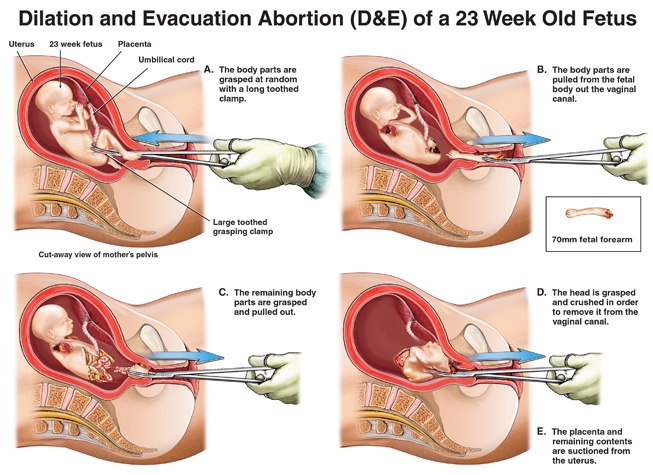
Here is a diagram of the D&E procedure:

 View actual pictures of a D & E abortion.

You’ve read about a D&E abortion, but did you know that even early abortions are gruesome? Abortions before 13 weeks are done by suction curettage if they are done surgically and by RU-486 if they’re done medically. Read more about RU-486 abortions in this section.

In a suction curettage abortion, the cervix is dilated and the unborn baby is torn apart via suction. Here is a diagram of this kind of procedure.


See pictures of aborted babies at 20 weeks here, mostly aborted by D &E .

See pictures of babies aborted by suction.

Share on Facebook